“…” an archeology of silence in the digital age

Christoph Wachter & Mathias Jud
“…” an archeology of silence in the digital age

Exhibition
30 August–29 September 2017
Aksioma | Project Space, Ljubljana

Curated by
Daphne Dragona

In the framework of State Machines


“I have not tried to write the history of that language (A/N the language of psychiatry) but, rather, the archeology of that silence.”

M. Foucault, Madness and Civilization, 1961

In an era when connectivity is taken as a given, communication is often thought of as free and boundless. As network infrastructures increasingly disappear into the environment, to always be in touch has come to be felt as natural. Posts, chats, comments and multiple instant reactions shape an image of a space where communication is immediate, vivid and often noisy. But how accessible, inclusive and democratic is this space at the same time? Overwhelmed by the busyness and speed of today’s environments, seldom do we get to reflect upon recurring forms of exclusion and absence: What about voices that cannot be heard on “feeds” and streams of information? Who gets to speak? Who listens in and who remains silent?

Artists Christoph Wachter and Mathias Jud have been paying special attention to the different forms of silence that prevail on the Internet. With their work, they aim to undermine power structures while also developing tools and systems of communication for those in need. They uncover network mechanisms, expose cases of censorship and surveillance, and embrace infrastructural literacy as a response to the dominance of today’s network infrastructures. Minorities deprived of the possibility to connect, people fleeing in fear of being tracked, citizens suffering violent Internet black-outs, as well as users wishing to react to the constant capturing of their data are the ones the artists have been turning their attention to. In areas such as the suburbs of Paris, the island of Lesvos, the cities of the Arab Spring, even the very center of Berlin, they have worked alongside communities and activists to develop independent zones of communication that users themselves can control and sustain. Bringing back to the foreground what the 90s community network pioneers once called the “freedom to connect,” Wachter and Jud formulate possibilities for communication, opposing silence and exclusion.For the exhibition “…” an archeology of silence for the digital age, the artists have built a communication network similar to the ones they set up in the open space. Two network terminals and one mobile network unit, functioning independenty of the Internet are hosted in the show. Their distinctive tin-powered antennas held by minimal wooden structures allow the signal to reach great distances of connectivity. The mobile network unit – called “Gezi Park Edition” –  offers citizens and users the possibility to set up a local communication network anywhere and at any time. The visibility, materiality and tangibility of these infrastructures invite us to experience the aesthetic, technological and social elements that they involve. Viewing, accessing and trying out these counter-infrastructures, we get to join different zones of connectivity that remind us of the power asymmetries as well as of our very role and silence in the connected world.

TALKS

“What does the war in Syria have to do with the privacy debate in Europe? What does NSA mass surveillance have to do with a Chinese Internet café? On the one hand, we have our own specific views. On the other hand, the forms of expression are subject to a collective political, cultural, governmental and linguistic regime. In order to overcome the forms of attribution, exclusion and paternalism in our own views and expressions, we specifically address the social and cultural mechanisms of exclusion in our art projects. Our projects, such as picidae (since 2007), New Nations (since 2009) and qaul.net (since 2012), have gained worldwide interest by revolutionizing communication conditions. As open-source projects these works uncover forms of censorship of the Internet, undermine the concentration of political power and even resolve the dependency on infrastructure. The tools we provide are used by communities and activists in the USA, Europe, Australia and in countries such as Syria, Tunisia, Egypt, Iran, India, China and Thailand. Even North Korean activists participate.
This talk is a tour d’horizont to the isolated and hidden depths. Particularly in the digital age we usually forget about the exclusion and the gaps because they don’t appear in our worldview. By looking into our communication conditions, we can realize new strategies and ways to reach out to eachother.” – Christoph Wachter in Mathias Jud

THE AUTHORS

Christoph Wachter and Mathias Jud were both born in Zurich and live and work in Berlin. They have participated in numerous international exhibitions and have been awarded many international prizes. In particular, the projects picidae (since 2007), New Nations (since 2009) and qaul.net (since 2012) have gained worldwide interest. As open-source projects these works uncover forms of censorship of the Internet, undermine the concentration of political power and even resolve the dependency on infrastructure. The tools provided by the artists are used by communities in the USA, Europe, Australia and in countries such as Syria, Tunisia, Egypt, Iran, India, China and Thailand. Even activists from North Korea participate. In 2012 their project Hotel Gelem was awarded a prize by the Council of Europe. But not everyone is fond of these projects. China has denied Wachter and Jud entry to the country since 2013.

THE CURATOR

Daphne Dragona, born in Athens, lives and works in Berlin. She is the conference curator of transmediale festival and has been part of the team since 2015. She has collaborated with a number of institutions for exhibitions, conferences, workshops and other events. Among her curated or co-curated projects are Tomorrows: Urban Fictions for Possible Futures (Onassis Cultural Center, 2017), New Babylon Revisited (Goethe Institut Athen, 2014), Home/s (Goethe Institut Athen & Benaki Museum, 2013), Afresh: A New Generation of Greek Artists (ΕΜSΤ, 2013), Mapping the Commons, Athens (EMST, 2010) and Homo Ludens Ludens (Laboral, 2008). While exploring various fields of interest, her interest always lies in emerging or recurring artistic practices and methodologies that challenge contemporary forms of power. Her articles have been published in various books, journals, magazines and exhibition catalogs. She holds a PhD from the Faculty of Communication & Media Studies of the University of Athens.

WORKSHOP

Nada Žgank/festival Mladi levi | More

Christoph Wachter & Mathias Jud
Tools for the Next Revolution
FRI, 25 August 2017, 5 pm– 8 pm
Aksioma | Project Space, Ljubljana

The workshop is a journey into the possibilities of expression in the communication society and uncovers the narratives and power structures behind it. Participants will create their own Internet independent Wifi communication network, learn how to use it and how to extend the range of Wifi-networks with self-built antennas.

In the framework of the Mladi levi festival

CREDITS

Authors: Christoph Wachter & Mathias Jud
Curator: Daphne Dragona

Production of the exhibition:
Aksioma – Institute for Contemporary Art, Ljubljana, 2017

Production of the workshop:
Aksioma Institute and Festival Mladi levi / Zavod Bunker, Ljubljana, 2017

“…” an archeology of silence in the digital age and Tools for the Next Revolution are events realised in the framework of State Machines, a joint project by Aksioma (SI), Drugo more (HR), Furtherfield (UK), Institute of Network Cultures (NL) and NeMe (CY).

This project has been funded with support from the European Commission. This communication reflects the views only of the author, and the Commission cannot be held responsible for any use which may be made of the information contained therein.

Supported by:
the Creative Europe programme of the European Union, the Ministry of Culture of the Republic of Slovenia, the Municipality of Ljubljana and the Swiss Arts Council Pro Helvetia.

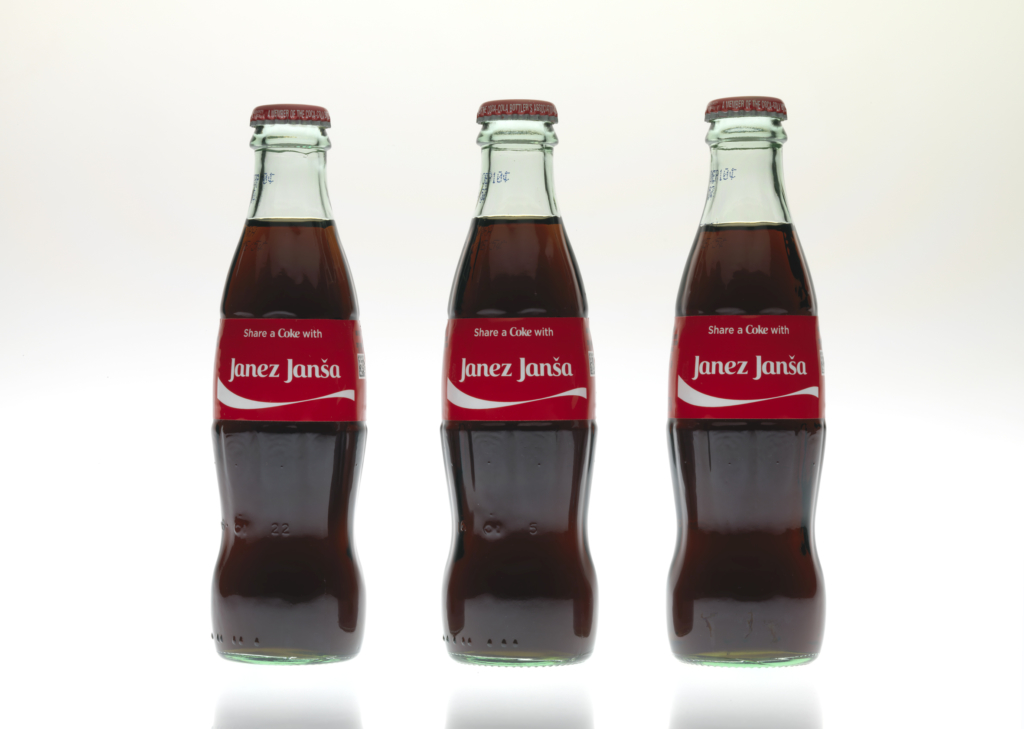
350 Janez Janša Bottles

Janez Janša, Janez Janša, Janez Janša

Requiem for The Future

Maja Smrekar

Hybrid Performance

Performance reprises:
WED, 5 July 2016 at 9 pm
FRI, 7 July 2016 at 9 pm
SAT, 8 July 2016 at 9 pm

Ticket: 5 €

Krekov trg 2, Ljubljana, Slovenia

The World Without Us. Narratives on the age of non-human actors

The World Without Us
Narratives on the age of non-human actors

Exhibition
27 June–27 August 2017
Vžigalica Gallery | Museum and Galleries of Ljubljana

Curated by
Inke Arns

Artists
Morehshin Allahyari & Daniel Rourke, Timo Arnall, Sidsel Meineche Hansen, Ignas Krunglevicius, Mark Leckey, Nicolas Maigret & Maria Roszkowska, Eva & Franco Mattes, Yuri Pattison, Sascha Pohflepp, Suzanne Treister, Addie Wagenknecht, Pinar Yoldas

In the framework of State Machines


The exhibition asks what a world without us would be like. But rather than conjuring up a post-disaster scenario, it describes such a world as the result of a gradual development whose origins can be traced back to our day and age. Taking its cues from science-fiction literature and the philosophical school of Speculative Realism, the exhibition largely relies on the principle of extrapolation.

The tools for the creation of a “world without us” are at hand. The first driverless cars are driving on our streets, news articles are compiled by algorithms, and translations are done by machines. Already in 2009 a third of all shares in the EU and the US were traded by algorithms. We can only speculate on the current proportion.

In a “world without us” humans will be replaced by machines, artificial intelligences will be optimized by other AIs and algorithms will be programmed by other self-learning algorithms. In this way, a radically different, post-anthropocentric world could emerge in which non-human life forms could eventually prove better able to adapt than man himself. Benjamin Bratton said of such a world in 2014: “Worse than being seen as the enemy (by AI) is not being seen at all.”

The increasing influence of non-human actors in our everyday life has not only been explored by several recent blockbusters, including Her (2013), and in TV series such as Black Mirror (2011) and Real Humans (2012), but also in contemporary (media) art. Loosely inspired by Timothy Morton’s book Ecology Without Nature, the artists in this exhibition explore the possibility of an ecology after man – an age of the post-Anthropocene, in which other “life” forms, such as algorithms, artificial intelligence, artificially created nanoparticles, genetically modified micro-organisms and seemingly monstrous plants, have taken control. This new era, which has already begun, albeit imperceptibly, is the age of non-human actors.

The World Without Us was originally produced and presented by HMKV in Dortmund, Germany in 2016. For the 2017 Ljubljana version a selection of the Dortmund show was made and some works of the exhibition alien matter (curated by Inke Arns for the transmediale festival, HKW, 2017) were added to The World Without Us.The exhibition will move to Rijeka (Mali Salom / MMSU) at the end of the summer as a part of the project State Machines – Art, Work, and Identity in an Age of Planetary-Scale Computation.

The exhibition overview: HERE

CURATOR’S TALK

Inke Arns
From alien matter to The World Without Us
TUE, 27 June 2017 at 7 pm
City Museum of Ljubljana

In this talk Inke Arns speaks about two exhibitions she recently curated: The World Without Us (HMKV Dortmund, 2016/17) and alien matter (transmediale festival, HKW Berlin, 2017). Alien matter refers to man-made, and at the same time, radically different, potentially intelligent matter. It is the outcome of a naturalization of technological artifacts. Environments shaped by technology result in new relationships between man and machine. Technological objects, previously defined merely as objects of utility, have become autonomous agents. Their capacity to learn and network throws into question the previously clear and dominant division between active subject and passive object. Within the alien matter exhibition 30 artists presented works about shifts within such power structures, raising questions about the state of our current environment and whether it has already passed a tipping point and is in the process of becoming “alien matter”. Content-wise, the works clustered around four thematic focal points: artificial intelligence, plastics, infrastructure, and the Internet of Things – subcategories that are deemed to merge into the nascent great machine and thereby, in the words of Günther Anders, are “future obsolete”.

THE CURATOR

Anne Bergner

Inke Arns, PhD, artistic director of Hartware MedienKunstVerein (HMKV) in Dortmund since 2005. She has worked internationally as an independent curator and theorist specializing in media art, net cultures, and Eastern Europe since 1993. After living in Paris (1982-1986) she studied Russian literature, Eastern European studies, political science, and art history in Berlin and Amsterdam (1988– 1996) and in 2004 obtained her PhD from the Humboldt University in Berlin with a thesis focusing on a paradigmatic shift in the way artists reflected the historical avant-garde and the notion of utopia in visual and media art projects of the 1980s and 1990s in (ex-)Yugoslavia and Russia. She curated exhibitions at Bauhaus (Dessau), n.b.k. (Berlin), Moderna galerija (Ljubljana), Künstlerhaus Bethanien (Berlin), Karl Ernst Osthaus Museum (Hagen), Museum of Contemporary Art (Belgrade), HMKV (Dortmund), Centre for Contemporary Arts – CCA (Glasgow), KW Institute for Contemporary Art (Berlin), Videotage (Hong Kong), Museum of Contemporary Art Vojvodina (Novi Sad), Centre for Contemporary Art Zamek Ujazdowski (Warsaw), Centre for Contemporary Art “Znaki Czasu” (Toruń), Contemporary Art Centre CAC (Vilnius), Muzeum Sztuki (Łodz), La Panacée (Montpellier), Jeu de Paume (Paris), Autocenter (Berlin), Kunstpalais (Erlangen), Haus der Kulturen der Welt (Berlin), Kunsthal Charlottenborg (Copenhagen). She has curated numerous exhibitions at home and abroad, a.o. History Will Repeat Itself (2007), Arctic Perspective (2010), The Oil Show (2011), Sounds Like Silence (John Cage – 4’33’’ – Silence today / 1912 – 1952 – 2012) (2012), His Master’s Voice: On Voice and Language (2013), World of Matter (2014), „Now I Can Help Myself“ – The 100 best online video tutorials (2014), Evil Clowns (2014), Hito Steyerl: Factory of the Sun (2016), Whistleblowers & Vigilantes (2016), The World Without Us (2016), alien matter (2017), and The Brutalism Appreciation Society (2017). Author of numerous articles on media art and net culture, and editor of exhibition catalogues. Books include Neue Slowenische Kunst (NSK) – an analysis of their artistic strategies in the context of the 1980s in Yugoslavia (2002), Net Cultures (2002), Objects in the mirror may be closer than they appear! The Avant-Garde in the Rear-View Mirror (2004).

BOOK

The World Without Us. Narratives on the Age of Non-Human Agents
Exhibition catalogue

Publisher: Revolver Publishing by VVV
ISBN: 978-3-95763-393-4

RELATED EVENTS

Adam Harvey
Computer Vision, Surveillance, and Camouflage
Talk
TUE, 20 June 2017 at 7 pm
City Art Gallery, Ljubljana

This talk explores new ways of appearing and disappearing in a machine readable world including strategies for blocking face detection and thermal imaging, and tools for advanced visual-metadata analysis.


Adam Harvey
Privacy Gift Shop
Exhibition
21 June–21 July 2017
Aksioma | Project Space, Ljubljana


Maja Smrekar
Requiem for the Future

Hybrid performance
5, 7, 8 July 2017 at 9 pm
Ljubljana Puppet Theatre, Ljubljana

CREDITS

Authors: Morehshin Allahyari & Daniel Rourke, Timo Arnall, Sidsel Meineche Hansen, Ignas Krunglevicius, Mark Leckey, Nicolas Maigret & Maria Roszkowska, Eva & Franco Mattes, Yuri Pattison, Sascha Pohflepp, Suzanne Treister, Addie Wagenknecht, Pinar Yoldas

Curated by: Inke Arns (HMKV)

Head of production: Janez Janša
Producers: Marcela Okretič, Jani Pirnat
Executive producer: Sonja Grdina
Public relations: Alja Žorž, Janja Buzečan

Produced by:
HMKV (Hartware MedienKunstVerein)
and Aksioma – Institute for Contemporary Art, Ljubljana

Co-production:
Museum & Galleries of Ljubljana and Drugo more, Rijeka

Thanks to: Annely Juda Fine Art, London; bitforms gallery, New York; Cabinet, London; Carroll / Fletcher Gallery, London; Helga Maria Klosterfelde Edition, Berlin; Rodeo, London.

The World Without Us in Ljubljana and Rijeka is realised in the framework of the project State Machines, a joint project by Aksioma (SI), Drugo more (HR), Furtherfield (UK), the Institute of Network Cultures (NL) and NeMe (CY).

Supported by:
the Creative Europe programme of the European Union, the Ministry of Culture of the Republic of Slovenia and the Municipality of Ljubljana

This project has been funded with support from the European Commission. This communication reflects the views only of the author, and the Commission cannot be held responsible for any use which may be made of the information contained therein.

The World Without Us in Dortmund (HMKV) was funded by the German Federal Cultural Foundation.

Privacy Gift Shop

Adam Harvey
Adam Harvey
Privacy Gift Shop

Exhibition
21 June–21 July 2017
Aksioma | Project Space, Ljubljana

In the framework of State Machines


“The NSA declined to comment on Harvey’s work, as did the Office of the Director of National Intelligence.”

Washington Post

The Privacy Gift Shop is a marketplace for counter-surveillance technology, privacy accessories, and new ideas about privacy. It was founded by Berlin-based American artist Adam Harvey in 2013, and since then, it has been presented as a “concept store” in many institutional venues, including The New Museum, New York, and other locations in Hong Kong, Tel Aviv, Vienna, and London. It has also been discussed on magazines and newspapers, including Wired, Motherboard, and the Observer. In 2015 the Privacy Gift Shop joined NEW INC, the art+tech incubator led by the New Museum in New York City. The store is currently located in Berlin, and sells its outcomes also through an online store, available at https://privacygiftshop.com.

The project wants to “normalize otherwise controversial ideas about surveillance and encourage a critical speculative discourse about issues related to data, surveillance, and privacy.” Its products include the OFF Pocket Phone Case, which blocks wireless signals and protects your phone from stealth data;  the IXNY Tee, a redesign of the iconic “I Love NY” T-shirt featuring an OCR-resistant font that makes it difficult for the NSA to decipher; the Metal Dollar Bill, a copper wallet insert that shields your credit cards from RFID skimming; and the Stealth Wear collection, a series of garments – conceived in collaboration with fashion designer Johanna Bloomfield – inspired by burkas and hijabs that shield against thermal imaging, a surveillance technology used widely by military drones to target people.

More recently, the Privacy Gift Shop launched Think Privacy (2015), a year-long art campaign conceived to raise awareness about emerging issues in the age of data collection. The campaign collects statements that are part education and part provocation, printed over coloured backgrounds reminiscent of motivational posters, and presented in various formats, including wall placards, coasters, refrigerator magnets, mugs, and other ephemera.

Creative resistance to surveillance was a topic in Adam Harvey’s research long before the Snowden revelations. In 2010 he launched CV Dazzle (also included in the show at Aksioma Project Space), a research project about creating a form of camouflage against computer vision, using haircuts and make-up to make a face unrecognizable to most surveillance algorithms. By creating and marketing relatively cheap products that follow the same approach, the Privacy Gift Shop takes a step forward, and realises the artist’s ambition “to bring privacy and counter-surveillance ideas to a wider audience and engage in discussions about how art, design, and creativity can play a role in protecting privacy.” [1]

In Ljubljana, the project was displayed at Aksioma Project Space in a hybrid gallery / popup shop setup, with tentacles reaching out to MSUM and MGML’s Museums Shops, where, from the summer onward, was be possible to buy various “souvenirs” specially produced by Aksioma for the launch of the Privacy Gift Shop in Slovenia.

[1] Quoted in  Stephanie Murg, “I Spy: New Museum Opens ‘Privacy Gift Shop’”, in Adweek, September 9, 2013, online at www.adweek.com/fishbowlny/new-museum-privacy-gift-shop/302687.

ARTIST TALK

Adam Harvey
Computer Vision, Surveillance, and Camouflage

TUE, 20 June 2017 at 7 pm
City Art Gallery, Ljubljana

This talk explores new ways of appearing and disappearing in a machine readable world including strategies for blocking face detection and thermal imaging, and tools for advanced visual-metadata analysis.

RELATED ACTION

Metadata Kills
Think Privacy Ad Campaign
17–24 June 2017
Ljubljana

Photo: Miha Fras/Aksioma | MORE

AUTHOR

Adam Harvey is an artist and independent researcher based in Berlin. His previous work includes developing camouflage from face detection (CV Dazzle) and thermal imaging (Stealth Wear). Harvey has taught at New York University, participated in the Belligerent Eyes workshop at Prada Foundation and the Uncertain Images workshop at the University of Copenhagen, and contributed to the Tabula Rasa project on spoofing and anti-spoofing. Harvey’s multidisciplinary work and collaborations have been featured widely in publications from the Air Force Times to the New York Times, featured on BBC, and mentioned in a tweet from the

CREDITS

Production of the exhibition:
Aksioma – Institute for Contemporary Art, Ljubljana, 2017

Partners: Museum and Galleries of Ljubljana, Moderna galerija
Media sponsor: Europlakat, Radio Študent

The solo exhibition Privacy Gift Shop is realised in the framework of State Machines, a joint project by Aksioma (SI), Drugo more (HR), Furtherfield (UK), Institute of Network Cultures (NL) and NeMe (CY).

This project has been funded with support from the European Commission. This communication reflects the views only of the author, and the Commission cannot be held responsible for any use which may be made of the information contained therein.

Supported by:
the Creative Europe programme of the European Union, the Ministry of Culture of the Republic of Slovenia and the Municipality of Ljubljana

Jennifer Lyn Morone™ Inc

Jennifer Lyn Morone
Jennifer Lyn Morone
Jennifer Lyn Morone™ Inc

Exhibition
17 May–16 June 2017
Aksioma | Project Space, Ljubljana

In the framework of State Machines


In 2014, American born artist, Jennifer Lyn Morone, registered herself as a corporation in Delaware, USA, as part of a protest project she developed at the Royal College of Art in London. She is now the founder, CEO, shareholder and product of her own company, Jennifer Lyn Morone™ Inc. JLM Inc presents itself as a new business, established to determine the value of an individual. The corporation derives value from three sources and legally protects and bestows rights upon the total output of Jennifer Lyn Morone: past experiences and present capabilities, offered as biological, physical and mental services such as genes, labour, creativity, blood, sweat and tears; selling future potential in the form of shares; and accumulation, categorization and evaluation of data that is generated as a result of Jennifer Lyn Morone’s life. Through the subversive adaptation of the corporate form the individual asserts their rights to their data as property and grants access to the markets otherwise inaccessible. In this way, the whole process of resources, production and ownership is rightly reclaimed by the individual.

With this project, which is also a life project with all the unpredictability that this implies, Jennifer Lyn Morone sets herself in the long tradition of subversive affirmation. Not a speculative project but a real event, JLM Inc allows the artist to translate into a powerful, clear narrative the workings of extreme capitalism, the economic system in which everybody is living today, but that only a few understand and use to their own advantage. Recognizing that, in the age of social networks and data mining, we are all “data slaves”, exploited by companies to which we hand our data for free, she subverts this mechanism by turning herself into a company, thus able to protect and profit from her data. If exploitation is unavoidable, why not head into self-exploitation?In order to take control over the data she produces, JLM Inc is working on the development of an app called Database of ME or DOME. The app collects and stores for her the data she generates: her location, heartbeat, browsing activity, mood, etc. This way, the company can sell, lease, rent, exchange or invest the data for her own profit. But personal data are only a part of JLM Inc’s business. When you are a corporation you can turn almost anything into a good or service. By thinking of yourself as a product, you can identify what assets you possess and maximize their value by turning them into new products and services. Along these lines, JLM Inc produced Lure and Repel, two scents made from Morone’s pheromone molecules that, respectively, attract and repel men. The company also entered the pharmaceutical business by producing Rejuvanix, a hormone therapy made from Morone’s DHEA, and the luxury market by producing diamonds out of the artist’s hair. All these products (data, scents, pharmaceuticals, diamonds) are sold either online or through the art market, and promoted by commercials that satyrize the ways of communication of a commercial company.

ARTIST TALK

THE AUTHOR

This image has an empty alt attribute; its file name is jennifer_lyn_morone_portrait.jpg
Jure Goršič

Jennifer Lyn Morone is a conceptual artist and designer who makes work that seeks to disrupt the narratives that humans create – such as corporations and nation states. Research based, spanning various mediums and multi-disciplinary, her work examines the interrelations of political, economic, and technological designs and their impact on society. Morone is a trained sculptor, receiving a BFA from SUNY Purchase in 2001. Following 9/11 she spent 16 years living in Europe. In 2014, she graduated with an MA in Design Interactions from The Royal College of Art, London, where, dismayed by the Snowden revelations in 2013, she designed a protest against the data industry and corporate personhood.  This involved adopting the corporate form as a means to enter the economic and legal system in order to play with and challenge the rules.  Her work has been nominated and received an honorary mention from Ars Electonica (Linz),  and has been exhibited, screened and presented internationally, recently at the Martin Gropius Bau (Berlin), Haus der Kulturen der Welt (Berlin), Carroll/Fletcher Gallery (London), ZKM (Karlsruhe), Victoria & Albert Museum (London), and the HeK (Basel).

CREDITS

Author: Jennifer Lyn Morone

Production of the exhibition:
Aksioma – Institute for Contemporary Art, Ljubljana, 2017

This exhibition is realized in the framework of State Machines, a joint project by Aksioma (SI), Drugo more (HR), Furtherfield (UK), Institute of Network Cultures (NL) and NeMe (CY).

This project has been funded with support from the European Commission. This communication reflects the views only of the author, and the Commission cannot be held responsible for any use which may be made of the information contained therein.

Supported by:
the Creative Europe programme of the European Union, the Ministry of Culture of the Republic of Slovenia and the Municipality of Ljubljana

Rule 34

Iza Pavlina
Iza Pavlina
Rule 34

Exhibition
19 April – 12 May 2017
Aksioma | Project Space, Ljubljana

Part of U30+ production programme for supporting young artists

This image has an empty alt attribute; its file name is U30_logo_event_small.png

Online pornography has profoundly changed the access of younger generations to sexual content. Online, everything is easily accessible; everything is explicit, categorized to meet any preference and / or perversion; and the explosion of amateur pornography has turned the representation of the sexual sphere into something that potentially involves everybody.

In the recent past visual artist Iza Pavlina began to research peculiar sexual fetishes and filmed staged situations using her own body as a medium to enact them. However, the materials she generated differ from typical pornographic materials in that there is an absolute lack of explicit content. The artist decided instead to place the object of the fetish itself in the very centre of the attention. Then she uploaded her materials on a popular porn website and passively monitored responses and comments from online audience members. This initial experiment encouraged her to carry on her scrutiny of these kinds of practices, communication forms and relationships, this time focusing more on the development of her online identity and the way her alter ego engages and interacts with its audience.

The project Rule 34, on display at Aksioma Project Space, is the result of this further investigation. For this exhibition new video and photographic materials illustrating various specific sexual fetishes, such as Exophilia (attraction to non-human life-forms), Plushophilia (attraction to stuffed animals), Agalmatophilia (attraction to statues and dolls), Coulrophilia (attraction to clowns and jesters) and so on, were produced and submitted on a regular basis to all major pornographic media and social networking sites. This became the “habitat” in which the artist’s online persona could exist, live and perform. Her engagement with the audience’s responses, private messages and comments were all but passive. Iza in fact established a direct dialogue with her fans, encouraging them to trade her original digital artwork and drawings for a “Cum Tribute” or any other kind of creative feedback.

Everyday conversations, comments, private messages and exchanged items were regularly documented and then accurately formatted to become part of a multimedia installation. This specific content is made available to the gallery’s audience through a number of Wi-Fi routers, each of which hosts a set of reactions to a specific fetish. These devices, installed next to the artist’s staged paraphilia videos, are disconnected from the internet and broadcast their content only locally, so in order to access a specific collection, visitors have to connect to the proper network through a personal device, being it a smart-phone, tablet or laptop. [1] They can also access the artist’s profiles directly on xHamster, Pornhub and XVideos by scanning QRcodes the artist holds in her hands in the exhibited framed self-portrait drawings. If they decide to do so they will have the opportunity to explore Rule 34 even deeper and actively engage with the project.

[1] This exhibition format, called OFFLINE ART, was initially developed by German artist Aram Bartholl

THE AUTHOR

Iza Pavlina (1991) is finishing her postgraduate studies in painting at the Academy of Fine Arts and Design in Ljubljana, where she, among other things, received a special achievements award in 2015. Her work is characterised by her interest in topics related to sexuality, paraphilias and pornography. She creates fictitious identities with which she enters the virtual space to explore various phenomena of social anomalies, relations of power and the question of how to manipulate one’s own image to establish communication with a target group of internet users. Her work has been presented in solo shows Talk to Strangers (Erotic Gallery Račka, Celje, 2014) and Isabelle Peacocks (Gallery of Contemporary Art Celje, 2016). She has also participated in several group exhibitions: To ni ljubezenska pesem (This is Not A Love Song, Miklova hiša Gallery, Ribnica, 2014), Situacija Dogville (Situation Dogville, Project Space DUM, Ljubljana, 2015), Mediterranea 17 – No Food’s Land – Young Artists Biennial (Fabbrica del Vapore, Milano, 2015), the 3rd Triennial of Young Artists – Premiera 2015 (Premiere 2015, Gallery of Contemporary Art Celje, 2015).

CREDITS

Author: Iza Pavlina

Production:
Aksioma – Institute for Contemporary Art, Ljubljana, 2017

Technical support: Rok Borštnar
Video production: Studio Atlas
Camera: Rok Tržan

Supported by: the Ministry of Culture of the Republic of Slovenia and the Municipality of Ljubljana

Aksioma’s programme is additionally supported by the Ministry of Public Administration as part of the public call for co-financing projects for the development and professionalisation of NGOs and volunteerism as well as by JSKD

Please Do Not Take Photographs

Dorotea Škrabo
Dorotea Škrabo
Please Do Not Take Photographs

Exhibition
22 March–14 April 2017
Aksioma |Project Space, Ljubljana

Part of U30+ production programme for supporting young artists

This image has an empty alt attribute; its file name is U30_logo_event_small.png

Today’s tools of image production have turned everyone into a producer, distributor and consumer of images. In the current condition of information overload, images are among the most transferred content: via instant messaging, social networking platforms like Facebook and Twitter, micro blogging tools like Tumblr, and services like Instagram and Snapchat. As art critic David Joselit noted, “The scale at which images proliferate and the speed with which they travel have never been greater.” [1]

The impact of this condition on professional visual production and visual art has yet to be recognized, but it has been discussed by many scholars and artists. As early as 2002, artist Seth Price discussed online “dispersion” as a powerful alternative to official art circulation systems. [2] Later on, artist and teacher Hito Steyerl wrote about the potential of “poor images”, the low quality version of an offline artifact that circulates for free on the internet, where it is shared, compressed, remixed, and often deprived of its links to the original author; [3] and artist Brad Troemel talked about “athletic aesthetics” to describe the fast and quantitative approach to art production that artists adopt to maintain an online presence, where they are confronted with compressed attention spans and with modes of fruition that are totally different from those of a dedicated art space. [4]

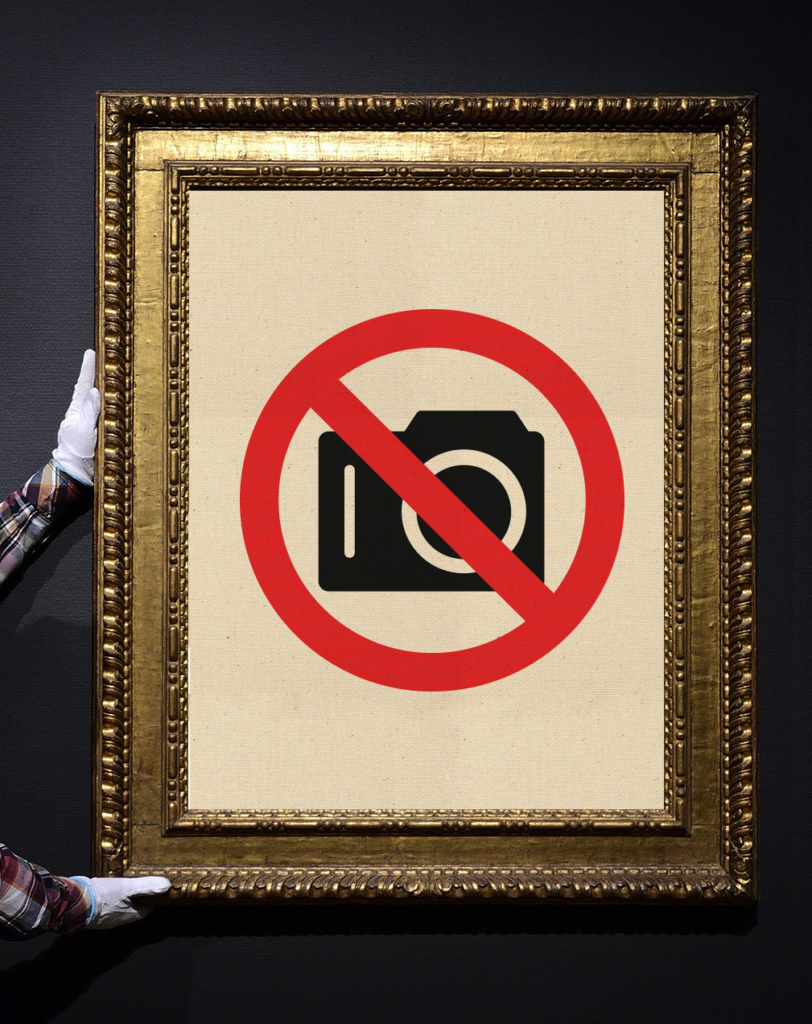
We can’t forget this when considering the work of younger generations of artists, who happen to be “users” of digital devices and participants in the social networking economy, even before being “artists”. Trained in art and design, “digital native” artist Dorotea Škrabo has grown up in this kind of environment. Before existing as an artist, she existed as a computer and smartphone user. To her, online image production is a performative gesture in a way that artworks can’t be understood as autonomous artifacts, but as traces of the artist; and “viewers” are not consumers of a finished artifact, but are an active part of an ongoing process.In her new installation Please Do Not Take Photographs designed for Aksioma Project Space, Škrabo draws upon these premises. The show consists of two main pieces. In Let Them Eat Cake, images are printed on cakes. These edible treats represent a “snap” published on “Snapchat ”, a phone app that allows a user to develop an intense dialogue with others through images. All posts are deleted from the user’s Snapchat story after 12 hours. The temporary nature of the pictures therefore encourages frivolity and emphasizes a more natural flow of interaction. The visitors of the exhibition are invited to take a piece of cake, offering a metaphorical, yet playful and engaging comment on the ephemeral nature of online images.

The second piece, Musée du Lowres, is a replica of the part of the Louvre where the Mona Lisa is exhibited. The central piece is a screen in a baroque framing displaying the artist impersonating Leonardo’s masterpiece. Mobile devices, loaded with several images, texts and emoji, are applied on the surface encouraging visitors to slightly mutate the artwork by swiping through their contents. Beside the centerpiece, a series of video snaps are displayed on mobile phones along with oversized golden-framed prints of their captions, ironically subverting the traditional relationship between visual artwork and contextual information.

[1] David Joselit, After Art, Princeton University Press 2012.

[2] Seth Price, “Dispersion”, 2002 – ongoing. Online at .

[3] Hito Steyerl, “In Defence of the Poor Image”, in eflux journal, 11/2009, online at www.e-flux.com/journal/in-defense-of-the-poor-image/.

[4] Brad Troemel, “Athletic Aesthetics”, in The New Inquiry, May 10, 2013. Online at http://thenewinquiry.com/essays/athletic-aesthetics/.

THE AUTHOR

Dorotea Škrabo (1992) is a visual artist born in Rijeka and currently living and working in Ljubljana, Slovenia, who primarily deals with the phenomenon of photography and video on the internet. Her research is focused on new media, popular culture and art, especially through the limitations of social networks. She regularly produces short online videos, where she develops critical relation towards popular trends. Since 2015 she has been a part of the FrešTreš Art Collective. Her work has been exhibited in various group exhibitions in Slovenia and abroad and in 2014 Kino Šiška hosted Skrabzi: A šalim se, her first solo show. In 2014 she obtained a B.A. in Graphic and Interactive Communication from the Faculty of Natural Sciences and Engineering and has continued to study graphic design at the Academy of Fine Arts and Design in Ljubljana.

CREDITS

Author: Dorotea Škrabo

Production:
Aksioma – Institute for Contemporary Art, Ljubljana, 2017

Part of U30+ Aksioma Institute production programme for supporting young artists.

Mentors: Janez Janša (production), Domenico Quaranta (text editing)

Thanks to: Loški muzej, Petra Švajger

Supported by: the Ministry of Culture of the Republic of Slovenia and the Municipality of Ljubljana

Passports

Janez Janša, Janez Janša, Janez Janša

In the framework of the group exhibition Make Truth Great Again.
Curated by Martin Le Chevallier

Exhibition opening: SAT, 11 March 2017 at 4 pm

6 Rue Saint Claude, Paris, France

My Name is Janez Janša

Documentary screening

In the framework of the Segal Center Film Festival on Theatre and Performance.

365 Fifth Ave, New York, USA

Wet Dreams

Valerie Wolf Gang

Solo Exhibition

Exhibition opening: THU, 16 February 2017 at 8 pm

Free entrance

Korzo 28/1, Rijeka, Croatia


* Part of Aksioma Institute production programme to support young artists.

Wet Dreams

Valerie Wolf Gang

Solo Exhibition

Exhibition opening: SAT, 11 March 2017 at 8 pm

Free entrance

Cesta IX. korpusa 99A, Solkan, Slovenia


* Part of Aksioma Institute production programme to support young artists.

OUCH! – Pain and Performance

OUCH – Pain and Performance
SCREENING PROGRAMME

Curated by Live Art Development Agency, London

Aksioma | Project Space, Ljubljana

15 – 17 March 2017

I see pain as an inevitable byproduct of interesting performance.

Dominic Johnson

ARTIST TALK

Dominic Johnson
IT HURTS: Art, Performance, and Pain

Aksioma | Project Space

We are all familiar with pain, from that of the minor twinge to devastating injury or illness, to emotional pain. Yet we struggle to articulate the particularity of our hurt. Making an object of one’s pain has been a frequent project for historical and contemporary art, from paintings depicting great duress, to performances that harness self-injury as a formal technique. This lecture introduces key works in art and performance and asks how artists deal with the constitutive manner in which pain evades representation and communication.

According to Wikipedia ‘pain’ is an “unpleasant feeling often caused by intense or damaging stimuli… (it) motivates the individual to withdraw from damaging situations and to avoid similar experiences in the future.” But for many artists and audiences the opposite is just as true, and pain within the context of performance is a challenging, exhilarating and profound experience. 

Ouch is a collection of documentation and artists’ films looking at pain and performance – both the pain artists cause themselves within the course of their work, whether intentional or not, and the experiences of audiences as they are invited to inflict pain on artists or are subjected to pain and discomfort themselves. 

The selected works feature eminent and ground breaking artists from around the world whose practices address provocative issues including the lived experiences of illness, the aging female body, cosmetic surgery, addiction, embodied public protest, animalistic impulses, bloodletting, staged fights, acts of self-harm and flagellation, and what can happen when you invite audiences to be complicit in performance actions.  

Ouch featured artists: Marina AbramovićORLANOleg KulikRon AtheyFranko B,  Marcel.li Antunez RocaHeather CassilsBob FlanaganWafaa BilalRocio BoliverPetr PavlenskyMartin O’BrienRegina Jose GalindoErnst Fisher & Nicola HunterKira O’Reillyjamie lewis hadley.Previous versions of Ouch have been shown at Martin O’Brien’s Discharge (Jan 2013), the Wellcome Collection’s In Pursuit of Pain (Jul 2016) and the Venice International Performance Art Week (Dec 2016).

Adult content will feature at this event, including nudity and strong images.

SCREENING PROGRAMME

Bob Flanagan (US) 
Cystic Fibrosis Song, 1990’s 
1’32” 

A short film of Bob Flanagan parodying a famous Disney song to convey his experiences of living with Cystic Fibrosis.  The performance took place at Los Angeles Contemporary Exhibitions (LACE) in the early 1990’s and is featured in the award winning 1997 film Sick: The Life and Death of Bob Flanagan, Supermasochist

Bob Flanagan (1952 – 1996) was an American performance artist, stand-up comic, writer poet and lifelong sufferer from cystic fibrosis, whose S&M experiences helped him manage the pain of his illness. 

Cassils (CA/US) 
The Powers That Be, 2016  
2’24” 

Cassils collaborates with fight choreographer Mark Steger to stage a brutal two-person fight. Illuminated by car headlights in the depths of a parking garage, Cassils is the sole figure, sparring with an invisible force. The stereos of the surrounding cars broadcast a multi-channel score of static noise and radio samples designed by Kadet Kuhne. By amplifying the sociopolitical conflicts at each performance location with sound, The Powers That Be explores the radical unrepresentability of certain forms of trauma and violence. Here the radio signal is a transmission of site-specific issues, both proximate and distant.  The Powers That Beaddresses the mediation of violence by calling into question the roles of witness and aggressor on the part of the spectator. 

Cassils is an artist who uses the physical body as sculptural mass with which to rupture societal norms. Forging a series of powerfully trained bodies for different performative and formal purposes; it is with sweat, blood and sinew that they construct a visual critique and discourse around physical and gender ideologies and histories. 
http://heathercassils.com

Oleg Kulik (RU) 
Dog House, 1996 
4’10” 

A short extract from documentation of Kulik’s participation in Manifest 1’s Interpol group exhibition in Fargfabriken, Stockholm in 1996. It was suggested that Kulik produce his Doghouse project within Interpol, an exhibition devoted to the problem of communication. The artist was invited as a sort of a ready-made to stay in a specially built house. The audience was warned that any communication with the artist who denounced the language of culture is dangerous and that no one should cross the borders of his territory. Following the logic of this action Kulik bit a Mr. Lindquist who had neglected the warning. Kulik was arrested by the Swedish police. This performance and the exhibition as a whole aroused scandalous response from the media. Interpol was called an event that divided the art world into East and West. 

Oleg Kulik is a Moscow based performance artist, photographer and curator, most renowned for his performances as a dog, including Mad Dog, Reservoir Dog and I Bite America and America Bites Me

Marina Abramovic (RS/US) 
On ‘Rhythm O’ 1974, 2013 
3’07” 

A short film in which the artist talks about one of her most famous works, a six-hour performance at Galleria Studio Morra in Naples during which Abramović allowed herself to be used by the public in any way they chose, using 72 objects of pleasure and pain placed on a table, including a rose, perfume, honey, wine, scissors, a scalpel, nails, a metal bar, and a gun loaded with one bullet. 

RHYTHM 0 Documentary, 2013. Directed and Edited by Milica Zec. Video courtesy of Marina Abramovič Institute 

RHYTHM 0, 1974. Studio Morra, Naples. Ph: Donatelli Sbarra. Courtesy Marina Abramović and Sean Kelly Gallery New York 

Marina Abramović is one of the seminal artists of our time.  Since the early 1970s she has pioneered the use of performance art as a visual art form. Exploring the physical and mental limits of her being, she has withstood pain, exhaustion, and danger in the quest for emotional and spiritual transformation. 
http://www.mai-hudson.org

Wafaa Bilal (IQ/US) 
On ‘Shoot an Iraqi’, 2007 
2’21” 

The artist discusses his provocative interactive performance in which, over the course of 30 days, members of the public were invited to fire a paintball gun at him over the internet. He was shot at 60,000 times. 

The award-winning Iraqi-born artist Wafaa Bilal is known internationally for his on-line performative and interactive works provoking dialogue about international politics and internal dynamics. Bilal’s work is constantly informed by the experience of fleeing his homeland and existing simultaneously in two worlds – his home in the “comfort zone” of the U.S. and his consciousness of the “conflict zone” in Iraq. 
http://wafaabilal.com

ORLAN (FR/US) 
Successful Operation, 1990 
6’16” 

A short film of the artist preparing for cosmetic surgery in which the operating theatre is turned into a different kind of theatrical space. 

ORLAN is an artist working between Paris, Los Angeles and New York. She creates sculptures, photographs, performances, videos, videogames, and augmented reality, using scientific and medical techniques like surgery and biogenetic. Always mixed with humor, often-on parody or even grotesque, her provocative artworks can shock because she shakes up the pre-established codes. 
http://www.orlan.eu

Ron Athey (US) 
Ron’s Story, 2001 
4’44” 

A short film of early performances by Ron Athey on his experiences of addiction and self harm, created by Janez Janša with original music by BAST. 

Ron Athey is an iconic figure in contemporary art and performance. In his frequently bloody portrayals of life, death, crisis, and fortitude in the time of AIDS, Athey calls into question the limits of artistic practice. These limits enable Athey to explore key themes including gender, sexuality, radical sex, queer activism, postpunk and industrial culture, tattooing and body modification, ritual, and religion. 

Rocio Boliver (MX) 
Times Go By and I Can’t Forget You: Between Menopause and Old Age, 2013 
4’18” 

Extract from documentation of a performance at Grace Exhibition Space, New York in which the artist parodies a catwalk show and critiques representations and expectations of the (ageing) female body. 

Rocío Boliver’s practice is a sharp and focused critique of the many repressive ideologies that burden the lives of women in Mexico. “In this pasteurized society, I prefer to cause disgust, hatred, rejection, confusion, weariness, anxiety, hostility, fear … to further promote mental asepsis.” 

Petr Pavlensky (RU) 
Radical Artist In Court – Ukraine Today News Item, 2015 
1’57” 

A Ukrainian TV news feature from November 2015 about Pavlensky’s arrest and trial for a performance action in which he set fire to the wooden entrance doors of the Federal Security Service building (former KGB headquarters) on Lubyanka Square in Moscow to draw attention to the terror tactics employed by the Russian Security Services. 

Petr Pavlensky is a Russian performance artist and political activist.  His works include Seam (2012) in which he sewed his mouth shut in protest at the imprisonment of Pussy Riot, Carcass (2013) in which he was wrapped naked in barbed wire, and Fixation (2013) in which he nailed his scrotum to Red Square as  “a metaphor for the apathy, political indifference and fatalism of modern Russian society”. He was awarded the Václav Havel Prize for Creative Dissent in 2016. 

Martin O’Brien (UK)
Taste of Flesh, 2015 
2’59” 

A durational performance in which O’Brien turned his attention to the theme of contagion extending to the fear of contamination associated with both the sick body, and our virtual online (projected) identity. In doing so, he highlighted recent acute public anxiety around the risk of infection and invasion, both IRL and online as he references the surge in depictions of the zombie in popular culture. The traditional sci-fi figure of contagion – the zombie – often reflects environmental, political, or societal concerns, all of which are referenced in this piece. 

Commissioned by The Arts Catalyst for the European project – Trust me, I’m an Artist: towards an ethics of art/science collaboration

Martin O’Brien’s practice uses physical endurance, disgust and pain-based practices to explore the meaning of being born with a life threatening disease (cystic fibrosis) by confronting others’ responses to illness. 
http://www.martinobrienperformance.com

Franko B (UK/IT) 
Don’t Leave Me This Way, 2009 
5’03” 

Don’t Leave Me This Way marked a shift in Franko B’s performance practice, formalising his departure from blood-based work. Here he allows the viewer time to look at his naked body and approach it as a sculptural form; heavily tattooed and scarred, voluptuous in shape and size. Franko B’s performances have always left metaphorical marks on the psyches of vulnerable spectators, moving empathetic viewers with the visceral charge of the prone body. If the ways in which he could exact this effect through bleeding were exhausted, then Don’t Leave Me This Way continued the scene of wounding in the realm of the metaphorical, inscribing his form in painful vision. 

Franko B makes drawings, installations, sculpture and performance as well as working in many other mediums and disciplines. He lives and works in London. He is Professor of Sculpture at l’Accademia di Belle Arti di Macerata. 
http://www.franko-b.com

Marcel.li Antunez Roca (ES) 
Epizoo, 1994 
8’29” 

Epizoo is a real life videogame in which the spectator controls Marcel.li’s body by means of a mechatronic system involving a computer, a mouse, a robotic exoskeleton and a set of pneumatic mechanisms. The pneumatic devices move the artist’s nose, buttocks, pectorals, mouth and ears while he remains upright on a rotating circular platform, taking whatever pain is inflicted upon him.   Epizoo was one of the first artistic applications of computer technology to the human body. The work caused a sensation in the 1990s as it reflected what can happen when people are given permission to control another’s body and the ironic, and even cruel, paradox rising from the coexistence between virtual digital iniquity and the performer’s physical vulnerability. 

Marcel.li Antunez Roca is widely known as a founder of La Fura dels Baus and for his mechanotronic performances and robotic installations. Since the 1980s Antúnez’s work has been based on a continuous observation of how human desires are expressed and in what specific situations they appear. In 2014, the exhibition and publication Systematurgy. Actions, Devices and Drawings focused on his Dramaturgy based on computational systems.  
http://marceliantunez.com

Regina Jose Galindo (GT) 
Lucha, 2002 
3’37” 

A performance in which Galindo wrestles a female professional wrestler. 

Regina José Galindo is a Guatemalan performance artist known for the political themes of her work. In her work Who Can Erase the Traces (2003) she walked from the Congress of Guatemala building to the National Palace, dipping her bare feet at intervals in a white basin full of human blood as a protest against the presidential candidacy of Guatemala’s former dictator José Efraín Ríos Montt. She received the Golden Lion award for artists under 30 at the Venice Biennale in 2005 for her video Himenoplastia which depicted the surgical reconstruction of her hymen. 
http://www.reginajosegalindo.com

Ernst Fisher and Nicola Hunter (UK/DE) 
Passion/Flower, 2012 
4’02” 

A man and a woman, sitting on suitcases, are engaged in an act of ritual self-flagellation, which is periodically interrupted and thus never reaches the level of passionate intensity it is meant to induce.  After some time, first one, then the other, cover their body, pack up their belongings and leave, the secret flower of their failure burning on their skin. 

Original footage by Daniel Marner, edited by Nicola Hunter. 

Over the last 10 years Nicola Hunter has been developing a feminist practice which is rooted in action based performance and spans live work, documentations of its products and traces and the re-presentation of these in other forms. With performance at its core, she investigates themes around abjection and ritual with a focus on interpreting or creating experiences in her own body. 
http://www.nicolahunter.com

Ernst Fisher was born in Germany and moved to the UK in 1979. Between 1986 and 1997 he staged performances in his home in South London, which was renamed Brixton heArt Room. He is particularly concerned with issues of belonging, domesticity and homeliness, and his work seeks to explore how we occupy as well as ‘uncannily’ disrupt a variety of spaces – from our own bodies to social conventions and political/ideological systems. 
http://www.ernstfischer.com

Kira O’Reilly (UK/IE) 
Wet Cup, 2000 
2’29” 

A performance which draws on the ancient medical technique of wet cupping for the treatment of hysterical women. Heated glass ‘cups’ are placed over small cuts on O’Reilly’s body, and as they cool they create a vacuum which slowly extracts the artist’s blood. 

Kira O’Reilly’s practice, both wilfully interdisciplinary and entirely undisciplined, stems from a visual art background; it employs performance, biotechnical practices and writing with which to consider speculative reconfigurations around The Body. Recent works have seen her practice develop across several contexts from art, science and technology to performance, Live Art, combat sports and martial arts,  and movement work. 
http://www.kiraoreilly.com

jamie lewis hadley 
this rose made of leather, 2012 
4’57” 

Competing against and subverting the use of a stack of ceramic tiles – exactly his height – lewis hadley explores the politics of blood and masculinity through strategies of repetition and a display of physical endurance. The performance also aims to highlight the functionality of the body, with each tile documenting the body’s ability to heal. 

jamie lewis hadley utilises his career as a former professional wrestler as a departure point to create performances, actions and installations that explore, both aesthetically and thematically, issues of deterioration, endurance, pain and violence. His recent research and creative output is concerned with performing medicine and the history of bloodletting as a medical practice. He values blood as a communicative tool and attempts to use it to create images that are affective, challenging and beautiful. 
http://jamielewishadley.com

Video by SPILL TV.

AUTHOR

Dominic Johnson is Reader in Performance and Visual Culture in the School of English and Drama, at Queen Mary, University of London. He is the author of Glorious Catastrophe: Jack Smith, Performance and Visual Culture(2012); Theatre & the Visual (2012); and The Art of Living: An Oral History of Performance Art (2015). He is the editor of five books, including most recently Pleading in the Blood: The Art and Performances of Ron Athey (2013); and (with Deirdre Heddon) It’s All Allowed: The Performances of Adrian Howells(2016).

He is also an Editor of the journal Contemporary Theatre Review. From 2005 to 2012, his frequently bloody performances (solo and in collaboration with Ron Athey) were shown around the world, including at festivals of performance and live art in Copenhagen, Ljubljana, Rome, Toronto, Vienna, Zagreb, and elsewhere, and throughout the United Kingdom, including most notably at the National Review of Live Art in Glasgow, and at National Portrait Gallery in London as part of ‘Gay Icons’.

CREDITS

Concept: Live Art Development Agency, London

Production of the event in Ljubljana: Aksioma – Institute for Contemporary Art, Ljubljana, 2017

Artistic Director: Janez Janša
Producer: Marcela Okretič
Executive Producer: Sonja Grdina
Public Relations: Urša Purkart
Technician: Valter Udovičić
Documentation: Jure Goršič

Supported by: the Ministry of Culture of the Republic of Slovenia and the Municipality of Ljubljana

Sonoseismic Earth

Saša Spačal and Ida Hiršenfelder

Saša Spačal & Ida Hiršenfelder
Sonoseismic Earth

RESPONSIVE INSTALLATION

Aksioma | Project Space
Komenskega 18, Ljubljana

22 February – 10 March 2017

The responsive kinetic installation Sonoseismic Earth presents Earth in the age of the Anthropocene, the geological epoch of industrial societies. It is an age that has witnessed disruptions in the earth’s systems on a planetary scale. The crisis of the planet is marked by climate change; loss of biodiversity; pollution of the sea, land and air; exploitation of natural resources; and heavy depletion of soil. The global capitalist structure of the world does not allow human beings to act globally, or to counter the planetary crisis produced by inevitable consumption. The obsolescence and, consequently, accumulation of waste are inscribed in every product. Non-renewable energy sources are the driving force of globalism. They all cause seismic shifts: the depletion of fossil fuels creates cavities in the lithosphere, accumulation lakes generate pressure on it, and accidents in nuclear reactors cause tectonic cracks.

Sonoseismic Earth makes a possible entry into a planetary perspective, into the sensual and haptic relationship between the human and the planet. The depletion of fossil fuels in the earth’s crust causes tectonic cracks; hence, in the installation, the globe is gradually polluted. The rendering of seismographic shifts intensifies with the proximity of human beings detected by sensors. The planet emits the infrasonic sound of earthquakes; it submerges the human in the ubiquitous acoustic space with no identifiable origin. The infrasonic sound is a warning frequency, recognised by the more sensitive beings as a sign of danger. With the acoustic environment of the Sonoseismic Earth, humans are caught actively and experientially in the drama of the endless circulation of capital. The crisis of the planet is the crisis of the system.Sonoseismic Earth tries to condense the effect of the fossil fuel industry into an experience of carbon war waged against all life forms on the planet. Such violence makes itself visible in an abrupt and unpredictable way. At the forefront of this war is the global distribution of water, which has been profoundly influenced by climate changes, global warming, and invasive and toxic fossil fuel extractions such as fracking. Equal disruption of water is further violated by privatisation of water resources and deprivation of a large number of living organisms from having access to their basic needs. The mechanism in theinstallation contains a solution of water and fossil fuels that is squeezed out of the globe and produces a poignant odor in the surroundings, making the pollution tangible for the senses. The water is not cleaned, as it is part of a planetary metabolic rift. The things humans consume do not rejuvenate or replenish through the metabolic processes of the earth. Products are discarded as toxic waste and end up in the bodies of organic creatures, amassing in landfills, polluting the oceans. The metabolic rift may only be overcome in millions of years. One of the candidates for replenishment of the earth’s fossil fuel reserves is a living product, an industrial chicken. Due to mass production, it is predicted that the industrial chicken will be the model fossilised organism of the Anthropocene. By putting the bones of industrial chickens into the polluted water-oil solution, Sonoseismic Earth announces the replenishing of fossil fuels in the distant future. However, it cannot announce human existence.

AUTHORS

Saša Spačal is a post-media artist with a background in the humanities; she currently works at the intersection of living systems research and media art. Her work focuses on a post-human environment, in which humans exist and function as one of the elements in an ecosystem, and not as its sovereign. The artist has been featured at festivals and venues such as the Ars Electronica Festival, the Prix Cube Exhibition, Eyebeam, the Onassis Cultural Center Athens, the Pixelache Festival, the Cynetart Festival, the ThingWorld Triennial – National Art Museum of China, the Device_art Festival, the Eastern Bloc Gallery, the Art Laboratory Berlin, the Museum of Contemporary Art of Vojvodina, the Kapelica Gallery, the Kiblix Festival, the Sonica Festival, the Gallery of Contemporary Art Celje, the Enter Festival, the Amber Festival and elsewhere. The artist’s solo exhibition Symbiome – Economy of Symbiosis with an overview of her work was held at Museum of Contemporary Art Metelkova +MSUM in 2016. For her work she has received an Honorary Mention at the Ars Electronica Prix 2015, and was nominated for the Prix Cube 2016. MORE

Ida Hiršenfelder is a Ljubljana-based curator who also works as an artist in the field of sound and media art. She focuses on the history of media, archives, their disappearance and media archeology. She is a collaborator of +MSUM Museum of Contemporary Art Metelkova for Network Museum online aggregator of contemporary art archives. Since 2011, she is a member of Theremidi Orchestra noise collective, creating sonic landscapes and collaborates with media artist Saša Spačal on a series of sonoseismic installations (Crust 2014, Earth 2015). With Saša Spačal she also co-initiated ČIPke – Initiative for Women with a Sense for Technology, Science and Art. Her work Time Displacement – Chemobrionic Garden, created with co-artists Robertina Šebjanič and Aleš Hieng – Zergon first presented at Aksioma Project Space, has been presented on Ars Electronica festival (2016) in the context of Radical Atoms exhibition and at Device_art 5.016 in Montreal. MORE

CREDITS

Concept: Saša Spačal and Ida Hiršenfelder

Associate professionals: Mirjan Švagelj, Anil Podgornik

Production and development of the artwork: KID Kibla, Maribor, 2015 and Aksioma, Ljubljana, 2017

Production of the exhibition: Aksioma – Institute for Contemporary Art, Ljubljana, 2017

Artistic Director: Janez Janša
Producer: Marcela Okretič
Executive Producer: Sonja Grdina
Public Relations: Urša Purkart
Technician: Valter Udovičić
Documentation: Jure Goršič

Supported by: the Ministry of Culture of the Republic of Slovenia and the Municipality of Ljubljana

Survival kit for the Anthropocene – Trailer

Maja Smrekar

Solo Exhibition

Exhibition opening: TUE, 17 January 2017 at 7 pm

Škrabčev trg 21, Ribnica, Slovenia

Wet Dreams

Valerie Wolf Gang
Valerie Wolf Gang
Wet Dreams

Exhibition
14 December 2016 – 6 January 2017

Aksioma | Project Space, Ljubljana

Part of U30+ production programme for supporting young artists

This image has an empty alt attribute; its file name is U30_logo_event_small.png

“We fly over the world, we consider it from the outside, we see oceans of data, expanding and swirling, transformed by tsunamis of social trends, as sudden as it is fleeting, occupying all available space before giving way to the next start up. We can analyze the attitudes of the masses and the aggregate opinion is easy to obtain through polls and data mining. We, the targets are enthusiastic and willing victims; we love to be ‘free’ consumers. The general, global recording of everything is the price to be paid if we want to be truly ‘free’ to choose.”

– Ippolita, In the Facebook Aquarium: The Resistible Rise of Anarcho-Capitalism, 2015

Listening to strangers’ conversations and secretly watching other people has always been part of our human behavior. We are constantly observing others, comparing ourselves with them and making up new stories and assumptions. In the 21st century, in the era of technology and virtual communications, we (ab)use technology to hide our identity and spy on others even more. We hack into intimate places and invade the privacy of others, we talk with anonymous people and we invent our own alter egos. The installation Wet Dreams by young Slovenian artist Valerie Wolf Gang creates social interventionism, which allows us to hide behind an anonymous identity and gives us the opportunity to ‘hack’ into the intimate life of others if we dare to look and break social conventions. We become invisible people, stuck in the aquarium of our own imagination.

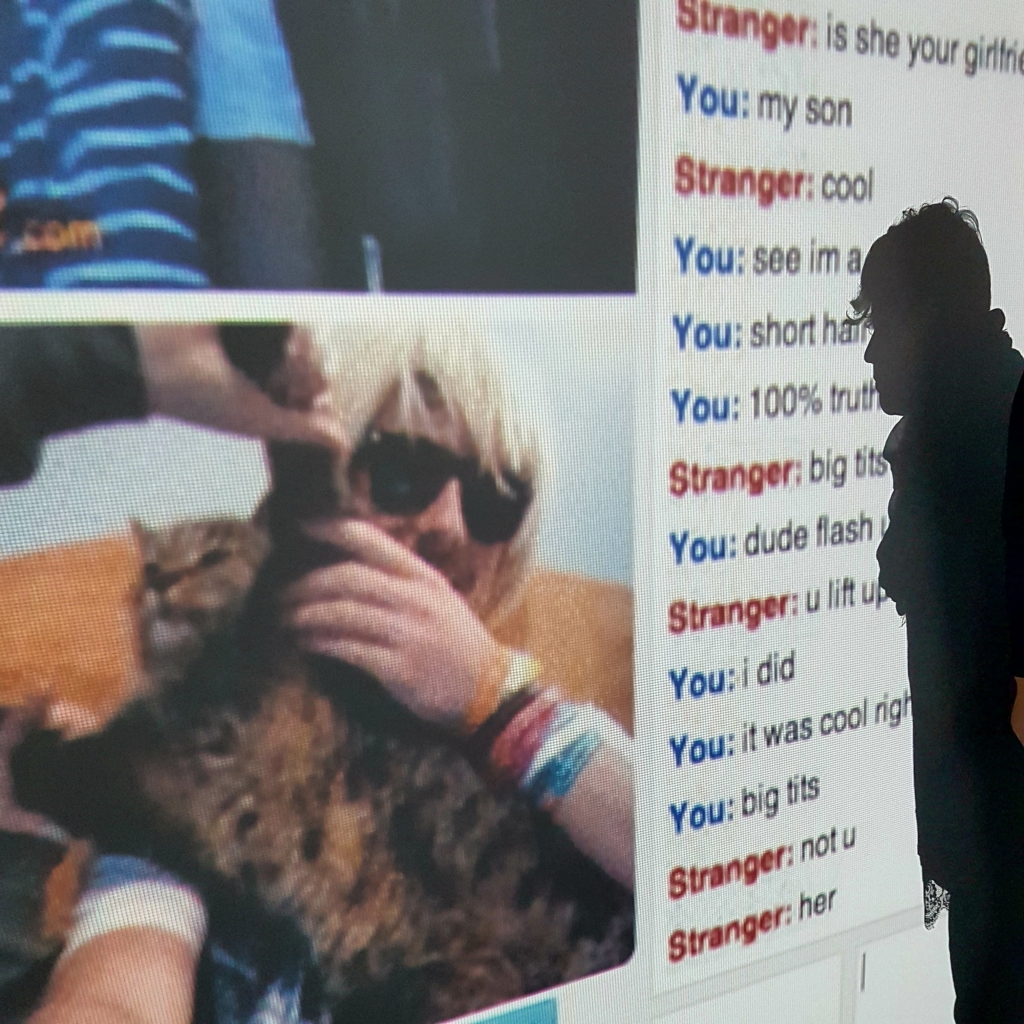
The main piece of the installation is an aquarium in which we see two working computer monitors sink into the liquid inside. On both monitors runs a browser open on Omegle, an online chat website that pairs random people from around the world together for webcam-based conversations. Visitors to the website begin an online chat with another visitor. At any point, either user may leave the current chat by starting another random connection. These random ‘real time’ connections create unpredictable conversations and moments in time. The people on Omegle don’t know that they are being observed by the visitors of the gallery; the two monitors are facing each other and the web-cameras are filming each other’s screen, presenting the digital reflection of random online people, selected by algorithms, stuck in a ‘digital aquarium’.
The signal of both monitors is split and the interface of each monitor is projected on the gallery walls: people entering the gallery step inside the ‘digital conversation’ and become part of the aquarium. They can follow the conversation and circle around the aquarium, they can be silent spies, like the NSA, or they can start to interact with the conversation and disturb ‘the reality’.
The installation becomes a medium for spontaneous performance and the symbiosis between the virtual and physical world, constructed from algorithms and real time human interactions.

“To understand what the outside of an aquarium looks like, it’s better not to be a fish.”

– André Malraux

THE AUTHOR

Janez Janša

Slovenian visual artist Valerie Wolf Gang, MA of Media Arts and Practices, works in the field of film, video and contemporary artistic practices. Her work and research reflect social conflicts arising from political regulations and constrains, especially when travelling and working abroad. She actively creates multimedia installations, which are exhibited in various international galleries, and her videos and films are screened at various festivals and cinema theatres. She is a mentor of video and film workshops and is actively involved in different forms of artistic production, video and film projects, international exhibitions, festival selections and artistic residencies.

CREDITS

Author: Valerie Wolf Gang
Mentors: Janez Janša (production and development), Domenico Quaranta (text editing)

Production:
Aksioma – Institute for Contemporary Art, Ljubljana, 2016

Supported by: the Ministry of Culture of the Republic of Slovenia and the Municipality of Ljubljana

Aksioma’s programme is additionally supported by the Ministry of Public Administration as part of the public call for co-financing projects for the development and professionalisation of NGOs and volunteerism as well as by JSKD
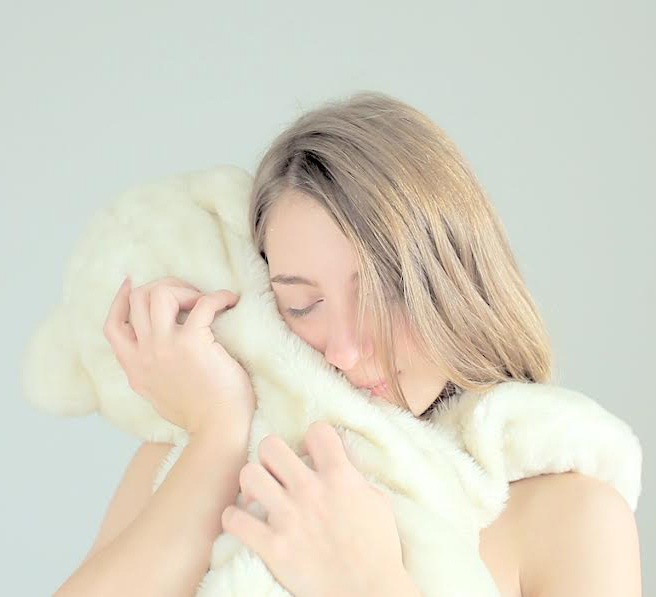
Minimal Difference between This and That

Peter Rauch

Solo Exhibition

Exhibition opening: WED, 19 October 2016 at 7 pm

Guided tour by Peter Rauch: WED, 26 October 2016 at 5 pm
Guided tour by Peter Rauch and Miha Colner: WED, 9 November 2016 at 7 pm

Free entrance

Komenskega 18, Ljubljana, Slovenia

Sonic Geometry of Space

Marko Batista

Marko Batista
Sonic Geometry of Space

SOLO EXHIBITION

Aksioma | Project Space
Komenskega 18, Ljubljana

16 November – 9 December 2016

In his works, Ljubljana-based intermedia artist Marko Batista analytically thematises DIY electro-acoustic processes at the intersection of electronic sound, technology and contemporary art. On display in Aksioma is his exhibition Sonic Geometry of Space, conceived as a prototype of a hyper-acoustic capsule. The ambient set-up designed by Marko stems from long-standing sound experiments, for his work is based on the exploration of dynamic self-generating systems and the phenomenology of sound resonances in space. He draws the phenomenality of sound from temporally determined processes within intermedia performing practices, and he attempts to design new modes of the distribution of acoustic resonances in space. The history of electro-acoustic art reveals the complex phenomenality of sound and the relations concerning the time and architecture in which it is located. Sound undulation can be perceived as a series of physical phenomena or as the non-material gestuality of the surrounding objectivity. The question that continues to arise is thus: is electro-acoustic art, in its essence, able to elude its meta-position of listening? Over the past few years, Marko’s site-specific installations have been presented in various galleries, and they offer their viewers a space of apperception and, at the same time, sensory perception. Spatial sound, which is characteristic of Marko’s work, is created by means of aesthetically designed modular interfaces and prototypical acoustic resonators, which were designed especially for the exhibition. The material for the exhibition derives from the inventions of the previous millennium; the show problematises the processes of the production of electro-acoustic artefacts and processuality. By means of sound objects created in the studio, the viewer is led to the questions of sound reality and phenomenality of the phenomenology of sound within contemporary art practices.

AUTHOR

Marko Batista is a Ljubljana based tech-mixed-media artist, sound researcher, video experimentalist and AV performer, born in Tito’s Yugoslavia. Batista focuses on themes such as displaced sound-scapes, video transformation processes, networking data, collaboration, linking concepts, hybrid spaces and other fields of contemporary media art. Graduated from Academy of Fine Arts in Ljubljana and finished Master of Arts degree from Central Saint Martins in London. Marko Batista is a founding member of experimental multimedia group Klon:Art:Resistance. E participated at numerous festivals and exhibition spaces like 10. International Istanbul Bienale, Ars Electronica 2008, Cellsbutton#3 Jogjakarta, Zero Gallery/Transmediale Berlin, NetAudio Festival London, razstava Device Art Prague, Spajalica/MMSUM Rijeka, Temporary Objects and Hybrid Ambients at KGLU Slovenj Gradec.

CATALOGUE

Edited by Andreja Hribernik and Janez Janša

Jurij Krpan
Painting with sound

Andreja Hribernik
The fluid space of inscription of artwork, postproduction and assemblages

Ida Hiršenfelder
MicroRobotic Machines

Luka Zagoričnik
Transparent Non-Transparency of Sound

ISBN: 978-1-312-68473-7

PRINT ON DEMAND

 eBOOK (PDF) 
FREE!

CREDITS

Production: Aksioma – Institute for Contemporary Art, Ljubljana, 2016

Artistic Director: Janez Janša
Producer: Marcela Okretič
Executive Producer: Sonja Grdina
Public Relations: Urša Purkart
Technician: Valter Udovičić
Documentation: Jure Goršič

Supported by: the Ministry of Culture of the Republic of Slovenia and theMunicipality of Ljubljana

Requiem for The Future

Maja Smrekar
Maja Smrekar
Requiem for The Future

Hybrid performance
14-15 October 2016
Ljubljana Puppet Theatre / Stage under the stars


Maja Smrekar conceived  her project Requiem for The Future as an experiment/performance in which the human body is substituted by animals and machines. For several years she has been exploring the work with dogs on an empirical level using elements of modern technology and is particularly interested in creating spatial choreography, mainly performed by dogs and robots. In her work she deals with synergic transitions between anthropomorphic, technomorphic and zoomorphic – the associations, which are evoked by puppets as well.

“As an interdisciplinary artist, fusing humanities and natural sciences into interdisciplinary projects, I look at the complex field of puppetry through an interdisciplinary perspective, ranging from Medieval Spanish theatre, with the so-called máquina real style, to modern, Stelarc’s techno-performances.”

Maja Smrekar

The initial inspiration for the show comes from the concept of Das Triadische Ballet (1922) by Oskar Schlemmer, who understood the early 20th century zeitgeist through two key contemporary currents: the mechanical (the human as a machine and the body as a mechanism) and the primary impulses (the sudden rise of the creative urge, which is a wild, instinctive drive); he believed that he achieved a synergy of the Dionysian and the Apollonian creative principles in his choreographies. Schlemmer thought that the movement of puppets or marionettes was aesthetically superior to human movement; thus, he wanted to emphasise that every artistic medium is artificial, which he achieved through stylised movement, which he kept simplifying until it became reminiscent of the abstracted movement of puppets or marionettes. Similarly, Maja Smrekar is interested in the associative paradigm of animal movement and machine movement. Geometry, which is reminiscent of mechanical movements, is also always present in constant repetition in the formal part of dog training. At the same time, the human guidance of drones could also be understood as the inverse paraphrase of Kant’s reflection on upbringing and education: the human is an animal that needs a teacher/leader. Hence, at this point, the artist addresses particularly the gaze of the other: not only what the existence of humans means to animals, but also how “monstrous” the human appears to artificial intelligence.

On the basis of the theory of the harmony of spheres, the Greek mathematician Pythagoras formed the hypothesis that the Sun, the Moon and the rest of the planets in our solar system emit their unique orbital resonances, which are based on their orbital revolution, while the quality of life on Earth reflects the meaning of cosmic sounds which are otherwise inaudible to humans. Starting from his thesis, music, which shapes the temporal-dramaturgical arch of the performance, establishes one of the key layers in addition to the voice. Beginning with the granulations of sounds from nature and the creation of organic atmosphere in the first part (“DOG”), the performance continues with a cut into techno-steam-punk accompanied by the robust sounds of the flying drones in the second part (“DRONE”). A contrast to both appears with the shift to choir singing in the third part (the absent “HUMAN”), with the opening beats from a Bulgarian folk song Dragana and the Nightingale which speaks about the anthropocentric relationship in the race between nature and culture; yet, it is soon dispelled through the counterpoint of pulsating intervals based on some coefficients of the relations between the orbital frequencies of the planets closest to Earth (13 Venus orbits for 8 Earth orbits, 3 Venus orbits for 1 Mars orbit, 2 Earth orbits form 1 Mars orbit). The concept of the music of spheres entails the metaphysical principle in which mathematical relations express the tonal qualities of the energy manifested in numbers, shapes and sounds – combined into proportional patterns with which, at the end of the performance, we close the paradoxical circuit of human existence in the infinity of the universe.

Human perception of the animal machine as well as the machine run by artificial intelligence is quick to slip into the identification of demonising the other, for in the vicious circle of dialectics we always stop with the discourse of feelings and subjectivisation of the (human) soul.

In establishing links between technology, nature, the hybrid anthropo-, zoo- and technomorphic nature of robots and animals, we are dealing with an interrogation of the contemporary social paradigm in which humans have destroyed nature almost completely due to the excessive exultation of our own culture; yet, despite this, nature survives and lives more fully in symbiosis with technology only after mankind has destroyed itself.

The music from the performance is available from the online publisher Kamizdat under the conditions of the Creative Commons licence.

THE AUTHOR

Jože Suhadolnik

Maja Smrekar is an established interdisciplinary artist, creating for many years at the intersection of science, technology and the arts. She tackles her projects in an extremely analytical manner and with a great deal of social sensibility. Her interest lies in various phenomena of media environments, systems of perception, and the anthropology of fear. She graduated from the Sculpture Department of Academy of Fine Arts and Design in Ljubljana, where she also obtained master’s degree from the Video and New Media Department. Her main interest is dwelling towards the concept of life by connecting humanistic and natural sciences into the interdisciplinary artistic projects. In 2010 she organised the International Festival HAIP10/New Nature. The festival took place at the Multimedia Centre Cyberpipe in Ljubljana where she has been active as an artistic director for two years. She has been awarded with the 1st prize at the Cynetart festival 2012 by the European Centre for Arts Hellerau (Dresden, Germany), Honorary mention at the Ars Electronica festival 2013 (Linz, Austria), as well as the Golden Bird Award 2013 – the national award for special achivements in the field of visual arts by the Liberal Academy (Ljubljana, Slovenia) for the project Hu.M.C.C. This year she is nominated for New Technological Art Award (NTAA), an international art competition of the Liedts-Meesen Foundation (Gent, Belgium). Maja Smrekar lives and works between Ljubljana and Berlin.

CREDITS

Author: Maja Smrekar

Co-production:
Ljubljana Puppet Theatre and Aksioma – Institute for Contemporary Art, Ljubljana, 2016

in collaboration with the City of Women Festival

Producers: Pija Bodlaj and Marcela Okretič

Actress: Alenka Marinič
Dogs training: Mia Zahariaš
Dog trainers: Mia Zahariaš, Tina Šolar
Dogs: Atiya Maiara and Express O Magic of Michéles Garden; Nuria del Somni Catala and Tails of Magic Fang
Drone technology: Alen and Mia Balja
Drone management: Alen Balja, Blaž Kovačič, Urša Purkart, Bojan Vlah, Maja Smrekar
Music: Luka Prinčič
Lighting design: Miloš Vujković
Set design: Andrej Strehovec
Set design manufacture: ScenArt
Assistant: Urša Purkart
Head of performance and sound designer: Luka Bernetič

Supported by:
the Ministry of Culture of the Republic of Slovenia and the Municipality of Ljubljana.

Red Web

Olja Grubić and Živa Petrič
Olja Grubić & Živa Petrič
Red Web

Performance
10 – 13 October 2016

Aksioma | Project Space, Ljubljana

Part of U30+ production programme for supporting young artists

This image has an empty alt attribute; its file name is U30_logo_event_small.png

Red Web is a digitalised performative installation of a sexual chatroom in which a female performer takes her female or male spectator through a test/experience intertwining the intimate and public space and through an interface addressing everything in between.

The focus of interest in this artwork is the intimate relation of the spectator as an active communicator to the performer upon entering one of the sex portals. It tackles the individual interaction of the performer with a visitor, challenging the limits of communication, levels of perception, intensification of fantasy – as a consequence of a new era of digital reality as a phantasm that blurs the boundary between the public and private spaces.

Red Webis a user’s experience of an individual’s intimate space which includes both the real and the fictional Other at the same time, as well as different performative strategies that generate and transform this relation. It is a fusion of digital communication into a performative situation that will be created in the interaction between the user’s desire and its (un)fulfilment; personal data are valuable goods… The limits of my interface are the limits of my world… You get what you click… Freedom is all around

THE AUTHORS

Nada Žgank

Olja Grubić (1990) is a performer and visual artist of a younger generation. She graduated from Ljubljana’s Academy of Visual Arts in the conceptualisation of space. She investigates contemporary and engaged issues in different media such as performance, cabaret, video, installation. Her work reflects a broad spectrum of sensations and the social situation of today’s society. Recently Grubić has collaborated with a number of artists, including Bojan Jablanovec (Via Negativa), Janez Janša (Maska), Julia Bardsley, Ursula Martinez, Kate McIntosh and La Pocha Nostra.

Živa Petrič (1981) graduated from the Academy of Visual Arts in the conceptualisation of space in 2015. In her studies, her main interest of research were the relations between different media (space, movement, text), in particular the concept of physical limitations, intimate and collective freedom and the issue of identity. She also works in the field of theatre and film set design, and is the director of two short films, Omejenost razsežnosti and Fuck machine, which was nominated for an ESSL ART AWARD in 2013. Her last video project Sistem suicide (aka Eta Carinae), made in collaboration with the musician Kristjan Kropa and choreographer Kristina Aleksova, investigates the basic principles of the system and the functioning of contemporary society within the system through the question of the corporeal.

CREDITS

Authors: Olja Grubić & Živa Petrič

Production:
Aksioma – Institute for Contemporary Art, Ljubljana, 2016

Co-production:
Društvo Mesto žensk

In the framework of:
22nd International Festival of Contemporary Arts – City of Women

Mentors: Teja Reba, Andreja Kopač, Janez Janša
Madam: Kristina Aleksova
Bouncer: Franci Kokalj
Thanks: Javni sklad Republike Slovenije za kulturne dejavnosti

Supported by:
the Ministry of Culture of the Republic of Slovenia and the Municipality of Ljubljana

Aksioma’s programme is additionally supported by the Ministry of Public Administration as part of the public call for co-financing projects for the development and professionalisation of NGOs and volunteerism as well as by JSKD

To top