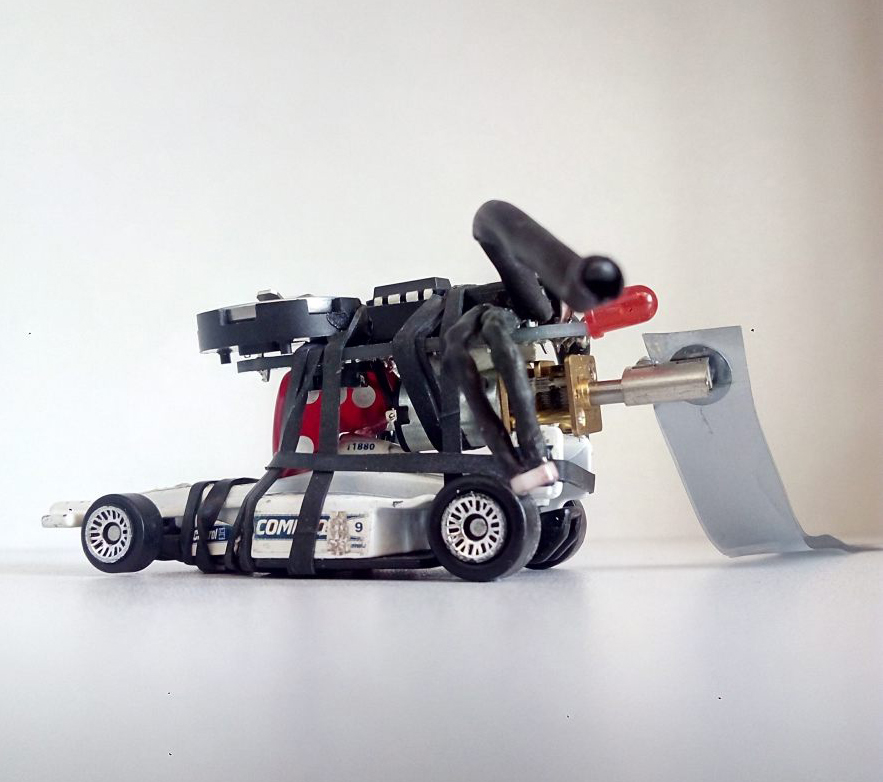
The current wave of pervasive automation and the ever faster development and use of technologies of prediction are radically transforming and reorganising all forms of labour. As the delegation of tasks to machines becomes widespread, Sanela Jahić’s starting position in this project was to explore the possibility of a machine-conceived exhibition. What if her labour as an artist were automated? If a prediction algorithm were developed based on the collected database of her work, research and interests, in order to determine the content and aesthetics of her next artwork, would the algorithm then turn on itself? The fact that the algorithm is created to interpret the individual’s relation to technology and the way the latter influences the nature of labour, clearly puts such a machine in a particular loop.
Yet, this research also places the artist in a peculiar position. Formulated according to her artworks and her working methods, this particular technology of prediction will become more advanced and complex the more data it receives. It may then produce something surprising, something that surpasses our expectations and could be perceived or mistaken for the machine’s creativity. But what if that turns out to be something the artist fundamentally disagrees with? Would that be a reflection of her biases, given the fact that these technological systems are not neutral, but manmade and political, reproducing the values of the people who program them? And if she works alongside the algorithm to create the artworks for the exhibition in tandem, will the audience be able to distinguish which work was formulated by the machine? In addition, since she produces technologically supported kinetic objects, this requires that the algorithm – itself a machine – conceives works of art that are also machines.
The relations between machines and humans is one of the constants in Sanela Jahić’s work. Her latest production places the research of complex relations between technology and the social, individuals and their identity directly into the context of the critique of capitalist relations of production. This project continues her research into the intertwinement of technology, labour, capitalist production relations and subjectivity. Its realisation requires collaboration with experts in programming, computation, machine learning and process automation. Thinking through and with this technology enables her to investigate its complexity – instead of being overtaken by it – and disclose some of its hidden mechanics.
ARTIST TALK
AUTHOR
Sanela Jahić (1980, Kranj) graduated in Painting from the Academy of Fine Arts and Design, University of Ljubljana in 2008, and received her master’s degree in 2010 in Public Art and New Artistic Strategies from the Bauhaus University in Weimar. Jahić is an intermedia artist, who constructs visual and technologically supported kinetic objects and installations. Her artistic practice often involves collaboration with specialists for mechanical engineering, automation, software and electronics. She lives and works in Škofja Loka. Jahić has exhibited her work in numerous shows in Slovenia and abroad.
CREDITS
Author: Sanela Jahić Technical support: Andrej Primožič Graphic design: Vasja Cenčič Development and programming of the predictive model, data visualisation: Iztok Lebar Bajec Development and programming of the predictive model: Jure Demšar Programming: Umer Muhammad Photography: Janez Pelko Data analysis and animation: Jernej Lunder
Production: Aksioma – Institute for Contemporary Art, Ljubljana, 2018
Co-production: Drugo more, Rijeka
Partner: Faculty of Computer and Information Science, University of Ljubljana
This project is a co-production in the framework of the Dopolavoro flagship of the Rijeka 2020 – European Capital of Culture project, with support from the City of Rijeka – Department of Culture, the Ministry of Culture of the Republic of Croatia, the Ministry of Culture of the Republic of Slovenia and the Municipality of Ljubljana.
Aksioma’s programme is additionally supported by the Ministry of Public Administration as part of the public call for co-financing projects for the development and professionalisation of NGOs and volunteerism as well as by JSKD
RELATED EVENTS
Jaka Babnik
Hyperemployment Exhibition 7 November 2019–19 January 2020 MGLC – International Centre for Graphic Arts, Ljubljana
Curated by: Domenico Quaranta Artists: Danilo Correale, Elisa Giardina Papa, Sanela Jahić, Silvio Lorusso, Jonas Lund, Michael Mandiberg, Sebastian Schmieg, Guido Segni
Automate all the Things! Symposium 14–15 January 2020 The Academy of Fine Arts and Design of the University of Ljubljana Moderna galerija
Speakers: Elisa Giardina Papa, Sanela Jahić, Silvio Lorusso, Michael Mandiberg, Domenico Quaranta, Sašo Sedlaček, Sebastian Schmieg
During the Second World War, engineers working on the new top-secret technology of radar would see mysterious shapes bloom across their screens, shifting and moving in great strands across the sky. They named these phenomena “angels”. Only later did ornithologists working with radar manage to prove that these shadows were flocks of birds, and use radar to learn much more about the natural world.
“My delight on a shining night” is a line taken from the old English folk song, “The Lincolnshire Poacher”, which describes the pleasures of taking game from rich landowners. The opening bars of “The Lincolnshire Poacher” were also used as the call sign of a numbers station – a mysterious radio shortwave radio signal believed to be related to espionage – broadcast from RAF Akrotiri, in Cyprus, from the mid-1970s until 2008.
Akrotiri is the site of the one of the largest military radar installations in Europe and the Middle East, collecting intelligence on the Middle East and Russia far over the horizon. It is also home to a population of Greater Flamingos, who migrate around the Mediterranean. Since the 1970s, these flamingo populations have been tracked by the Station Biologique de la Tour de Valat in the South of France, whose database of half a million sightings over thirty years includes more than twenty thousand birds.James Bridle’s work is concerned with how political and social attitudes shape technology, and the ways in which new technologies in turn shape our understanding of the world. In My Delight on a Shining Night, he connects histories of surveillance and covert communication, data and visuality, migration and nationalism through video, and exercises in database recovery and storytelling.
Click HERE to read more about James’s research for this project.
BOOK PRESENTATION
New Dark Age Technology and the End of the Future, Verso, June 2018 WED, 20 February 2019 at 5 pm Moderna galerija Ljubljana
“New Dark Age is among the most unsettling and illuminating books I’ve read about the Internet, which is to say that it is among the most unsettling and illuminating books I’ve read about contemporary life.”
We live in times of increasing inscrutability. Our news feeds are filled with unverified, unverifiable speculation, much of it automatically generated by anonymous software. As a result, we no longer understand what is happening around us. Underlying all of these trends is a single idea: the belief that quantitative data can provide a coherent model of the world, and the efficacy of computable information to provide us with ways of acting within it. Yet the sheer volume of information available to us today reveals less than we hope. Rather, it heralds a new Dark Age: a world of ever-increasing incomprehension. In his brilliant new work, leading artist and writer James Bridle offers us a warning against the future in which the contemporary promise of a new technologically assisted Enlightenment may just deliver its opposite: an age of complex uncertainty, predictive algorithms, surveillance, and the hollowing out of empathy. Surveying the history of art, technology and information systems he reveals the dark clouds that gather over discussions of the digital sublime.
BROCHURE
James Bridle State to Stateless Machines: A Trajectory PostScriptUM #33
James Bridle is an artist and writer working across technologies and disciplines. His artworks and installations have been exhibited in Europe, North and South America, Asia and Australia, and have been viewed by hundreds of thousands of visitors online. He has been commissioned by organisations including the Victoria & Albert Museum, the Barbican, Artangel, the Oslo Architecture Triennale, the Istanbul Design Biennial, and been honoured by Ars Electronica, the Japan Media Arts Festival, and the Design Museum, London. His writing on literature, culture and networks has appeared in magazines and newspapers including Frieze, Wired, Domus, Cabinet, the Atlantic, the New Statesman, and many others, in print and online, and he has written a regular column for the Observer. New Dark Age, his book about technology, knowledge, and the end of the future,was published by Verso (UK & US) in 2018. He lectures regularly on radio, at conferences, universities, and other events, including SXSW, Lift, the Global Art Forum, Re:Publica and TED. He has been a resident at Lighthouse, Brighton, the White Building, London, and Eyebeam, New York, and was an adjunct professor on the Interactive Telecommunications Programme at New York University.
CREDITS
Author: James Bridle
Production: Aksioma – Institute for Contemporary Art, Ljubljana, 2018
Co-production: Drugo more, Rijeka
Partner: Museum of Modern Art Ljubljana
Realised in the framework of State Machines, a joint project by Aksioma (SI), Drugo more (HR), Furtherfield (UK), Institute of Network Cultures (NL) and NeMe (CY).
Supported by: the Creative Europe programme of the European Union, the Ministry of Culture of the Republic of Slovenia, the Municipality of Ljubljana.
This project has been funded with support from the European Commission. This communication reflects the views only of the author, and the Commission cannot be held responsible for any use which may be made of the information contained therein.
Aksioma’s programme is additionally supported by the Ministry of Public Administration as part of the public call for co-financing projects for the development and professionalisation of NGOs and volunteerism as well as by JSKD
Responsibility for Things Seen
BADco., Aldo Milohnić, Janez Janša (Maska), Ida Hiršenfelder, Pia Brezavšček
a discursive forum, focusing on the Croatian contemporary dance collective BADco.
Participants: members of the collective BADco., Aldo Milohnić, Janez Janša (Maska), Ida Hiršenfelder, Pia Brezavšček
“In evaluating systems the artist is a perspectivist considering goals, boundaries, structure, input, output, and related activity inside and outside the system. Where the object almost always has a fixed shape and boundaries, the consistency of a system may be altered in time and space, its behavior determined both by external conditions and its mechanisms of control.”
The exhibition space in PD4 is empty. There are only a pair of VR goggles [2] and a couple of transmitters. The artwork is not present in three-dimensional space. Its object is a virtual body that extends into the algorithmic infinity of alternate reality.
PD4 explores the idea of presence and self-awareness measured by effects such as a sense of space, time, the body and emotional states. It also deals with the idea of (un)real spaces. The visitor becomes a player in a reality game in which one is constantly losing one’s sense of one’s own body and, therefore, feeling the gravity of one’s own corporeality even more. By creating monochromatic autogenerative levitational architectural elements, the artist conceives a programmed space that the player produces with his or her gaze. He is interested in improvisational aesthetics and the metamorphoses of a live computed sculpture in which the morphing space becomes the spectator’s psychological portrait. Active players are struggling with a sense of balance and orientation in the unpredictable, constantly growing space. Passive spectators are overwhelmed by the expanding constructions, feeling immersed in a doubly interior space: firstly in the space within virtual architecture, and secondly in the space within their own perceptual apparatuses. What the spectator is viewing is not a digital image, but rather a very corporeal image. The architecture of space is not something external, but rather an intrinsic string of characteristics that grow at various levels of syntax and manifest themselves as a set of random formations. These discreet sequences are translated in space as continuous events. The entire environment in PD4 is a sensitive alternate body composed of data-points that deconstruct or saturate.
The space of the alternate reality of PD4 is programmed with Unreal Engine 4, a suite of integrated tools for professional developers of games, simulations and visualisations. [3] Simulations of commercial virtual spaces, which, among others, use these tools, are inclined to producing approximations of reality, whereas Čadež is interested in exploring the boundaries of algorithmic worlds. He is interested in physical and mental effects escaping the users’ control. The aesthetics of PD4 does not aim at effects that would be “better than reality”. In PD4, the player does not identify with anything. PD4 is a simulacrum, it is a walk through alternate nature, the incoherent world with a new geography testing the limits of its own perception. The player is dealing with one’s own corporeality, depth, height, searching for a point of orientation, which challenges all established or learned perceptual processes. The game has no scenario, no narrative; it has generative scenes that keep changing all the time, expanding and flipping over ad infinitum in a temporal and spatial sense. The game has no goal that could be controlled, anticipated or completed because it leads to the expansion of consciousness achieved through the medium of corporeal and mental processes. It is not an escapist resort to entertainment industry and synthetic please. If PD4 has a goal, it is to show that the greatest illusion is the idea of objective reality, the idea that there exists a world that is stable, fixed, and can be perceived as is. For we cannot prove deductively that the “real world” exists without the need for our argument to take into account our presupposition “that the real world exists”. Given the consistency of human perceptions and our seeming inability to affect the findings about these perceptions, it is reasonable to believe that a reality exists as an effect of our perception. The most we can say is that a real world exists only because we do not have sufficient evidence to prove that is does not exist.
The updated HD VR technologies with minimal lagging are announcing a new revolution in the post-information age. At last, VR consoles take into account the carbon-based body which was condemned to a passive sedentary experience for several decades. With VR technology, the player has no surrogate body or avatar that is not subject to bodily functions. Virtual environment is an apparatus for perceiving relations, which takes into account the tension between freedom and necessity. It appears as a causal network of infinite dimensions, which cannot be fully computed or foreseen, for the human body does not have a uniform or exclusively geometric sense of space that could be determined by measuring distances. Space is not uniform but rather condensed or dispersed like time and PD4 challenges our sense of both.PD4 generates alternate reality, it is a programmed sculpture that enables the players to experience the environment that translates the architecture into a situation. PD4 produces a perceptual spectrum that is not better than real; yet, it is real in all its corporeal and mental perceptibility.
NOTES
[1] Jack Burnham: Systems Esthetics, v: Artforum, New York, 1968, p. 32. See also: Jack Burnham: Systems Esthetics, in: Richard Kostelanetz, ed.: Esthetics Contemporary, Buffalo: Prometheus Books, 1978, pp. 160–171. [2] VR goggles are special glasses enabling perception of virtual reality.[3] Unreal Engine 4 tools are free for all not-for-profit users. Unreal environment is projected in VR goggles, connected to Lighthouse (HTC Vive) laser transmitters, which enable the tracking of visitors in the entire space.
THE AUTHOR
Janez Janša
Boštjan Čadež (1979) studied industrial design at the Academy of Fine Arts and Design, University of Ljubljana. As an intermedia artist, he’s lately been focusing mostly on the fields of computer, real-time-generated and generative graphics and robotics, presented in the form of performances and installations. He’s received several prestigious awards and prizes for his innovations in design and programming. His previous artistic endeavours include graffiti, street art and VJ-ing. In 2013, he received the Golden Bird Award in the category of intermedia art.
CREDITS
Aksioma – Institute for Contemporary Art, Ljubljana, 2017 Supported by: the Ministry of Culture of the Republic of Slovenia and the Municipality of Ljubljana
Part of U30+ production programme for supporting young artists.
In his 1992 book The End of History and the Last Man, philosopher Yoshihiro Francis Fukuyama claims that the final stage of humanity will be the result of the height of liberal democracy and capitalism as well as the role of new technologies capable of transforming human essence. We can surely agree with him when we look from a critical distance at our everyday communication as it takes place on social media platforms. Online, the medium of conversation and dialogue, with its long tradition in western culture – from philosophy to theatre and cinema – has been reshaped beyond recognition. What is typical of the communication on platforms like WhatsApp and Facebook Messenger are short sentences, typos, abbreviations, interjections and widespread use of visual elements, such as emojis and GIFs, which are used to enhance the verbal content of the message. Furthermore, these conversations are often asynchronous and take place at the same time as other conversations online and offline. Thus they have to take into account our short attention span and open up a whole new range of possibilities for misunderstandings and equivocations.
Jure Goršič
We know all of this but are so used to it that it is not easy for us to reach the critical distance required to actually see how the medium of conversation has changed. An effective way may be turning these chats, such as they are, into a script, and asking actors to perform them as if they are a regular conversation.
That is what the project Seen by young Slovenian artist Vid Merlak is all about. He has created a video in which he invited actors to perform selected sections from his personal conversations with his partner and friends. The focus of the work is the “divided temporality” that is typical of online communication. Online conversations have acquired a unique form due to the difference in the time of transmission and the reception of the message. The medium itself is also changing the content of a conversation, from the most basic to absurd levels. Interestingly, the rules of the “chat” are the ones that have determined the narrative and the iconography for the work. The visual language of the video uses all the elements that we can observe in online communications, such as long pauses during conversations, the disappearance of people during “chats”, but also the inevitable fracturing of the linearity of communication, which occurs when two people are writing at the same time, but the replies are arriving with a delay.This project is a part of the U30+ initiative to support young Slovenian artists, a production programme that Aksioma has been systematically working on since 2013.
THE AUTHOR
Vid Merlak is an undergraduate student at the Academy of Fine Arts and Design of the University of Ljubljana, studying Video and New Media art. He has shown his work at term exhibitions at the Academy, the exhibitions for the Video and New Media students at the University of Ljubljana, the exhibition for the 70th anniversary of the Academy, ALUO LXX, and a solo exhibition in the bar BiKoFe. He has also participated in several artistic projects, such as the performance by Marina Rosenfeld: Teenage Lontano in Kino Šiška, Ljubljana; the filming and montage of the video work about the issue of immigration with Luka Prinčič and the collective Image Snatchers; and has worked as a VJ and DJ in the audio-visual collective SNIF.
CREDITS
Movie credits: Script and direction: Vid Merlak Actors: Vid Merlak – Damir, Alenka Marinič – Tjaša, Gal Oblak – Nik / Ian, Jure Rajšp – Simeon / Timotej Camera, lights, sound: Vida Habjanič Editing: Vid Merlak Original music: Simeon Perich Audio post production: 100 Scenography: Marko Batista Makeup artist: Zala Deželak Technician: Valter Udovičić Production manager: Janez Janša Producer: Marcela Okretič Executive Producer: Sonja Grdina Thanks: Dan Adlešič, Rajko Bizjak, Tristan Dragan, Miha Fras, Anže Grabeljšek, Simon Lee, Peter Rauch, Eve Sussman Special thanks: Tjaša, Nik, Ian, Simeon, Timotej
Production: Aksioma – Institute for Contemporary Art, Ljubljana, 2018
Coproduction: Academy of Fine Arts and Design, University of Ljubljana
Mentors: Sašo Sedlaček (University of Ljubljana, Academy of Fine Arts and Design) and Janez Janša (Aksioma)
Supported by: the Ministry of Culture of the Republic of Slovenia and the Municipality of Ljubljana
Aksioma’s programme is additionally supported by the Ministry of Public Administration as part of the public call for co-financing projects for the development and professionalisation of NGOs and volunteerism.
Part of U30+ production programme for supporting young artists
Today, thanks to crowdfunding platforms such as Kickstarter and to the easy access to the means of industrial production introduced by maker culture, consumerism has reached a brand new stage, that finds its way into distribution thanks to online stores like Etsy and the activity of social media influencers. The “long tail” [1] of net-based markets allows us to look for bizarre, original objects that would satisfy the needs of a small yet international niche; small producers find a small yet passionate market for their weird objects, and consumers find a way to enjoy, instead of repress, their weirdness. As Seth Godin puts it: “The epic battle of our generation is between the status quo of mass and the never-ceasing tide of weird.”[2]
As a consequence, today the success of a product is not measured by its quality but by how much it sells. Seeing how many bizarre objects are produced is disappointing yet fascinating. Most of the times, these objects come out of the improvement or combination of existing objects but are mostly useless, yet attractive exactly because they are absurd, adorable, cute, weird. The true quality products can’t cope with this market so they are forced to take similar steps. While on the side of consumption, being aware of the absurdity of this evolution does not necessarily mean to be immune to a disease that all of us, in different ways, share: the fascination for weird, useless objects.
Dan Adlešič’s project Furniture Pets addresses this situation. A young Slovenian artist and product designer selected through the U30+ call for proposals, designed a series of objects that push the logic of artificial needs and the rhetoric of “adorable cuteness” to the extreme, thus turning it into a means for parody and criticism. Inspired by Jacques Tati’s movie classic Mon Oncle (1958), where the gadgets are shown as unnecessary, clumsy and stupid yet seductive, Adlešič builds and promotes actual, mostly useless, sometimes “intelligent” objects. As the project’s name suggests, all objects display cute animals features which are often inspired by pets in the very way they work. For example, the Cat Broom is made out of pink sticky silicon and collects dust in the way a cat’s rough tongue cleans its soft hair; while the Squirrel Shelf – whose only ability is to clean itself – uses a robotic dust cleaner inspired by a squirrel’s tail. Another self-cleaning object is the Jelly Fish Table, equipped with a silicon tablecloth inspired by a jellyfish that spins raising its tentacles and pushing crumbs away. Finally, the Antisect Spider Lamp is a spider-shaped structure covered with a material that attracts insects with a blue neon light Jand kills them.
In the installation at Aksioma Project Space, these objects are presented in a typical fair booth setup, and accompanied by video commercials playing with the conflict between a very professional shooting and an over affirmative, absurdist soundtrack, echoing the way the Furniture Pets are advertised on social media:
“SMART FURNITURE DOES THING RIGHT IT DOES BY ITSELF NOT YOU / SO SMART IS ALMOST ALIVE O.K. 100% LIVE ACTION, EXTREME / NOW ALSO WITH INTEGRATED Advanced Self-Cleaning Technology / HALAL, GOOD FOR HUMANS / FROM TAIL TO A TALE, WOW / BUILT WITH CARE, TOP QUALITY MODEL / FIRST TIME IN SLOVENIA ALSO NOW THE BEST / PRODUCT LAUNCH 10.10.2018 COME BY”.
Dan Adlešič’s Furniture Pets exemplifies how a young generation of Slovenian artists is trying to cope with the rising market of cute yet useless “intelligent” objects, and critically respond to it. Adlešič both updates the long artistic tradition of machines célibataires and ironically plays with the uncomfortable proximity between media art and media design, that often use the same languages and take very similar forms. The project also offers a criticism of recent developments in the crowdfunding system that from a fundraising platform for experimental ideas that could be hard to realize otherwise, evolved into a Darwinistic arena where, more often than not, the dumber wins.
[1] Cf. Chris Anderson, The Long Tail, Hyperion 2006
[2] Cf. Seth Godin, We Are All Weird, The Domino Project 2011
THE AUTHOR
Jure Goršič
Dan Adlešič (1990) is a young Slovenian artist and product designer. He graduated in 2015 at Design Academy Eindhoven in the Contextual Design program with the project Electricity is just like … WOAH! that was further on presented by Studio Makkink & Bey at the Bi-City Biennale of Urbanism/Architecture in Shenzhen, China and at the Ram Gallery in Rotterdam. In 2016 he presented the project in the form of an exhibition in several galleries across Europe such as the Rossana Orlandi in Milan, the De Witte Dame in Eindhoven, and at the Helsinki Design Museum, and as a performance at the Palais de Tokyo in Paris. That same year he also had a solo show in Kino Šiška, Ljubljana. In 2017 he participated at the Design Biennale BIO25 in Ljubljana for which he created a custom audiovisual installation together with scientist and poet Andrej Detela that was then displayed in the Županova cave.
CREDITS
Author: Dan Adlešič
Logo design: Nejc Prah Voice: Peter Frankl Grandma: Pavla Adlešič Thanks: Bor Klemenc Mencin, Tit Briški, KRILI
Mentors: Domenico Quaranta and Janez Janša
Production: Aksioma – Institute for Contemporary Art, Ljubljana, 2017
Supported by: the Ministry of Culture of the Republic of Slovenia and the Municipality of Ljubljana
Aksioma’s programme is additionally supported by the Ministry of Public Administration as part of the public call for co-financing projects for the development and professionalisation of NGOs and volunteerism as well as by JSKD
Wet Dreams
Valerie Wolf Gang
In the framework of the new media culture festival Speculum Atrium.
Vrhovčeva 11a, Trbovlje, Slovenia
* Part of Aksioma Institute production programme to support young artists.
For a young artist like Sara Bezovšek a large part of social life takes place online, and developing a personal etiquette for her online behaviour is as important as understanding how to behave at official events; wasting time on the Internet, browsing various articles and YouTube channels, or random Instagram profiles, creates a space where boredom often nurtures artistic research. In her visual work, which takes the form of videos, Bezovšek manifests her interest in the graphic portrayal of online and physical violence, but at the same time also cute and funny topics.
In the trilogy comprising Revenge Porn, Sextortion, and Cyber Stalking, she explores Internet-based sexual habits by creating a visual narrative out of the elements shared by young users to communicate on social networking platforms like Facebook, as well as less controlled platforms like the imageboard 4chan, where users can post anonymously. GIFs, memes, YouTube videos, pirated TV shows and movies, explicit video clips, Snapchat videos, comments, and chats are recorded and remixed to portray the atmosphere in which younger generations live their sexual apprenticeship in the public sphere of the Internet, often subject to stalking and harassment. Revenge Porn, for example, focuses on the widespread practice of sharing pictures and videos taken during sex as a form of revenge against one’s ex-partner, turning images that were meant to be private into a form of pornography. While sharing nude photos with one’s partner, or recording one’s sexual intercourses, can open up new ways of living one’s sexuality, the inherent shareability of these bits and pieces raise new concerns about surveillance and privacy. Furthermore, by comparing mainstream media culture and amateur content, Bezovšek reflects on the interdependence between these two imageries.
While in these recent videos the emotional poles of this iconography are often intertwined and mixed with more nuanced content, in the older video RL, they are displayed on two parallel channels. RL is an acronym that stands for “real life”, as well as for “right and left”. In this video collage made out of footage found on Facebook, Instagram and YouTube, the screen is split into two parts, played simultaneously, respectively collecting the two visual extremes of the popular online visual content: the gore and violence of car accidents and murders, and the cuteness and fun of animal videos. As the two channels are very small and close to each other, it’s really impossible for the audience to see the cute image forgetting about violence, or vice-versa: an effective portrait of how we often experience content online, where good and evil are often at the distance of a tab.
THE AUTHOR
Jure Goršič
Sara Bezovšek (1993) is a Slovenian visual artist. Primarily studying and working as a graphic designer, her other interests include photography, new media and video art. She graduated in Visual Communications at the Academy of Fine Arts and Design of the University of Ljubljana, where she is currently finishing her master’s degree. Her main focus is on the impact that the Internet culture, online social media and the desktop interface have on the visual culture today. Her current research aims to portray the internet as a living space, using its bits and pieces and thus embracing, with the visual awareness of an artist, a remix culture that has become a genuine, generational means of expression and communication. She has participated in various group exhibitions, including Razumeti fotografijo, Mikado Gallery, Ljubljana (2013), 100 years of Leica, Dubrovnik (2014), Bodi črka – postani beseda!, Vodnikova domačija, Ljubljana (2015), ALUO LXX. Preteklost, sedanjost, prihodnost, Jakopič Gallery, Ljubljana (2016), AAVV All That Happens Must Be Known, Vn Gallery, Zagreb (2018). In 2018 she was awarded The Prešeren Award from the Academy of Fine Arts and Design, for the Mobile Application ZNAM.
CREDITS
Author: Sara Bezovšek Mentors: Peter Rauch, Emil Kozole, Sašo Sedlaček (Academy of Fine Arts and Design – University of Ljubljana) and Janez Janša (Aksioma)
Production: Aksioma – Institute for Contemporary Art, Ljubljana, 2018
Supported by: the Ministry of Culture of the Republic of Slovenia and the Municipality of Ljubljana
Aksioma’s programme is additionally supported by the Ministry of Public Administration as part of the public call for co-financing projects for the development and professionalisation of NGOs and volunteerism as well as by JSKD
The Whole Internet
Olia Lialina
Artist talk
Part of the ALUO uho events organized by The Academy of Fine Arts and Design of the University of Ljubljana.
Light, attractive and hypnotic, animated GIFs are a genuine phenomenon of our time. The acronym GIF stands for Graphic Interchange Format, a file format invented in 1987 that makes it possible to create and visualize a short sequence of moving images within a web browser. Very popular in the nineties, GIFs were then replaced by other graphic formats and by video, but continued to be used for artistic purposes because of their lightness, accessibility, flexibility and their close connection with the worlds of photography and cinema. In recent years, the emergence and growth of social networks have also resulted in a massive increase in the use of this medium.
The group exhibition STOP AND GO explores the artistic use of animated GIFs, presenting a broad and diversified panorama of the various approaches currently adopted by the international community. The show includes works by nine artists who are some of the most famous exponents of the genre: Bill Domonkos, Zack Dougherty, Roberto Fassone, Carla Gannis, Nika Ham, Lorna Mills, Okkult Motion Pictures, Chiara Passa and James Kerr (Scorpion Dagger).
Bill Domonkos uses archival images: old photographs animated by “special effects” that provide these vintage GIFs with an alienating kind of elegance and a disturbing poetic quality. Zack Dougherty, with his customized frames, brings a handcrafted artisanal dimension to the digital support; his works – photographic “vanitas” in motion – evoke a sense of death and decadence that conflicts with the vitality typical of the format. In a floating self-portrait, Roberto Fassone ironically presents himself as a homemade superhero, while Carla Gannis reinterprets The Garden of Earthly Delights by Hieronymus Bosch, enriching it with emojis and turning the painting into a kaleidoscopic universe of different signs, shapes and colors. In Lorna Mills’ work, dominated by a convulsive and hybrid imagination, the most pervasive images circulating online are assembled into frenetic and looping low-resolution collages. With their Giphoscopes, Okkult Motion Pictures reflects on the relationship between analogue and digital, stressing the connections between today’s web culture and early cinema. Chiara Passa presents a “sculpted” abstract GIF projected onto an uneven and bumpy surface, which gives the animation a three-dimensional spatial extension. James Kerr (Scorpion Dagger) draws on Flemish and Northern European Renaissance paintings, generating episodic micro-stories in which the characters – mostly religious figures – perform actions that are absolutely profane and grotesque. Finally, Nika Ham takes advantage of museum surveillance cameras to perform and record a series of small and repetitive actions. Her performances are then edited and converted in short videos and animated GIFs that spread on social networks like memes.
THE CURATORS
Valentina Tanni(1976, Rome, Italy) is a contemporary art critic and curator. Her research is focused on the relationship between art and new technologies, with a particular focus on Internet culture. In 2002, she graduated in Art History from La Sapienza University in Rome with a master’s thesis on net art (Net Art.1994–2001), and in the following years she published a number of articles, reviews and essays for Italian and international magazines. She is the founder of Random Magazine and co-founder of Exibart and Artribune, two important Italian art magazines. She also directed the online version of FMR magazine. Since 2001 she has curated several solo and group exhibitions, including Maps and Legends. When Photography Met the Web (Rome, 2010), Datascapes (Rome, 2011), Hit the Crowd. Photography in the Age of Crowdsourcing (Rome, 2012), Nothing to See Here (Milan, 2013), Eternal September (Ljubljana, 2014) and Stop and Go. The Art of Animated Gifs (Rome, 2016). From 2010 to 2012 she was a guest curator of the FotoGrafia International Photography Festival in Rome. She currently teaches “Digital Art” at Politecnico University in Milan.
Saverio Verini was born in Città di Castello, Italy, in 1985. He graduated in Contemporary Art History at Sapienza University. From 2011 to 2012 he was a member of the staff of the MACRO Museum of Rome. From 2013 to 2015 he was an assistant curator at the Ermanno Casoli Foundation and since 2017 he has been the exhibition manager at the Fondazione Memmo in Rome. He has collaborated with cultural institutions such as the Academy of France in Rome – Villa Medici, Polish Institute of Rome, Center for Contemporary Art Luigi Pecci, American Academy in Rome, FOTOGRAFIA – International Festival of Rome, Pastificio Cerere Foundation and Granpalazzo. From 2011 to 2016 he was the curator of the visual arts section of the Kilowatt Festival in Sansepolcro. He is one of the founders of the curators’ collective Sguardo Contemporaneo and of the Il Fondino cultural association, with which he has organized several cultural events characterized by a strong participatory attitude. He collaborates with Artribune magazine and regularly writes critical texts for personal and group exhibitions in private galleries and other spaces.
CREDITS
Curators: Valentina Tanni and Saverio Verini Authors: Bill Domonkos, Zack Dougherty, Roberto Fassone, Carla Gannis, Nika Ham, Lorna Mills, Okkult Motion Pictures, Chiara Passa and James Kerr (Scorpion Dagger)
Production: Aksioma – Institute for Contemporary Art, Ljubljana, 2018
Co-production: MGLC – International Centre of Graphic Arts
Realized in collaboration with: smART – polo per l’arte, Rome, Italy
Supported by: the Ministry of Culture of the Republic of Slovenia and the Municipality of Ljubljana
Aksioma’s programme is additionally supported by the Ministry of Public Administration as part of the public call for co-financing projects for the development and professionalisation of NGOs and volunteerism as well as by JSKD
On the World Wide Web, quality is measured through the lens of technological innovation and stylistic sophistication and only the newest tools survive, all else becomes obsolete and quickly forgotten. That is probably true for most of us but certainly not for Olia Lialina, a Moscow born, Germany-based artist, digital explorer, archivist, GIF model and iconic net.art pioneer. The reason for this is actually very simple: there has always been a tendency in digital cultures to render the subjacent technology invisible, naturalizing the gestures and habits of the users. It is precisely in apparently obsolete styles or in abandoned internet platforms where the trace of the user’s presence, taking creative and unexpected decisions, becomes visible again. “The development of the invisible computer”, Lialina wrote “gives birth to the Invisible User”, a standardized user, oblivious to his rights, particularly one that sums them all up: the user’s right to literally use the net, to adopt and customize technologies in creative, unexpected, unpredictable ways, beyond the expectations of the original programmers. Which is precisely what Olia Lialina does since 1996, when she made My boyfriend came back from the war, a narrative experiment with the then brand new technology of the HTML frames. The work became immediately a classic of net.art, an experimental art movement interested in the web as an operative field for the avant-garde, working with tools as mundane as a computer and an internet connection.
The Whole Internet, the title of the solo exhibition by Olia Lialina at Aksioma Project Space in Ljubljana, is borrowed from The Whole Internet User’s Guide and Catalog by Ed Krol, a book published in September 1992 by O’Reilly to make offline users familiar with protocols, utilities and resources already available to lucky owners of modems. The book “sold over 1,000,000 copies and was later selected by the New York Public Library as one of the most significant books of the 20th century. The title and format of this book were in its turn inspired by Stewart Brand‘s Whole Earth Catalog, an American counterculture magazine and product catalog featuring essays, articles, and product reviews on self-sufficiency, ecology, alternative education, “do it yourself” (DIY), and holism, under the slogan “access to tools”.
“I never had a chance to hold the very first edition in my hands” Olia Lialina said “but I am more than happy with my late 1993 edition even if it had only 25 out of 520 pages dedicated to the World Wide Web!” The 1999 edition instead was almost only about the web ― 400 out of 512 pages ― becoming the last attempt to grasp on paper the immensity of the web.
This exhibition is not about the past though. Quite the opposite! For The Whole Internet Olia Lialina selected works that don’t allow the viewer to think in before and after, past and present, not even new and old categories. It shows the history of her favourite medium as a continuum and infinitude.
WORKS
Janez Janša
The Whole Internet (2018) The first and the last editions of The Whole Internet will be exhibited at Aksioma next to each other for the first time, as an interactive “ready-made sculpture.”
Janez Janša
Taking Your Talent to the Web(2011 – ongoing) Taking Your Talent to the Web is a pile of last century web design manuals such as Creating Killer Websites, Bringing Your Talent to the Web, Jazz Up Your Website in a Weekend, Pages that Suck, Finding Images Online, VRML and other books no one read. Visitors of the exhibition are welcome to flip through the pages and get inspired to make their own web site. Among the books is Jeffrey Zeldman’s professional web design manifest, Taking Your Talent to the Web, which the installation is named after.
Janez Janša
Give Me Time / This Page is No More (2015 – in progress) Give Me Time / This Page is No More is a synchronized slide show that documents the life cycle of the web pages of GeoCities.com, the now defunct web hosting service founded in 1994 by Beverly Hills Internet. In just a few years, GeoCities became the third most visited website on the World Wide Web but, with the advent and professionalization of Web 2.0, also became synonymous with “bad taste” and with the rise of social media users drastically declined until the closing of the service in 2009. Internet activists and archivists managed to download a terabyte worth of webpages hosted on GeoCities. This work presents Lialina’s archival study into this unprecedented cache of user culture.
Animated GIFs Timeline(2014 – ongoing) GIFs are the luckiest element of early web culture. Not only did they survive and make a glorious comeback, they have also received recognition as an art form and have a good chance of replacing all other forms of animation. Lialina’s timelines of the medium is very subjective; it starts with the two legendary animated ladies of 1996 and follows the development of the genre to the present day.
Trajectory (ivk)(2017, with Mike Tyka) This work is about Blingee.com, a platform that allows people who don’t have Photoshop, After Effects and other pro tools to create animated collages. It is a tribute to one particular Blingee user, Irina Vladimirovna Kuleshova (ivk), the author of many backgrounds, stamps, and frames that have spread all around Blingee and beyond. With the help of artist and machine learning expert Mike Tyka, Lialina created an endless journey through ivk’s creations.
ARTIST TALK
The Whole Internet TUE, 29 May 2018 at 6 pm Moderna galerija, Ljubljana
In this talk Olia Lialina discusses the most important elements of the web from the mid ’90s and exposes the relationship between a new medium and its first users. The web of the mid ’90s was bright, rich, personal, slow and under construction. Today this relationship has dissipated as the Internet became a mass medium to accommodate dotcom ambitions, professional authoring tools and usability guidelines. Olia Lialina’s talk deals with the choices web masters of pre-social networks had to make in their work before web design became a profession, and about her choices today, being a designer, a passionate researcher of the vernacular web, and a keeper of the One Terabyte of Kilobyte Age archive. In her highly illustrated talk the artist will introduce to the audience pearls of the early web culture, going much deeper than usual ‘Under Construction’ signs and animated GIFs nostalgia.
THE AUTHOR
Lea Roewer
Olia Lialina is among the best-known participants in the 1990s net.art scene – an early-days, network-based art pioneer. Her early work had a great impact on recognizing the Internet as a medium for artistic expression and storytelling. This century, her continuous and close attention to Internet architecture, “net.language” and vernacular web – in both artistic and publishing projects – has made her an important voice in contemporary art and new media theory. Lialina has, for the past two decades, produced many influential works of network-based art: My Boyfriend Came Back from the War (1996), Agatha Appears (1997), First Real Net Art Gallery (1998), Last Real Net Art Museum (2000), Online Newspapers (2004-2018), Summer (2013).
Lialina is also known for using herself as a GIF model, and is credited with founding one of the earliest web galleries, Art Teleportacia. She is cofounder and keeper of One Terabyte of Kilobyte Age archive and a professor at Merz Akademie in Stuttgart, Germany.
CREDITS
Production: Aksioma – Institute for Contemporary Art, Ljubljana, 2018
The lecture is realised in the framework of ALUO uho events organized by The Academy of Fine Arts and Design of the University of Ljubljana.
Partners: The Academy of Fine Arts and Design of the University of Ljubljana and Museum of Modern Art Ljubljana
Supported by: the Ministry of Culture of the Republic of Slovenia and the Municipality of Ljubljana
Aksioma’s programme is additionally supported by the Ministry of Public Administration as part of the public call for co-financing projects for the development and professionalisation of NGOs and volunteerism as well as by JSKD
Transnationalisms (exhibition)
Raphael Fabre, Jeremy Hutchison, They Are Here, Julian Oliver, Daniela Ortiz, Jonas Staal, Studio Folder
We live in a time of stark and often violent paradoxes: the increasing liberalization of social values in some parts of the world compared to increasing fundamentalism in others; the wealth of scientific discovery and technological advances in contrast to climate denialism, “post-factual” and conspiracy-driven politics; freedom of movement for goods and finance while individual movement is ever more constricted and subject to law; a drive towards agency, legibility and transparency of process while automation, computerization and digitization, render more of the world opaque and remote. At every level, mass movement of peoples and the rise of planetary-scale computation is changing the way we think and understand questions of geography, politics, and national identity.
These ever-increasing contradictions are seen most acutely at the border. Not merely the border between physical zones and between nation states, with their differing legal jurisdictions and requirements for entry and residency, but also the border between the physical and digital, when we apparently – but perhaps misleadingly and certainly temporarily – cross over into a different zone of possibility and expression.
This contradiction is also clear in the balkanisation of newly independent and fragmenting states, and in the rising current of nationalism across Europe, which seems to run in parallel to, and might even be accelerated by, digital connectivity. Some of the most outwardly regressive powers themselves employ what Kremlin theorist Vladislav Surkov has called “non-linear strategy”: a strategy of obfuscation and deliberate contradiction clearly indebted to the convolutions and confusions of the digital terrain – and of art. As ever more varied expressions of individual identity are encouraged, revealed, made possible and validated by online engagement, so at the same time a desperate rearguard action is being fought to codify and restrain those identities – online and off. These new emergent identities are, inevitably and by necessity, transient and contingent, slippery and subject to change and redefinition.The artists featured in Transnationalisms address the effect of these pressures on our bodies, our environment, and our political practices. They register shifts in geography as disturbances in the blood and the electromagnetic spectrum. They draw new maps and propose new hybrid forms of expression and identity. In the exhibition and in associated lectures from artists, researchers and theorists, Transnationalisms acknowledges and even celebrates the contradictions of the present moment, while insisting on the transformative possibilities of digital tools and networks on historical forms of nationalism, citizenship, and human rights. While the nation state is not about to disappear, it is already pierced and entangled with other, radically different forms. Alternative models and protocols of citizenship, identity, and nationhood are being prototyped and distributed online and through new technologies. Transnationalisms examines the ways in which these new forms are brought into the physical world and used to disrupt and enfold existing systems. It does not assume the passing of old regimes, but proclaims the inevitability of new ones, and strives to make them legible, comprehensible, and accessible.
24 – 25 April 2018, 5 – 8:30 PM Kino Šiška Centre for Urban Culture, Ljubljana
James Bridle The Real Name Game
New technologies are allowing new forms of identity and community to flourish and be recognized, from virtual citizenships to digital nations, and gender identities to non-human actors. At the same time, systems of power and governance attempt to corral and suppress identity within geographical borders and database schema. James Bridle explores the uses and abuses of identity in his own practice, and the work of others.
Mojca Pajnik Reclaiming Humanity: The utopias of world citizenship
The transnational reality of living in contemporary global societies poses several challenges for contemporary societies. The prioritization of western nation-state membership and economic imperatives has produced second-class citizenships, while the inhumanity of managing migration by reintroducing border regimes and prioritizing fake security has robbed millions of individuals of their humanity, and fed populist rage against migrants. World citizenship, based on more than the nation state, might assume an interplay of institutional policy with non-institutional practices of various subjectivities, constituting the public. Reclaiming humanity against “the globalization of indifference” requires a utopian invention of “worldliness of people” that stands for a political project of equality, rather than the moral project of the defence of traditions.
Marco Ferrari Italian Limes: Mapping the Shifting Border across Alpine Glaciers
The border between Italy and its adjacent countries traverses snowfields and perennial ice sheets at high altitudes, mostly following the path of the Alpine watershed. Due to the global warming–induced shrinkage of the glaciers, a substantial shift of the watershed line has been detected in several places. Between 2014 and 2016, the project team of Studio Folder installed a network of custom-made, open-source sensors on a small section of the Austrian–Italian border on the Similaun glacier, to transmit in real time the position of the line. Marco Ferrari will talk about the genesis of the project and the fieldwork done in the Alps; he will also present the ongoing research on the history of Italian border surveys, along with a glimpse over other projects of Studio Folder that aim to develop a similar methodology of inquiry within the field of cartographic representation.
Eleanor Saitta Performing States
We have built our concept of the nation on the ideas of institutions, of fixed points on maps, in time, and in law. We’re also somewhat aware that this is fiction? Here, we’ll explore how we might re-understand what we call a “nation”.
Denis Maksimov steɪt əv nəʊlænd [State of Noland]: on potent futures post- sovereignty, nationalism & imperialism
The nation state is a modern fiction: a result of the conceptual intercourse between a sovereign introduced by Thomas Hobbes in “Leviathan” and the imperialist and nationalist ideologies of the nineteenth century. Despite all the criticism of it, it is approached as a fundamental component of the political order, an everlasting tabula rasa for (re)structuring power. We suggest an alternative ideology for political self-organisation: steɪt əv nəʊlænd [State of Noland]: a ‘state of mind’ of not aligning with any geopolitical entity and a ‘state-after-state’ as a constellation of practices that functionally replace nation-state monopoly.
Peng Collective Hacking politics with subversion, civil disobedience and law
Peng’s art functions as a burning barricade in the media biosphere. What are the challenges to this position when working across national boundaries? Something apparently edgy in Germany might be illegal in Poland or the UK. In Europe, freedom of art is of greatest importance; in the US, freedom of speech. In the midst of questions of left-wing censorship and right-wing subversion, Peng share their tactics for disrupting both sides of the debate.
THE EXHIBITION
Raphael Fabre, Jeremy Hutchison, They Are Here, Julian Oliver, Daniela Ortiz, Jonas Staal, Studio Folder April 24 – May 24 2018, 10:00 – 18:00 Museum of Contemporary Art Metelkova +MSUM
Raphael Fabre, Jeremy Hutchison, They Are Here, Julian Oliver, Daniela Ortiz, Jonas Staal, Studio Folder April 25 – May 25, 2018, 12 pm – 6 pm Aksioma | Project Space, Ljubljana
EXHIBITED WORKS
Raphael Fabre CNI, 2017
On April 7th, 2017, Raphael Fabre submitted a request for a French ID card. All of his papers were deemed to be legal and authentic and so the demand was accepted and a new national ID card was issued. In fact, the photo submitted to accompany this request was created on a computer, from a 3D model, using several different pieces of software and special effects techniques developed for movies and video games. Just as our relationship with governments and other forms of authority is increasingly based on digital information, so the image on the ID is entirely virtual. The artist’s self-portrait suggests the way in which citizens can construct their own identities, even in an age of powerful and often dehumanising technologies.
Jeremy Hutchison Movables, 2017
The starting point for this work was a found photograph, taken by police at a border point somewhere in the Balkans. It showed the inside of a Mercedes, the headrests torn open to reveal a person hiding inside each seat. This photograph testifies to a reality where human bodies attempt to disguise themselves as inanimate objects, simply to acquire the same freedom of movement as consumer goods. ‘Movables’ translates this absurdity into a series of photo collages, combining elements of high-end fashion and car adverts, enacting an anthropomorphic fusion between the male form and the consumer product. The results are disquieting yet familiar, since they appropriate a visual language that saturates our everyday urban surroundings, highlighting the connections between transnational freedoms and limitations, and international trade.
They Are Here We Help Each Other Grow, 2017
Thiru Seelan dances on an East London rooftop, looking out towards the skyline of the Canary Wharf financial district. His movements are inspired by the dance form Bharatanatyam, traditionally only performed by women and taught to Thiru in secret by his younger sister. Thiru is a Tamil refugee and when he arrived in the UK in 2010, following six months of detention in Sri Lanka during which he was tortured for his political affiliations, Canary Wharf was his first home. His movement is recorded by a heat sensitive camera more conventionally used as surveillance technology and deployed to monitor borders and crossing points, where bodies are recorded and captured through their thermal signature. The song ‘We’ve helped each other grow’, composed and performed by London based Mx World, was chosen with Thiru to soundtrack the performance. Mx is a prefix that does not indicate gender. In the UK, it can be used on many official documents – including passports. The repeated refrain, ‘We’ve helped each other grow’ suggests a communal vision for self and social development.
Julian Oliver Border Bumping, 2012-2014
Border Bumping is a project to map the ways in which national boundaries shift and overlap in the electromagnetic spectrum. Using a freely available, custom-built smartphone application, Border Bumping agents collect cell tower and location data as they traverse national borders in trains, cars, buses, boats or on foot. Close to the border, cellular devices hop from network to network across neighbouring countries, often before or after we ourselves have arrived. These moments, when the device operates in one territory whilst the body continues in another, can be seen to produce a new and contradictory terrain for action: a tele-cartography, produced by movement and new technologies.
Daniela Ortiz Jus Sanguinis, 2016
Jus sanguinis, meaning ‘the right of the blood’, is one of the main ways in which people acquire citizenship: from the blood of their parents. Daniela Ortiz is an artist of Peruvian descent living in Spain, where only babies with Spanish blood are recognized as subjects with the right to the nationality at the moment of the birth. As a result, her child would not have access to Spanish nationality. In this performance, undertaken when Ortiz was four months pregnant, she receives a blood transfusion from a Spanish citizen, directly challenging the racist and nationalist regime of citizenship which would classify her Spanish-born child as an immigrant.
Jonas Staal New Unions – Map, First draft, 2016
Jonas Staal’s New Unions is an artistic campaign supporting progressive, emancipatory, and autonomist movements all over Europe, and proposing the creation of a “transdemocratic union” which is not limited by the boundaries of nation states. The New Unions map illustrates the recent, massive rise in social movements and new political parties which are creating new models of political assembly and decision making while challenging traditional national and institutional structures. From the civil initiative in Iceland to collectively rewrite the constitution after the economic crash, to regional independence movements and pan-European solidarity groups, these emerging political experiments propose new forms of transdemocratic practices. This map is the first in a series which is continuously updated to reflect the evolving geography of transdemocracy.
Studio Folder Italian Limes, 2016
Italian Limes is a research project and an interactive installation that explores the most remote Alpine regions, where national borders drift with glaciers. Installed at 3,300m above sea level on the watershed separating Italy and Austria, a network of GPS sensors monitored the shifting position of the border between the two countries due to climate change. By focusing on the fragile balance of the Alpine ecosystem, Italian Limes shows how natural frontiers are subject to the complexity of ecological and territorial processes—and that they depend on the technologies and historical norms that are used to represent them. The full dataset can be explored at www.italianlimes.net.
Curated by: James Bridle Artists: Raphael Fabre, Jeremy Hutchison, They Are Here, Julian Oliver, Daniela Ortiz, Jonas Staal, Studio Folder
Artistic director: Janez Janša Head of production: Marcela Okretič Executive producer: Sonja Grdina Development Specialist: Jana Reneé Wilcoxen Technician: Valter Udovičić Public relations: Urška Barut Documentation: Miha Fras (photo), Gregor Gobec (video) Corporate visual identity: Kristjan Dekleva
Production: Aksioma – Institute for Contemporary Art, Ljubljana, 2018 Co-production: Kino Šiška Centre for Urban Culture, Ljubljana and Drugo more, Rijeka
Partners: Museum of Contemporary Art Metelkova
Critical Engineering is realised in the framework of State Machines, a joint project by Aksioma (SI), Drugo more (HR), Furtherfield (UK), Institute of Network Cultures (NL) and NeMe (CY).
Supported by: the Creative Europe programme of the European Union, the Ministry of Culture of the Republic of Slovenia, the Municipality of Ljubljana.
Media sponsors: Radio Študent and TAM-TAM
This project has been funded with support from the European Commission. This communication reflects the views only of the author, and the Commission cannot be held responsible for any use which may be made of the information contained therein.
Italian Limes
Studio Folder
Solo exhibition
Curated by: James Bridle
Exhibition opening: TUE, 24 April 2018 at 8:30 pm
In the framework of the conference and exhibition Transnationalisms.