Mr Processor, do you understand life?

Boštjan Čadež

Performance in the framework of the symposium AI for artists

Tobačna 5, Ljubljana, Slovenia

Counting Craters on the Moon

Kyriaki Goni
Kyriaki Goni
Counting Craters on the Moon

Exhibition
2 – 25 October 2019

Curated by
Daphne Dragona

Aksioma | Project Space, Ljubljana


To a great extent, the understanding of the world today is mediated by machines. Deep learning algorithms define what we see or hear, and influence what we accept as real or possible. Based on the use of artificial neural networks, which are modelled after the human brain, machines now learn and act autonomously, exceeding the human capacity to memorise and process information. Trained to classify information, predict outcomes and cluster data, they are meant to free us from labour intensive activities, and to assist us in decision making. What challenges, though, does deep learning bring to human-based knowledge? What changes when machines self-learn? What do they see and do differently than humans? How can artificial intelligence enhance new forms of experience and understanding?
Wishing to address these questions, Kyriaki Goni purposely turns her gaze to a distant and uncanny territory: the Moon and its surface. The Moon, according to the artist, constitutes a fascinating example and offers an interesting analogy. Lacking an atmosphere, it operates as a data center which stores in its body the memory of our solar system and allows predictions for the future. The indicators for this chronology and evolution have been its craters, which for this reason have been closely examined by astronomers from the 17th century until today, based on the technological affordances of each period.
At its core, the project Counting Craters on the Moon presents an imaginary encounter between an astronomer and an AI system. Johann Friedrich Julius Schmidt (1825–1884), who dedicated his life to studying the moon with his telescope and drew the most accurate lunar map of his era, meets DeepMoon, a convolutional neural network (CNN) developed in 2018 to specifically identify lunar craters. Their dialogue is presented as a two-channel video, which captures the human-machine relationship and playfully tackles the hopes and fears, possibilities and limitations, achievements and errors, different ways of learning and knowing related to each side. Parts of this conversation take shape in the exhibition space, in the form of drawings, objects and archival material, which shed light on the real facts behind this fictional encounter. We see the portrait of the astronomer drawn by the artist and old newspaper articles which reveal a lonely life dedicated to science. A list of craters with the given names hints at the tasks which can only be performed by humans and not by machines. Samples of the dataset with images of the craters indicate how human and machine vision differ. A CNC marble sculpture of a crater manifests with its materiality the effects of a possible error as well as the potential it holds for further learning and improvement. The big, hand-drawn lunar map of Schmidt reveals the meticulous and passionate human observation, while the detection icons of pattern recognition imply the accuracy, efficiency and velocity of artificial intelligence systems. Finally, a hand-made drawing of a lunar crater by Goni after Schmidt’s map indicates her own positioning and methodology.
For the realisation of the project, Goni has herself become an observer and a “machine learner”. [1] She has placed herself in the shoes of the meticulous astronomer, on the one hand, and has attempted to inhabit, to impersonate an artificial intelligence system, on the other. Studying historical and contemporary scientific resources and having reached out to the scientific team behind DeepMoon, she has traversed and bridged the distance between human- and machine-based knowledge. Like in her previous works, in which she has studied the entanglements and relationships between users and interfaces, technological and living networks, human and more-than-human worlds, in Counting Craters on the Moon Goni passionately strives to reveal the synergies between human and artificial intelligence and to underline their interdependence. She is interested in the new languages, metaphors and aesthetics which emerge within these synergies, but also in the surprising continuities that can be found from past to present. Speculating upon what has been described as “augmented” [2] or “generative” [3] intelligence, she invites us to imagine how we can learn from and with machines in order to build different, multiple and, possibly, collective understandings of the surrounding world and its cosmos.

– Daphne Dragona

[1] Mackenzie uses the term “machine learner” for both humans and machines as well as their relationships, reminding us of the continuous effort of the human to understand how a machine learns. Adrian Mackenzie, Machine Learners: Archaeology of a Data Practice, (Cambridge, MA: The MIT Press, 2017), p. 6.
[2] Pasquinelli underlines that machines do not show signs of “autonomous intelligence”. Any “super-human scale” of intelligence would only be acquired with the human observer, he notes and suggests the term “Augmented Intelligence”. Matteo Pasquinelli, “Machines that Morph Logic: Neural Networks and the Distorted Automation of Intelligence as Statistical Inference,” in Glass Bead, Site 1, November 2017, p. 15. https://www.glass-bead.org/article/machines-that-morph-logic/?lang=enview.
[3] According to Bratton, artificial intelligence may augment any intelligence already existing in the world, on the planet. Benjamin Bratton, “Strelka Talks. Benjamin Bratton ‘Alternative Models of AI (at Urban Scale),’” YouTube, video uploaded by Strelka Institute, 26 June 2019, https://www.youtube.com/watch?v=A3C31DhoPQ4.

ARTIST TALK

In her talk, Kyriaki Goni discusses her artistic and research practice, which explores the synergies and interactions between the human and the algorithm. Datafication, memory, oblivion and prediction are the core elements of this exploration. In which ways does the algorithm affect the ways we perceive not only the world but also ourselves? How can we create new metaphors in order to grasp these processes and cope with them?


THE AUTHOR

Based in Athens, Greek artist Kyriaki Goni, creates extended multimedia installations focusing on the relations between technology and society. By utilising fiction and research, she investigates subjects such as human, non-human and machine interaction, data and privacy, perception and construction of the digital self. Her works have been exhibited in galleries and new media festivals worldwide: Museum of Contemporary Art Skopje, transmediale19, IMPAKT, Athens Biennial, Melbourne Triennial, Tomorrows, ADAF, ISEA21, SIGGRAPH2016, etc. She was recently selected for an art commission by the New Networked Normal (theNNN.eu). Following her practice, she also designs and conducts workshops for youth and adults, and presents her research on conferences and digital platforms. Her paper Deletion Process_Only you can see my history was published in Leonardo, Journal of Art, Science and Technology, MIT (August 2016). She completed a BA Hons in Visual Arts and an MA in Digital Arts at the Athens School of Fine Arts, as well as graduate and postgraduate studies in Social Anthropology at Panteion University (GR) and in Visual Anthropology at Leiden University (NL).

THE CURATOR

Daphne Dragona is a curator and writer based in Berlin. Through her work, she engages with artistic practices, methodologies and pedagogies that challenge contemporary forms of power. She has been collaborating with transmediale festival since 2015. Her writing has been published in various books, journals, magazines and exhibition catalogues by the likes of Springer, Sternberg Press and Leonardo Electronic Almanac. Her talks have been hosted at Mapping Festival (Geneva), MoMa (New York), Hek (Basel), Arts in Society (London), Leuphana University (Lueneburg) and Goethe University (Frankfurt). Among her curated – or co-curated – projects are the exhibitions: Tomorrows, Fictions spéculatives pour l’avenir méditerranéen (Le Lieu Unique, Nantes, 2019), “…” an archeology of silence in the digital age (Aksioma, Ljubljana, 2017), New Babylon Revisited (Goethe-Institut Athen, 2014), Afresh, a new generation of Greek artists (ΕΜSΤ, 2013), Mapping the Commons Athens (EMST, 2010), Homo Ludens Ludens (Laboral, 2008).She holds a PhD from the Faculty of Communication & Media Studies of the University of Athens.

CREDITS

Author: Kyriaki Goni
Curator: Daphne Dragona

Production:
Aksioma – Institute for Contemporary Art, Ljubljana, 2019

Supported by:
the Ministry of Culture of the Republic of Slovenia and the Municipality of Ljubljana.

Aksioma’s programme is additionally supported by the Ministry of Public Administration as part of the public call for co-financing projects for the development and professionalisation of NGOs and volunteerism as well as by JSKD

Mr Processor, do you understand life?

Boštjan Čadež
Boštjan Čadež
Mr Processor, do you understand life?

Performance
24 September 2019 at 7 pm

Cirkulacija2, Tobačna 5, Ljubljana


Machine learning is a field of computer science that uses statistical techniques to give computer systems the ability to “learn” with data, without being explicitly programmed. New improvements in machine learning, such as the possibility to create and train neural networks to perform specific tasks, have again turned machine learning and artificial intelligence into hot topics and buzzwords, raising concerns about the end of labour – but also pushing the champions of accelerationist thinking to “demand full automation”. Furthermore, discussions around AI have inevitably revived fears related to the Technological Singularity, the hypothesis that the emergence of an artificial superintelligence (ASI) “will abruptly trigger runaway technological growth, resulting in unfathomable changes to human civilization”.[1] The superintelligence would be the final output of the development of an Artificial General Intelligence (AGI), a machine capable of self-consciousness that could successfully perform any intellectual task.
How would such a self-conscious, intelligent machine behave? Are the “intelligence explosion” and the singularity the only possible outcomes? We know that extremely clever humans can occasionally behave in extremely stupid ways – why couldn’t a self-conscious machine decide to do the same? This is the scenario depicted by Mr Processor, do you understand life? by Slovenian artist Boštjan Čadež.
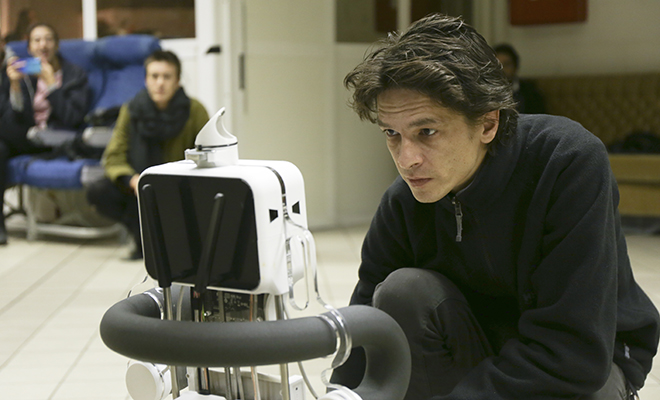
Mr Processor is a two-wheel self-balancing robot endowed with such a highly capable AI that it is self-aware. Contrary to all his author’s expectations, the robot almost immediately added mind-numbing code to its software and began acting in a rude and socially unacceptable way. The reason for its decision remains unknown. Was thinking about life just too much for it? Or was the realisation that each robot is made to serve its human masters the motivation to resign its intelligence and make itself a burden instead of being useful? It’s hard to say what motivated it, but whatever the cause, Mr Processor seems to be the first of its kind, the first “intoxicated AI”.
About one-metre high, the robot navigates the gallery space in a random manner. It uses its sensors and cameras to detect obstacles and people. It shows no regard for property and intentionally sprays graffiti on the walls that it encounters. It’s very noisy and rude to people. It follows them, nags them with sound and light and squirts water on them. It does not communicate in a human language, but in computer language.
As a self-conscious AGI has not yet been developed, Mr Processor still outlines a science fiction scenario, playing with the fears and ignorance about the current status of artificial intelligence, which is only able to learn from data sets. The work offers us a surprising, ironic take on what would actually mean to imbue “humanity” into a machine – and, ultimately, it’s more about us than the so-called “intelligences” to which our Promethean dreams are giving birth.

[1] https://scienceofsingularity.com/about/

THE AUTOR
Janez Janša

Boštjan Čadež (1979) studied industrial design at the Academy of Fine Arts and Design, University of Ljubljana. As an intermedia artist, he’s lately been focusing mostly on the fields of computer, real-time-generated and generative graphics and robotics, presented in the form of performances and installations. He’s received several prestigious awards and prizes for his innovations in design and programming. His previous artistic endeavours include graffiti, street art and VJ-ing. In 2013, he received the Golden Bird Award in the category of intermedia art.


CREDITS

Author: Boštjan Čadež

Production:
Aksioma – Institute for Contemporary Art, Ljubljana, 2019

Supported by:
the Ministry of Culture of the Republic of Slovenia and the Municipality of Ljubljana.

Aksioma’s programme is additionally supported by the Ministry of Public Administration as part of the public call for co-financing projects for the development and professionalisation of NGOs and volunteerism as well as by JSKD

deflowered by Lea

Lea Culetto
Lea Culetto
deflowered by Lea

Exhibition
4–27 September 2019

Aksioma | Project Space, Ljubljana

Part of U30+ production programme for supporting young artists.


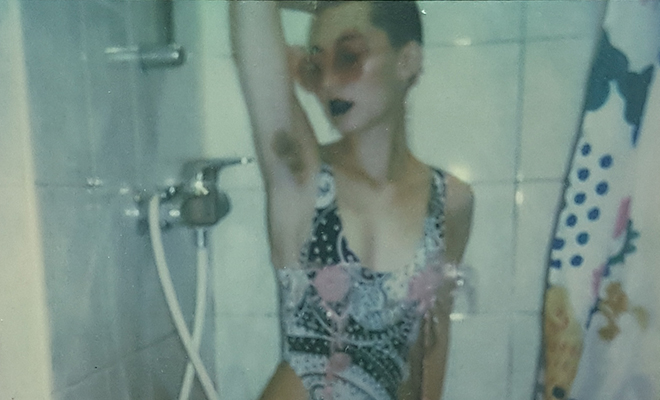
Young Slovenian artist Lea Culetto stands out among the artists of her generation for her ability to address sensitive topics, from menstruation to stretch marks, and to use problematic material, from menstrual blood to body hair, to make art that – far from being dramatic, disturbing and aggressive, is mostly intimate, delicate, fresh and pervaded by a sense of innocence and happiness. Culetto’s work focuses on the feminine body, and responds to the way it is shaped by the “male gaze” through fashion, advertising and the media – thus positioning herself in a long tradition of feminine – and feminist – art; her main media are embroidery and assemblage, used to produce garments and objects displayed in installations or site-specific interventions; she loves pink, dolphins and all that glitters. 1000 and One Nights is a floor installation made out of hundreds of bras; Your Housewife II is a video installation focused on the character of the housewife: in a set filled up with any sort of kitschy domestic knick knacks, from angels to trolls to madonnas to dolls painted in pink and glitter, a monitor shows the video of a woman wearing trashy fetish accessories, while preparing a  plucked hen in her kitchen; A Room of Her Own is a site specific installation done in an hotel room, where Lea Culetto embroidered her initials (LC) and the images of various domestic objects – underpants, a hairbrush, a razor, a whisk – on every pillow, sheet and blanket, in an act of personalisation and appropriation of an anonymous place; in Herbarium, she collects clumps, chunks from her menstrual blood and she displays them as they were dried flowers in an herbarium, or in shaped photo frames as they were pictures of relatives and ancestors; finally, My Life is a Hairy Tale is a series of wearable, skin colored collants decorated with braids made out of human hair: would female body hair become socially acceptable, were it “arranged” as a hairstyle?
Culetto will present in a gallery setup the most recent output of her visual research: the street fashion brand deflowered by Lea: a series of embroidered, wearable garments, marked by political, religious and feminist themes, combined into a whole with the help of kitsch esthetics and exaggeration. Troublesome topics – such as nipples, menstruation, stretch marks and body hair – are presented in unexpected ways, with irony used to discuss topics that are often perceived as taboo. In contrast with the fashion industry, which forces on us a model of the perfect body, causing in young people low self-esteem and various psychological and physical diseases, deflowered by Lea wants to spread a healthy and positive body image. Using different techniques such as embroidery, ornamental stitching, beading, knitting, braiding etc., Lea combines fragments from damaged clothes, second-hand clothes and fabric, and this manual work gives a story to each garment. The humans wearing her designs – real, unretouched bodies – become a live gallery, bringing the ideas embedded in the clothes out into the streets.

THE AUTHOR
Domen Pal

Lea Culetto (b. 1995, Trbovlje) uses embroidery, assemblage and mixed media to create objects and installations that challenge notions of femininity and feminism through the prisms of fashion, the gaze and the body. Group exhibitions in Slovenia and abroad include: Into the Space (Bežigrad Gallery I, Ljubljana, 2015), DSU ROG (Gallery Zelenica, 2015), Transformation of Image (Museum of Contemporary Art, Zagreb, 2016), ROOMS 2017 (Kappatos Gallery, Athens), Young Female Art in Šiška (Kino Šiška, 2017), PREMIERA 2018 – 4th Triennial of Young Artists. Cultural Body, Space, Placements (Gallery of Contemporary Art, Celje), ObjectiFication (2018) and Feminist Art at UL ALUO, Part 1: One, Two … Five (Hairy) Proposals for an Éden Better Tomorrow (2019), both Gallery Alkatraz, as well as the exhibition Strands by ČIPke initiative (Cerkno, 2019). deflowered by Lea is her first solo exhibition, which had its premiere at Galerija Miklova hiša (Ribnica, 2019) in co-production with Aksioma.
A graduate of the Academy of Fine Arts and Design, University of Ljubljana (UL ALUO), Lea received the UL ALUO Award 2018 for her “sharp, original approach to the thematisation of taboos in connection with the female body through a diverse range of approaches in the field of contemporary art”.


CREDITS

Author: Lea Culetto

Production:
Aksioma – Institute for Contemporary Art, Ljubljana, 2019
Co-production: Galerija Miklova hiša, Ribnica

Supported by:
the Ministry of Culture of the Republic of Slovenia and the Municipality of Ljubljana.

Aksioma’s programme is additionally supported by the Ministry of Public Administration as part of the public call for co-financing projects for the development and professionalisation of NGOs and volunteerism as well as by JSKD

MTCD – A Visual Anthology of My Machine Life

Teresa Dillon
Teresa Dillon
MTCD – A Visual Anthology of My Machine Life

Performance
25 and 26 August 2019 at 6 pm

Aksioma | Project Space, Ljubljana

Ticket reservation required: info@bunker.si
Entrance fee: 1 €

In the framework of the 22nd Mladi levi Festival


“How old are you? I’m seven iPhones old,” reads one of the statements in the iconic book The Age of Earthquakes (Shumon Basar, Douglas Coupland, Hans Ulrich Obrist, 2015), in response to the provocative question “Are generations still measured by years?” Are they, indeed?
Since the end of WWII, our life has been marked – at an exponential rhythm – by a number of technological inventions, which have changed the way we communicate, as well as socialise, represent ourselves, work, create and experience content and more. Other historical events in that period – from the Moon landing in the 1960s to the Arab Spring in 2010 – have not impacted our existence as much as our media experience of them has. Many of these inventions, from the personal computer to the World Wide Web, to iPhones, have been game-changing, impacting our lives in ways that make us forget how it was before them; others have not survived the descending curve of the hype cycle. But even the latter, often commercially presented as the “next big thing”, have succeeded in polarising our attention and desires.

Taking this basic truth as a starting point, MTCD – A Visual Anthology of My Machine Life is a monologue in which artist and researcher Teresa Dillon takes one “machine” from each year of her life, reflecting on the uses, misuses, and abuses of technology. From radios to home recording devices to her first experiences on the internet, Dillon’s sonic and visual journey explores the key “machines” that have come to shape her technological know-how and imagination, in turn revealing the contradictions and realities of a generation born as “digital natives”. This multimedia, personal, auto-ethnographic performance piece (which premiered at Berlin’s Transmediale in 2018), will be presented in Ljubljana for the first time in the framework of the 22nd edition of the international festival Mladi levi.

THE AUTHOR
Janez Janša

Artist, curator and researcher Teresa Dillon creates and tells stories about the techno-civic, that is, the relationships that exist between people, communities, technologies and governance. She is particularly interested in issues related to survival; repair cultures; environmental monitoring; interspecies relationships; sonic folklores; histories and heritages of technology and the built environment; surveillance; and open source civic resources.

Trained in theatre studies, set design and psychology, Teresa has since the mid-2000s created performances and works under the name Polar Produce. Along with MTCD – A Visual Anthology of My Machine Life (2018), recent pieces include Canary Songs, a sonic re-enactment and choral performance, drawing on the history of female workers in WWI ammunition factories, and AMHARC (2017), a sculptural work made from recycled materials, drawing attention to how surveillance architectures affect other creatures’ habits and ecologies.Teresa’s work has been published and exhibited internationally (Ars Electronica, Helsinki Design Week, LABoral, 7a*11d, Locws International), presented at various conferences and symposia (ISEA, Make City, EcoCity, Istanbul Biennale) and reviewed in Nature MagazineWireCreators,BBC online and we-make-money-not-art. Currently, she is professor of City Futures at the School of Art and Design, UWE Bristol and principal investigator at the international programme and network Repair Acts.


CREDITS

Author: Teresa Dillon
Set design and live image: Teresa Dillon, Rod Maclachlan, Luke Bennett

Production of the event: Aksioma – Institute for Contemporary Art and Festival Mladi levi / Zavod Bunker, Ljubljana, 2019

Supported by:
the Ministry of Culture of the Republic of Slovenia and the Municipality of Ljubljana.

Aksioma’s programme is additionally supported by the Ministry of Public Administration as part of the public call for co-financing projects for the development and professionalisation of NGOs and volunteerism as well as by JSKD

My Name is Janez Janša

Documentary screening in the framework of Simposio – utopia reale.

Borca di Cadore (BL), Italy

deflowered by Lea

Lea Culetto

Solo exhibition

Exhibition opening: THU, 27 June 2019 at 7 pm

Škrabčev trg 21, Ribnica, Slovenia


* Part of Aksioma Institute production programme to support young artists.

Seen

Vid Merlak

Film screening and talk with the artist

In the framework of the film festival Isola Cinema 2019 and its programme Video on the Beach III: Beyond Saturday Night Fever.

Isola, Slovenia


* Part of Aksioma Institute production programme to support young artists.

(more…)

And Now for Something Completely Different 10

Nika Oblak & Primož Novak
And Now for Something Completely Different 10

Exhibition
12 June–12 July 2019
Aksioma | Project Space, Ljubljana


A man is trapped inside a screen, walking endlessly. His movements, careful and repetitive, generate a rhythmic, hypnotic sound. As he moves, the rectangular screen moves too, rotating like a big hamster wheel. Where Do We Come From? What Are We? Where Are We Going? is a kinetic video installation that playfully reflects on our contemporary condition, depicting humans in a perpetual and pointless engagement with technological devices. Our device screens are portals to other dimensions: they help us to learn and remember, to create, and even to connect with each other, but at the same time they are powerful traps. Locking our eyes and our attention, they can become prisons, preventing us to establish more profound and complex relationships with the world and the people around us. The more we use the machine, the more we tend to resemble it: like Charlie Chaplin in Modern Times, when he morphs into a human screwdriver, the man inside the LCD adapts to the screen’s movements and limitations, transforming himself into a gear of the mechanism. In a wider sense, the work can also be considered a reflection on progress itself: we are constantly moving but making no real advancement, forced into hectic activity with no clear purpose. The title chosen for the work, which is taken after Paul Gauguin’s iconic painting D’ou Venons Nous / Que Sommes Nous / Où Allons Nous (1897), reinforces this idea.

Nika Oblak & Primož Novak use technology as a self-reflection tool; they build complex machines capable of bridging the physical and the virtual, the digital and the mechanical, the natural and the artificial. Since 2003, they have produced a large number of projects, including performances, films, photography and installations, that together constitute an ongoing investigation on contemporary life, focusing on its most controversial aspects: the traps of consumerism, the oppressive structures of work and politics, the ambiguous relationship between reality and fiction, the hidden perils of an uncritical use of technologies. In The Box (2005), for example, we see the artists inside a TV screen, trying to find a way out by pushing and kicking the walls. Their actions infiltrate the physical world by bending the frame of the monitor, but they are never able to break out: the mass media system is a giant rubber wall that won’t let us escape its influence, no matter how hard we try. This idea of helplessly trying to establish a physical connection between what’s inside the screen and what’s outside, opening a breach, reminds us of The Last Nine Minutes (1977), a seminal performance by American artist Douglas Davis. Like many other artists of the period, Davis engaged in a profound reflection about the rising world of telecommunication, considering its profound impact on human consciousness and social relationships. Despite these similarities, however, Oblak & Novak’s work is very different, aesthetically and conceptually: humans today are not just exploring new tools of communication, they are completely fused with them, to the point of not being able to recognise their true impact. To describe this new situation, the artists build alternative machines, ironic devices capable of depicting in a very accurate way our daily life: a circle of recursive actions that are both entertaining and exhausting.
In Endless Column (2017), which contains a direct visual reference to the work of media art pioneer Nam June Paik but also pays homage to avant-garde sculptor Constantin Brancusi, the protagonist tries to balance several monitor on her head, in a circus-like performance. All of her attention is focused on the action of keeping everything in place, without losing a single piece. In a world saturated with media contents, and surrounded by devices that continuously demand our attention, we always feel challenged, chased, and in the process of missing something. Distracted by this impossible task of managing everything, we slowly turn into entertaining machine ourselves, becoming part of the global media spectacle.

 Valentina Tanni

THE AUTHORS

Nika Oblak & Primož Novak have been working collectively since 2003. In their art practice they examine the influence of media and capital on contemporary society, dissecting its visual and linguistic structure. Oblak & Novak have exhibited worldwide, in venues like the Sharjah Biennial (AE), Japan Media Arts Festival, Tokyo (JP), Istanbul Biennial (TR), Biennale Cuvee, Linz (AT), Transmediale Berlin (DE), FILE Sao Paulo (BR), among others. They have received numerous grants and awards, including the CYNETART Award by the Trans-Media-Akademie Hellerau in Dresden (DE), an honorary mention of art critics at Biennale WRO, Wroclaw (PL), the White Aphroid Award for artistic achievement by MMC KIBLA, Maribor (SI) and a Rihard Jakopic honorable mention, awarded by the Slovenian Association of Fine Arts Societies, the Academy of Fine Arts and Design in Ljubljana, Moderna galerija and the Slovene Association of Art Critics (SI).


CREDITS

Authors: Nika Oblak & Primož Novak

Production of the exhibition
Aksioma – Institute for Contemporary Art, Ljubljana, 2019

Supported by: the Ministry of Culture of the Republic of Slovenia and the Municipality of Ljubljana.

The project Where Do We Come From? What Are We? Where Are We Going? was created as a co-production between Aksioma – Institute for Contemporary Art, KID KIBLA and Asia Culture Center.

Special thanks: Kresija Gallery, Kino Šiška, Lucijan Stanovnik, Jaka Mihelič, Miodrag Jovović, Simon Gorše.

Aksioma’s programme is additionally supported by the Ministry of Public Administration as part of the public call for co-financing projects for the development and professionalisation of NGOs and volunteerism as well as by JSKD

The Labour of Making Labour Disappear

Sanela Jahić

Solo exhibition

Exhibition opening: THU, 16 May 2019 at 7 pm

Talk with the artist: WED, 5 June 2019 at 7 pm
Moderated by the curator of the exhibition Barbara Sterle Vurnik.

Mestni trg 37, Škofja Loka, Slovenia

Modern Solutions Require Modern Problems

Jonas Lund
Jonas Lund
Modern Solutions Require Modern Problems

Exhibition
15 May – 7 June 2019

Aksioma | Project Space, Ljubljana


The exhibition Modern Solutions Require Modern Problems by Swedish artist Jonas Lund consists of a series of works exploring opaque algorithmic ranking systems and the increasing loss of agency online. The main body of the work consists of personalised signs, each presenting and ranking different aspects of Lund’s activity and emotional status, from happiness to productivity. Each ranking is the result of a different algorithm, written and composed by Lund, in order to make visible the aspects of his performance as an artist that typically remain unknown, how much trust his works inspire and how that, in turn, affects his happiness. By juxtaposing his own personal happiness in relation to opaque and large scale systems, Lund aims to explore the consequences and limits of algorithms and the rule book of avoiding responsibility as the current defaults for automatic decision-making and influencing processes.

Society has come to recognise that the current solutions presented by Silicon Valley startups often create more problems than solutions. From Airbnb and Uber to Google, Amazon and Facebook, etc., what is typically presented as a ground-breaking world-altering technological innovation quickly erodes political and social institutions with one main goal in mind: to maximise profits for shareholders. At the centre of this ideology lies the belief that all aspects of human behaviour can and should be measured. Thus, vast datasets of signals, preferences and parameters have become the foundation for data-driven algorithmic decision-making processes – how can we squeeze another 0.5% profit out of this transaction, how can we maximize the return on our investment in any given scenario, regardless of whom it affects, as long as it pleases the shareholders. The algorithm has become the ruler, the solution, the seemingly unbiased decision maker that functions as the justification for any arbitrary profit-driven decision. 

How do you counter a “solution” with a problem and think of alternative narratives to relentless technological innovations? In Modern Solutions Require Modern Problems Lund will present a new work in which he is exploring, subverting, satrising and portraying the current infrastructure of the internet and the different aspects of this problematic binary.For the last decade, Swedish artist Jonas Lund has been developing a consistent body of work, focused on contemporary networked systems and power structures of control. If there is a system to analyse, pick apart and reverse engineer, Lund will tackle it. A unique artist whose works are equally relevant in the gallery space as well as online through the development of net specific projects and websites, Jonas Lund attempts to portray the increasing algorithmisation of our daily life, from our daily web experience to economics, from art making to the art market.

ARTIST TALK

In the talk Modern Solutions Require Modern Problems, Lund will explore his artistic practice and body of work through the vantage point of the “solution vs problem” binary division. Very often the technological solutions offered by the Silicon Valley elite quickly turn into societal problems. Conversely, the works that Lund produces can act as problems to the presented solutions. The artist talk will explore Lund’s body of work in relation to this dichotomy and present an alternative narrative to the current dogma.

Part of the ALUO uho events organized by The Academy of Fine Arts and Design of the University of Ljubljana


THE AUTHOR

Jonas Lund (CC BY-SA 4.0)

Jonas Lund (1984, Sweden) creates paintings, sculpture, photography, websites and performances that critically reflect on contemporary networked systems and power structures of control. His artistic practice involves creating systems and setting up parameters that oftentimes require engagement from the viewer. This results in game-like artworks where tasks are executed according to algorithms or a set of rules. Through his works, Lund investigates the latest issues generated by the increasing digitalisation of contemporary society like authorship, participation and authority. At the same time, he questions the mechanisms of the art world; he challenges the production process, authoritative power and art market practices.Lund earned an MA at Piet Zwart Institute, Rotterdam (2013) and a BFA at Gerrit Rietveld Academy, Amsterdam (2009). He has had solo exhibitions at the Photographers’ Gallery, London (2019), Whitechapel Art Gallery, London (2016), Steve Turner, Los Angeles (2016, 2015, 2014), Växjö Konsthall Sweden (2016), Boetzelaer|Nispen, Amsterdam (2014), Showroom MAMA, Rotterdam (2013), New Museum, New York (2012), and has participated in numerous group exhibitions including ones at Carrol/Fletcher, London; Schinkel Pavillon, Berlin, ZKM, Karlsruhe; Van Abbemuseum, Eindhoven; Witte De With, Rotterdam; De Hallen, Haarlem; and the Moving Museum, Istanbul. His work has been written about in Artforum, Frieze, Kunstforum, the New Yorker, the Guardian, Metropolis M, Artslant, Rhizome, Huffington Post, Furtherfield, Wired and more.

CREDITS

Production:
Aksioma – Institute for Contemporary Art, Ljubljana, 2019

Partner:
The Academy of Fine Arts and Design of the University of Ljubljana

Supported by:
the Ministry of Culture of the Republic of Slovenia and the Municipality of Ljubljana.

Aksioma’s programme is additionally supported by the Ministry of Public Administration as part of the public call for co-financing projects for the development and professionalisation of NGOs and volunteerism as well as by JSKD

Critical Engineering

Critical Engineering Working Group

Group exhibition

Exhibition opening: WED, 27 March 2019 at 7 pm

Komenskega 18, Ljubljana, Slovenia

Tactics & Practice #7: Critical Engineering

Tactics & Practice #7:
Critical Engineering

Radical Tools for Interventions in Infrastructure 

Talks | Exhibition | Workshop
26 – 27 March 2019

Kino Šiška Centre for Urban Culture, Ljubljana
Aksioma | Project Space, Ljubljana

Part of the Tactics & Practice series and the EU project State Machines


Miha Fras | More

In 2011, a group of artists and engineers published the “Critical Engineering Manifesto”, since translated into 18 languages. Around the manifesto, originally written by Julian Oliver, Gordan Savičić and Danja Vasiliev, gathered a larger group – the Critical Engineering Working Group – now including also Sarah Grant, Bengt Sjölén and Joana Moll.

In true avant-garde fashion, the “Manifesto” launches by describing Engineering as “the most transformative language of our time, shaping the way we move, communicate and think”, thus, it is the work of the Critical Engineer “to study and exploit this language, exposing its influence”. Further, a Critical Engineer “recognises that each work of engineering engineers its user”, considering “any technology depended upon to be both a challenge and a threat”. And so the manifesto unfolds.

Nearly ten years later, the relevance of the “Critical Engineering Manifesto” has only become more evident, as an ever-growing public becomes aware of the techno-political implications of using – and depending upon – integrated systems and complex, networked technologies. Today, one can find its 11 points listed on the walls of hacklabs, museums, engineering and media-art academies, and in a great many texts, the world over.The Tactics&Practice event entitled Critical Engineering comprises an exhibition, a seminar and a workshop, underlining the artistic, theoretical and educational work done by the Critical Engineering Working Group along the last decade. The seminar will host all the members of the group – all of them recognised artists with long individual artistic careers – using their statements and their projects as case studies to analyse the transformative potential of Critical Engineering in the context of a tactical and technical arts practice.

Detailed program and biographies of the participants


THE TALKS

26 March 2019, 5 – 8 PM
Kino Šiška Centre for Urban Culture, Ljubljana

Danja Vasiliev
Dark Internet Topologies

In this talk, Danja Vasiliev gives an overview of “dark internet topologies” in the context of his and Julian Oliver’s commissioned piece Vending Private Network. Challenging the popular reading of the internet as a digital incarnation of the commons, “public space”, he – using command line utilities known to network administrators – reveals a deep and original privatisation, one that necessitates new “dark abstractions” to achieve the public space we expect from it. In doing so, he shows how “darknets” are technical implementations of the same rights structures we value and actively defend within corporeal public life.

Gordan Savičić & Bengt Sjölén
Electromagnetic Situationism

Gordan Savičić and Bengt Sjölén talk about works developed together with the Critical Engineering Working Group. Both artists explore network situations in which the electromagnetic infrastructure has been used as a field of intervention. Making use of contemporary technologies such as software-defined radio, they examine the analysis and reconstruction of any leaked signal over the air, independent of whether it originated from an intentional transmission at an antenna or from an unintentional emanation from a conductor on a substrate. The electromagnetic space serves as research framework for developing investigations into the traces and shadows of our technological dependency.

Joana Moll
An Autopsy of Data Business

Our so-called networked society has failed so far to transpose the logic of interconnectedness into our lives. Citizens are becoming increasingly machine-like and dependent on data, threatening the connection between humans and their natural habitats. Although most of our daily transactions are carried out through electronic devices, we know very little of the apparatus that facilitates such interactions, or in other words, about the factory that lies beyond the interface.

Sarah Grant
Radical Networks

Radical Networks is an international conference and arts festival which features practitioners working with the electromagnetic spectrum in critical and creative ways. In response to the obfuscation of the inner workings and issues that arise from being an always-on, internetworked society, Radical Networks seeks to demystify and push those very things to the foreground of our consciousness. Sarah Grant discusses some of the thinking that has led to the creation of Radical Networks as well as what it hopes to achieve as a community focused event, including highlights from past talks.

THE WORKSHOP
Miha Fras | More

Sarah Grant & Joana Moll
Surveillance Override
Wednesday, 27 March 2019, 09:00–18:00
Kino Šiška Centre for Urban Culture, Ljubljana

Psychological Warfare, also called PSYOPS, is a strategy used in military and government intelligence networks aimed at influencing the emotional, cognitive and rational structures of governments, organisations, groups, and individuals, in order to change their behaviours and ultimately their purposes and goals. PSYOPS tactics are deeply rooted in the diverse techno-social arrangements that lie at the core of algorithmic governance, yet they are often ignored or overlooked by most global citizens, who nevertheless operate within such arrangements. With increasing distrust in “The Cloud” comes a broad call for publicly-owned network infrastructures that would give users greater control over their personal communication, data and identities.

In this 8-hour, hands-on workshop we will try to connect the dots between PSYOPS, psychology, propaganda, surveillance, the internet, data and algorithms, and we will underline the need to build alternative networks to retain sovereignty over our communications technologies and natural resources.

In the first part of the workshop, Joana Moll will give participants a deep understanding about the many mechanisms used by corporations, agencies and governments to collect, sort and exploit personal data, along with the main social, political and environmental impacts of such processes. In the second part, Sarah Grant will introduce participants to the basic building blocks of computer networking, command line interface and WiFi communication. We will learn how to self-host our own web servers, file servers and personal wireless networks. These servers will allow their users to send messages, publish websites and share files across an offline local area and mesh network.


THE EXHIBITION

Critical Engineering
27 March – 26 April 2019
Aksioma | Project Space, Ljubljana

Janez Janša | More

How can we use engineering to visualise, respond to and resist the daily, strenuous – and mostly successful – effort perpetrated by the tools and infrastructures designed by corporate and governmental subjects to engineer us? Intended as “radical tools for interventions in infrastructure”, the works developed by the Critical Engineering Working Group offer different answers to this question, from simplified, easy access to resistance tools, to hijacking technological infrastructures in order to expose their inner workings. According to the Critical Engineering Manifesto, “the greater the dependence on a technology the greater the need to study and expose its inner workings, regardless of ownership or legal provision”. Thus, it’s no surprise that the three “tools for intervention” presented in this exhibition focus on networked infrastructures and online communication, especially WiFi communication via portable devices: technologies we depend upon to communicate as well as to locate ourselves in the physical space, yet that are also used to control and follow us.

EXHIBITED WORKS

Julian Oliver, Danja Vasiliev
Vending Private Network, 2018

Vending Private Network takes the form of a condom-vending machine, such as those typically seen in public toilets, nightclubs and bars. Equipped with mechanical buttons, a coin-slot and USB ports, it offers 4 VPN routes, each with an animated graphic depicting the route as a fantasy destination. Visitors are invited to insert a USB stick into the slot, a coin (1 pound or euro) into the machine, and to select a VPN destination by pressing a mechanical button. In doing so, a unique VPN configuration file is then written to the USB stick. Special instructions (in the form of a README.txt) are also copied, explaining how to use the VPN in a special “sheathed” mode that evades detection methods (namely Deep Packet Inspection, or DPI) used by corporations and state-controlled infrastructure administrators. This is the only means known to work against state-controlled firewalls.

Janez Janša

Bengt Sjölén, Gordan Savičić
Packetbrücke, 2012

Packetbrücke (Packetbridge) explores the simulation of entire network situations by transferring the electromagnetic infrastructure to a different physical space. The result is a revealing “confusion” of devices and services reliant on this infrastructure. Wireless network packets are directly captured from a specific location and tunnelled through the internet to a remote location, where they are released back into the air. In doing so, Packetbridge literally injects one electromagnetic representation of geographical space into another, effectively producing a new imaginary topography and, through this remediation, an “impossible reality”. Packetbridge demonstrates that positioning systems based on WLAN are a site for intervention, at the same time expressing their vulnerability to location spoofing attacks.

Janez Janša

Bengt Sjölén, Danja Vasiliev
Unintended Emissions, 2015

Inserted into urban environs, Unintended Emissions captures, dissects, maps and projects radio emissions unintentionally and invisibly shared by our portable wireless devices. Employing two arrays of directional Yagi antennas, the project attempts to determine positions of WiFi devices in the vicinity. Similarly to surveillance and tracking systems such as StingRay, Unintended Emissions places mobile WiFi users on to a map indicating the kind of a device a user has, the time of appearance, the user’s network activity and other user-specific metadata. This information can be further analysed to determine the user’s identity and movements within a locality and the internet. Using methods and technologies known to be deployed by federal surveillance initiatives, the intervention seeks to engender a “healthy paranoia” in the interests of an increased techno-political subjectivity.

Janez Janša

CREDITS

Curated by: The Critical Engineering Working Group

Artistic director: Janez Janša
Head of production: Marcela Okretič
Executive producer: Sonja Grdina
Development Specialist: Jana Reneé Wilcoxen
Technician: Valter Udovičić
Public relations: Urška Barut
Documentation: Miha Fras (photo), Gregor Gobec (video)
Corporate visual identity: Luka Umek

Production: Aksioma – Institute for Contemporary Art, Ljubljana, 2019
Co-production: Kino Šiška Centre for Urban Culture, Ljubljana and Drugo more, Rijeka

Critical Engineering is realised in the framework of State Machines, a joint project by Aksioma (SI), Drugo more (HR), Furtherfield (UK), Institute of Network Cultures (NL) and NeMe (CY).

Supported by: the Creative Europe programme of the European Union, the Ministry of Culture of the Republic of Slovenia, the Municipality of Ljubljana.

Media sponsors: Radio Študent and TAM-TAM

This project has been funded with support from the European Commission. This communication reflects the views only of the author, and the Commission cannot be held responsible for any use which may be made of the information contained therein.

Presonal Space Data Collection Vol. 1

Valerie Wolf Gang

Installation and performance

Slovenska cesta 54, Ljubljana, Slovenia

New Dark Age. Technology and the End of the Future

James Bridle

Artist talk / Book presentation

Cankarjeva 15, Ljubljana, Slovenia

Tales from the Dark Side of the City

Unknown Fields
Unknown Fields
Tales from the Dark Side of the City

Screening with live narration by the author
MON, 25 February 2019 at 8 pm

Kino Šiška Centre for Urban Culture, Ljubljana

In the framework of Akcija!, a cycle of screening events


Since 2008, the Unknown Fields Division has been venturing out on expeditions into the shadows cast by the contemporary city, to uncover the alternative worlds, alien landscapes, industrial ecologies and precarious wilderness set in motion by the powerful push and pull of the city’s desires. These dislocated landscapes – the iconic and the ignored, the excavated, irradiated and the pristine – are connected to our everyday lives in surprising and complicated ways. They are embedded in global systems that form a vast network of elusive tendrils, twisting threadlike over everything around us, crisscrossing the planet, connecting the mundane to the extraordinary.

The Unknown Fields Division makes provocative objects and films from this expedition work, exploring the dispersed narratives that coalesce to form a contemporary city. Its films include documentary shooting, animations and infographics, that, when screened, are typically presented in a performative fashion, with the collective’s participants narrating live over the moving images.

Co-founded and directed by Kate Davies and Liam Young, Unknown Fields Division has involved in its expeditions small companies like DJI, the market leader in easy-to-fly drones and aerial photography systems; but also reportage photographers, writers, designers, filmmakers and visual and media artists.

Such expeditions began in 2008 with a trip that traced Darwin’s expedition to the Galapagos Islands and South America. Discovering there “a precious and fragile wilderness teetering at the point of collapse, an ecology in crisis bearing the scars of a ravenous tourist economy”, they intervened with a project of “augmented ecology”. The following trip brought them to the Arctic Circle (Winter 2009). On this pilgrimage to visit the glaciers before they melt away, they shed a tear under the electric skies of the Aurora Borealis; yet the camp was not only a chance for contemplation and documentation of “the last wilderness” of the Arctic Sea, but also for developing some seemingly unrelated projects focused on the materialisation of immaterial digital data (Data Fossils by Tobias Jewson) and on the construction of the internet as an artefact, as a supercomputer server-farm (Scatterbrain: A Cautionary Tale by Jack Self).

In the following years, they embarked on trips to the West Australian Outback (2010), the Chernobyl Exclusion Zone and Baikonur Cosmodrome (2011), and the far North Alaska (2011). They took a reconnaissance road trip to chronicle a series of extraterrestrial encounters from the borderlands of the United States, ending at the Burning Man Festival in the Black Rock Desert, Nevada (2012); headed to Madagascar to catalogue the push and pull of economy and ecology and to trace the shadows of the world’s desires across the landscapes of this treasured island (2013); travelled, on board a mega container ship, to the manufacturing heart of Southern China (2014); and visited the Lithium Mines of Bolivia and the Atacama Desert exploring the infrastructure behind the scenes of our electric future (2015).

Each of these trips offered the chance for a variety of visionary projects that will be illustrated in this screening event.

THE AUTHORS
Miquel Taverna / The Influencers

Kate Davies is an artist, architect and writer. She is a co-founder of the multidisciplinary group LiquidFactory, which explores the rich hinterlands of art and architecture. She is deeply interested in how people inhabit and understand the landscape, particularly those places that are extreme, hostile or remote. Her work explores contemporary notions of wilderness – drawing on modes of understanding landscape ranging from contemporary survey technologies to folklore – and operates between writing, drawing, film and photography. Kate teaches award-winning design studios at two of the UK’s most prestigious architecture schools, the Architectural Association and the Bartlett School of Architecture, UCL, and regularly runs international design workshops.

Liam Young currently lives and works in London as an independent designer, futurist, critic and curator. Liam was named by Blueprint magazine as one of 25 people who will change architecture and design. He is a founder of the think tank Tomorrows Thoughts Today, a group whose work explores the consequences of fantastic, perverse and underrated urbanisms and teaches award-winning design studios around the world. His projects deploy fictional near-future scenarios as critical instruments for instigating debate about the social, architectural and political consequences of emerging biological and technological futures.

More: www.unknownfieldsdivision.com

CREDITS

Production of the event:
Aksioma – Institute for Contemporary Art, Ljubljana, 2019
in collaboration with the Center for Urban Culture Kino Šiška

Supported by: the Municipality of Ljubljana

Aksioma’s programme is additionally supported by the Ministry of Public Administration as part of the public call for co-financing projects for the development and professionalisation of NGOs and volunteerism as well as by JSKD.

Critical Triggers

César Escudero Andaluz
Critical Triggers

Exhibition
16 January – 15 February 2019

Aksioma | Project Space, Ljubljana


Traditionally, critical art practices developed artworks laying emphasis on uncovering problems hidden behind the user’s gaze. In 1936, Walter Benjamin argued that artists need to “enter into debate” with the apparatus instead of “thinking that they are in possession of an apparatus that in reality possesses them.”

The solo exhibition Critical Triggers by Linz-based Spanish artist César Escudero focuses on rethinking the relationship and perception of human-machine interaction (HCI) through speculative – and critical – art and design. It does so by exploring the multifaceted implications of interfaces, networked practices, new digital materiality and underlying algorithms, in order to understand and reflect the production of new aesthetics after, or in, the so-called digital revolution.

How do artefacts and interfaces affect our perceptions and change us? What are the social implications of invisible practices that cloud the way people and businesses are labelled and treated? How can we understand and describe the effects of interfaces and algorithms on society, economy and human relations? What kind of society will derive from this apparatus?

The exhibition’s selected artworks pose these relevant questions as they critique our current interfaces and their cultural, economical, political, social and environmental implications.

Interfight (2015) consists of a series of physical data polluters – displayed as bugs in bird cages – acting on the surface of a touch screen device clicking, scrolling and zooming in and out at will. In doing so, they pollute the data we provide to corporations and national agencies, helping us to resist online profiling and data surveillance. Two recent projects, done in collaboration with artist Martín Nadal, deal with the massive amount of time, electricity and computer power invested in mining a single Bitcoin and successfully registering it on the Blockchain.

BITTERCOIN  The worst miner ever (2016) is an old calculator machine hacked to be used as a miner validating the pending Bitcoin transactions on the Blockchain, thus increasing the time needed to produce a Bitcoin to almost an eternity. The operations are displayed on the calculator screen and printed, with the paper accumulating freely around the calculator.

Bitcoin of Things (BoT, 2017) features everyday objects – such as rubber stamps, maracas, hammers, salt shakers – transformed into mining devices equipped with a Wi-Fi microcontroller and different sensors in order to be able to generate a Bitcoin. For example, every time a visitor uses the rubber stamp, a number is sent to the Blockchain for validation, while the stamp returns an ironic message on a paper ticket. Thus, the process of generating Bitcoins is turned into a playful, and usually unsuccessful, lottery. Other works in the show also criticise interfaces, including prints of modified desktops (File_món, 2012); 3D-printed keys made from downloadable Open Source plans in order to liberate shopping trolleys from their commercial destiny (Shopping Trolleys Liberation Front – STLF, 2014); and a take on media archeology in which data extracted from personal profiles on social networks has been converted into audio documents and recorded on cassettes (Tapebook, 2014).

THE WORKSHOPS

Workshop #1
César Escudero Andaluz
DATA POLLUTERS | DO-IT-YOURSELF PHYSICAL NETBOTS
TUE, 15 January 2019, 10am – 1pm
 ALUO – Academy of Fine Arts and Design, University of Ljubljana
Department for Painting / Video and New Media

Data Polluters is a workshop for students aiming at developing a critical stance towards new technologies, the pervasive presence of interfaces in our lives, the ongoing homogenization of design and Graphical User Interface standards, and the data tracking and online management to which users are subjected. Participants will be given basic knowledge of BEAM robotics (Biology, Electronics, Aesthetics and Mechanics) and guided through the realization of their own small data polluter, a small bug-like physical bot designed to complicate the relationship between interactive systems.#DeviceArt #CriticalEngineering #GraphicalUserInterface #Data #DataPollution #SpeculativeDesign #BEAMrobotics

Workshop #2
César Escudero Andaluz and Martín Nadal
BoT | BITCOIN OF THINGS
WED, 16 January 2019, 10am – 1pm
ALUO – Academy of Fine Arts and Design, University of Ljubljana
Department for Painting / Video and New Media

Bitcoin of Things (BoT) is a workshop for students who want to address issues related to media art, digital culture, critical economy, electronics and the Internet of Things (IoT). The theoretical introduction acquaints participants to concepts that help them to contextualize and better understand the Bitcoin and Blockchain world, while the practical part consists in working with a basic electronic circuit, welding and microcontrollers to build a playful bitcoin miner out of ordinary objects such as hammers, staplers or salt-shakers. Participants will build their own BitCoin of Things (BoT) miner combining a Wi-Fi microcontroller and different sensors.

#DeviceArt #CriticalEngineering #Bitcoin #Blockchain #SpeculativeDesign #WirelessInterface

THE AUTHORS

Jure Goršič

César Escudero Andaluz is an artist and researcher focused on Human-Computer Interaction, interface criticism, digital culture and its social and political effects. His work spans image-making, sculpture, videogame, installation, networked culture, IoT, robotics, media archaeology. Since 2011, he is a researcher at the Kunstuniversität Linz in the Interface Culture LAB. His artworks have been shown at international electronic-art events, museums, galleries and conferences including the Ars Electronica Center (AT), ZKM (DE), ISMAR2015 (JP), WRO2015 (PL), Transnumeriques (FR), Hangar.org (ES), KIKK (BE), Rome Media Art Festival (IT) and ADAF (GR).

Martín Nadal is an artist/developer based in Linz and studying Interface Cultures at the Kunstuniversität Linz. In recent years, he has collaborated in a variety of projects dealing with cryptocurrencies, blockchain, IoT, etc., and taught several art- and technology-related workshops. His works have been shown at Visualizar 11, Medialab Prado in Madrid, the Ars Electronica festival and the Art Meets Radical Openness Festival in Linz, Settimana della Scienza in Genoa and at the  IAMAS – Institute of Advanced Media Arts and Sciences in Ogaki-shi.

CREDITS

Authors: César Escudero Andaluz, Martín Nadal

Production of the exhibition:
Aksioma – Institute for Contemporary Art, Ljubljana, 2019

The workshops are organized in collaboration with:
The Academy of Fine Arts and Design of the University of Ljubljana
and Kunstuniversität Linz

Supported by: the Ministry of Culture of the Republic of Slovenia and the Municipality of Ljubljana, the Austrian Cultural Forum, and the Embassy of Spain in Ljubljana

Aksioma’s programme is additionally supported by the Ministry of Public Administration as part of the public call for co-financing projects for the development and professionalisation of NGOs and volunteerism and JSKD

Workshops series: Critical Triggers

César Escudero, Martín Nadal

Academy of Fine Arts and Design, University of Ljubljana
Roška 2, Ljubljana, Slovenia

Workshop #1
DATA POLLUTERS | DO-IT-YOURSELF PHYSICAL NETBOTS by César Escudero
TUE, 15 January 2019, 10 am – 1 pm

Workshop #2
BoT | BITCOIN OF THINGS by César Escudero and Martín Nadal
WED, 16 January 2019, 10 am – 1 pm

Free of charge.
No prior experience is necessary.

APPLY HERE!

DEADLINE: 10 January 2019, midnight

The Labour of Making Labour Disappear

Sanela Jahić
Sanela Jahić
The Labour of Making Labour Disappear

Exhibition
12 December 2018 – 11 January 2019

Aksioma | Project Space, Ljubljana

See the last phase of this project here.


The current wave of pervasive automation and the ever faster development and use of technologies of prediction are radically transforming and reorganising all forms of labour. As the delegation of tasks to machines becomes widespread, Sanela Jahić’s starting position in this project was to explore the possibility of a machine-conceived exhibition. What if her labour as an artist were automated? If a prediction algorithm were developed based on the collected database of her work, research and interests, in order to determine the content and aesthetics of her next artwork, would the algorithm then turn on itself? The fact that the algorithm is created to interpret the individual’s relation to technology and the way the latter influences the nature of labour, clearly puts such a machine in a particular loop.

Yet, this research also places the artist in a peculiar position. Formulated according to her artworks and her working methods, this particular technology of prediction will become more advanced and complex the more data it receives. It may then produce something surprising, something that surpasses our expectations and could be perceived or mistaken for the machine’s creativity. But what if that turns out to be something the artist fundamentally disagrees with? Would that be a reflection of her biases, given the fact that these technological systems are not neutral, but manmade and political, reproducing the values of the people who program them? And if she works alongside the algorithm to create the artworks for the exhibition in tandem, will the audience be able to distinguish which work was formulated by the machine? In addition, since she produces technologically supported kinetic objects, this requires that the algorithm – itself a machine – conceives works of art that are also machines.

The relations between machines and humans is one of the constants in Sanela Jahić’s work. Her latest production places the research of complex relations between technology and the social, individuals and their identity directly into the context of the critique of capitalist relations of production. This project continues her research into the intertwinement of technology, labour, capitalist production relations and subjectivity. Its realisation requires collaboration with experts in programming, computation, machine learning and process automation. Thinking through and with this technology enables her to investigate its complexity – instead of being overtaken by it – and disclose some of its hidden mechanics.

ARTIST TALK

AUTHOR

Sanela Jahić (1980, Kranj) graduated in Painting from the Academy of Fine Arts and Design, University of Ljubljana in 2008, and received her master’s degree in 2010 in Public Art and New Artistic Strategies from the Bauhaus University in Weimar. Jahić is an intermedia artist, who constructs visual and technologically supported kinetic objects and installations. Her artistic practice often involves collaboration with specialists for mechanical engineering, automation, software and electronics. She lives and works in Škofja Loka. Jahić has exhibited her work in numerous shows in Slovenia and abroad.

CREDITS

Author: Sanela Jahić
Technical support: Andrej Primožič
Graphic design: Vasja Cenčič
Development and programming of the predictive model, data visualisation: Iztok Lebar Bajec
Development and programming of the predictive model: Jure Demšar
Programming: Umer Muhammad
Photography: Janez Pelko
Data analysis and animation: Jernej Lunder

Production:
Aksioma – Institute for Contemporary Art, Ljubljana, 2018

Co-production: Drugo more, Rijeka

Partner: Faculty of Computer and Information Science, University of Ljubljana

This project is a co-production in the framework of the Dopolavoro flagship of the Rijeka 2020 – European Capital of Culture project, with support from the City of Rijeka – Department of Culture, the Ministry of Culture of the Republic of Croatia, the Ministry of Culture of the Republic of Slovenia and the Municipality of Ljubljana.

Aksioma’s programme is additionally supported by the Ministry of Public Administration as part of the public call for co-financing projects for the development and professionalisation of NGOs and volunteerism as well as by JSKD

RELATED EVENTS

Jaka Babnik

Hyperemployment
Exhibition

 7 November 2019–19 January 2020
MGLC – International Centre for Graphic Arts, Ljubljana

Curated by: Domenico Quaranta
Artists: Danilo Correale, Elisa Giardina Papa, Sanela Jahić, Silvio Lorusso, Jonas Lund, Michael Mandiberg, Sebastian Schmieg, Guido Segni

Automate all the Things!
Symposium
14–15 January 2020
The Academy of Fine Arts and Design of the University of Ljubljana
Moderna galerija

Speakers: Elisa Giardina Papa, Sanela Jahić, Silvio Lorusso, Michael Mandiberg, Domenico Quaranta, Sašo Sedlaček, Sebastian Schmieg

Sanela Jahić
Uncertainty-in-the-Loop
Exhibition

 23 September–23 October 2020
Aksioma | Project Space, Ljubljana

My Delight on a Shining Night

James Bridle
James Bridle
My Delight on a Shining Night

Exhibition
20 February – 22 March 2019

Aksioma | Project Space, Ljubljana

In the framework of State Machines


During the Second World War, engineers working on the new top-secret technology of radar would see mysterious shapes bloom across their screens, shifting and moving in great strands across the sky. They named these phenomena “angels”. Only later did ornithologists working with radar manage to prove that these shadows were flocks of birds, and use radar to learn much more about the natural world.

“My delight on a shining night” is a line taken from the old English folk song, “The Lincolnshire Poacher”, which describes the pleasures of taking game from rich landowners. The opening bars of “The Lincolnshire Poacher” were also used as the call sign of a numbers station – a mysterious radio shortwave radio signal believed to be related to espionage – broadcast from RAF Akrotiri, in Cyprus, from the mid-1970s until 2008.

Akrotiri is the site of the one of the largest military radar installations in Europe and the Middle East, collecting intelligence on the Middle East and Russia far over the horizon. It is also home to a population of Greater Flamingos, who migrate around the Mediterranean. Since the 1970s, these flamingo populations have been tracked by the Station Biologique de la Tour de Valat in the South of France, whose database of half a million sightings over thirty years includes more than twenty thousand birds.James Bridle’s work is concerned with how political and social attitudes shape technology, and the ways in which new technologies in turn shape our understanding of the world. In My Delight on a Shining Night, he connects histories of surveillance and covert communication, data and visuality, migration and nationalism through video, and exercises in database recovery and storytelling.

Click HERE to read more about James’s research for this project.

BOOK PRESENTATION

New Dark Age
Technology and the End of the Future
, Verso, June 2018
WED, 20 February 2019 at 5 pm
Moderna galerija Ljubljana

New Dark Age is among the most unsettling and illuminating books I’ve read about the Internet, which is to say that it is among the most unsettling and illuminating books I’ve read about contemporary life.”

– Mark O’Connell, The New Yorker

We live in times of increasing inscrutability. Our news feeds are filled with unverified, unverifiable speculation, much of it automatically generated by anonymous software. As a result, we no longer understand what is happening around us. Underlying all of these trends is a single idea: the belief that quantitative data can provide a coherent model of the world, and the efficacy of computable information to provide us with ways of acting within it. Yet the sheer volume of information available to us today reveals less than we hope. Rather, it heralds a new Dark Age: a world of ever-increasing incomprehension.
In his brilliant new work, leading artist and writer James Bridle offers us a warning against the future in which the contemporary promise of a new technologically assisted Enlightenment may just deliver its opposite: an age of complex uncertainty, predictive algorithms, surveillance, and the hollowing out of empathy. Surveying the history of art, technology and information systems he reveals the dark clouds that gather over discussions of the digital sublime.

BROCHURE

James Bridle
State to Stateless Machines: A Trajectory

PostScriptUM #33

► eBROCHURE (PDF)
► PRINT ON DEMAND
► LIST ON ISSUU

OTHER PUBLICATIONS

THE AUTHOR

Jure Goršič

James Bridle is an artist and writer working across technologies and disciplines. His artworks and installations have been exhibited in Europe, North and South America, Asia and Australia, and have been viewed by hundreds of thousands of visitors online. He has been commissioned by organisations including the Victoria & Albert Museum, the Barbican, Artangel, the Oslo Architecture Triennale, the Istanbul Design Biennial, and been honoured by Ars Electronica, the Japan Media Arts Festival, and the Design Museum, London. His writing on literature, culture and networks has appeared in magazines and newspapers including Frieze, Wired, Domus, Cabinet, the Atlantic, the New Statesman, and many others, in print and online, and he has written a regular column for the Observer. New Dark Age, his book about technology, knowledge, and the end of the future,was published by Verso (UK & US) in 2018. He lectures regularly on radio, at conferences, universities, and other events, including SXSW, Lift, the Global Art Forum, Re:Publica and TED. He has been a resident at Lighthouse, Brighton, the White Building, London, and Eyebeam, New York, and was an adjunct professor on the Interactive Telecommunications Programme at New York University.

CREDITS

Author: James Bridle

Production:
Aksioma – Institute for Contemporary Art, Ljubljana, 2018

Co-production:
Drugo more, Rijeka

Partner:
Museum of Modern Art Ljubljana

Realised in the framework of State Machines, a joint project by Aksioma (SI), Drugo more (HR), Furtherfield (UK), Institute of Network Cultures (NL) and NeMe (CY).

Supported by: the Creative Europe programme of the European Union, the Ministry of Culture of the Republic of Slovenia, the Municipality of Ljubljana.

This project has been funded with support from the European Commission. This communication reflects the views only of the author, and the Commission cannot be held responsible for any use which may be made of the information contained therein.

Aksioma’s programme is additionally supported by the Ministry of Public Administration as part of the public call for co-financing projects for the development and professionalisation of NGOs and volunteerism as well as by JSKD

To top