Beti Frim
They Should Make Retirement Homes for 20-Something Girls
Curated by
Maja Burja
Exhibition
Aksioma | Project Space, Ljubljana
25 November 2026–8 January 2027
Opening: Wednesday, 25 November, 18:00
Part of U30+ production programme for supporting young artists

A view through the embrasure meets the cold obstruction of daydream. The horizon opens up like an abyss of oversaturated currents of the future, rendered obsolete before they even reach us. In the endless drift through digital noise, the closest thing to an experience of fulfilment is an algorithmic recommendation for a song that you have been humming since childhood, but have never heard in its original form. Within the generated contextual mass, you unpick anecdotes about the optimism of the early internet and collect low-resolution images of medieval bestiaries and Victorian interiors. In this cultural imaginary, the past emerges as a collection of unfulfilled potentialities and traces of lost acts of imagining.
In the “year of the analogue”¹, the frenzied flow of posts, the extraction of attention, and the questionable credibility of data and images have fuelled a renewed interest in physical media, craft, and offline experiences. At the same time, nostalgia for pre-industrial freedom and a squandered digital future has been co-opted into new consumer categories and curated aesthetics that present rest as an individual choice, supposedly accessible to all. Yet precisely time, along with the rhythms of its passage, is a key resource of the attention economy: colonised, fragmented, and optimised for further extraction.
The “Retirement Home for 20-Something Girls” is a space of voluntary withdrawal, where rest becomes a state legitimate in and of itself, and time opens up to unpredictable lingering and aimless duration. It was developed with the “girl online”² in mind: a mode of subjectivity shaped by the interplay of cultural and computational forces within platform capitalism, asociated with demands for constant visibility and availability to the projections of others.The home does not represent a desire to return to nature or to some form of authenticity beyond technology. Rather, it is an attempt to establish alternative protocols for living and coexisting in a shared space, in which the “girls”, as products of digital culture, also act as its potential saboteurs.
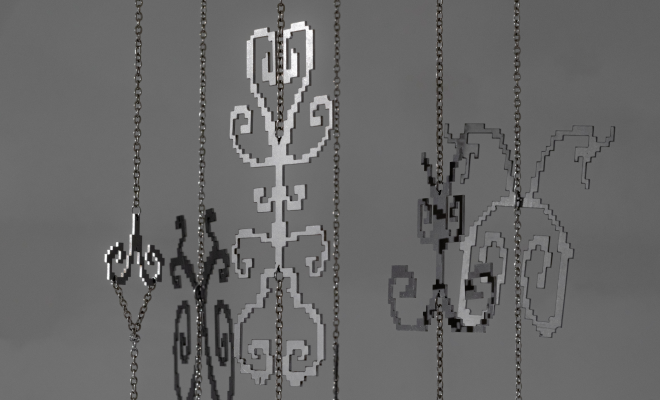
The home’s eclectic design appropriates and freely recombines Gothic, ornamental, pixelated, and folkloric motifs into a desaturated interior that feels both soothing and unsettling. The furniture and decorations function as unfaithful reproductions of historical forms that have characterised spaces of withdrawal as sites of belonging or exclusion within the social order: a remix of past materiality evoked through silhouetted images, stripped of texture and depth. Behind the walls of the home, confidential communal gatherings take place; radio waves carry stories and reflections on the histories and alternative destinies of “girls”, while the newspaper circulates accounts of coping and resistance strategies within online cultures.
The retirement home is a refuge, a community, a fantasy, a potential trap, and a site of experimentation. The “girls” do not withdraw to a pleasant, harmonious, or healing environment free of friction. The possibility of escaping the feedback loops of contemporary cultural production is not guaranteed; rather, it must be continually established and tested time and again. As a space of detachment, the home remains open to disorientation, the dissolution of identity, and unpredictable encounters; within the system, it seeks to persist as its other side, to remain illegible to the system itself, evading indexation.
¹ See: Véliz, C. “Expert Comment: Why cherish the analogue in a digital age?”. University of Oxford, 5 January 2026. Accessed 4 November 2026. https://www.ox.ac.uk/news/2026-01-05-expert-comment-why-cherish-analogue-digital-age; Maskell, E. “Is 2026 the year of analogue?”. Dazed, 23 January 2026. Accessed 4 November 2026. https://www.dazeddigital.com/life-culture/article/69449/1/is-2026-the-year-of-analogue-tiktok-trend-social-media-offline; Bakhtiari, K. “Why Offline Is The New Luxury”. Forbes, 29 March 2026. Accessed 3 November 2026. https://www.forbes.com/sites/kianbakhtiari/2026/03/29/why-offline-is-the-new-luxury/
² Following Alex Quicho the “girl” is understood as “an operative entity and a technology of subjectivity” within technological systems. By appropriating their codes and strategically operating within their mechanisms, she can also develop unpredictable tactics of survival, evasion, and destabilisation. See: Quicho, A.“Girl Intelligence”. Accessed 3 November 2026. https://girl-intel.cargo.site/
Workshops
Olja Simčič Jerele and Lucija Klauž
We’re Tired, but We’re Still Generating Discourse
Friday, 27 November 2026, 16:00 to 18:00
Aksioma | Project Space, Ljubljana
Free admission, registration required at the exhibition.
Recommended in cases of cognitive exhaustion and acute TikTok intellectualism.
We’re tired, but we keep chewing over and grinding down theoretical texts and assembling them into points that can be delivered in thirty seconds. Even when we’re no longer thinking about anything, we feed the algorithm with thought. Are we resisting the system through in-depth reflection, or plugging into the dominant discourse, creating an illusion of understanding, an atmosphere of social critique and producing engagement?
In the workshop, we will take on the role of a content creator who explains philosophical concepts through TikToks, Shorts or Reels by applying them to pop culture phenomena or online trends, but we will do it in analogue. We will cut sentences and phrases out of printed articles and assemble them into punchy, relatable and engaging takes. We’ll provide prompts to respond to by collaging academic texts, but you’re welcome to bring your own. The collages will not be posted anywhere; they will stay on the notice board in the home’s common space.
Olja Simčič Jerele and Lucija Klauž are the founders of Tudi bralni krožek, a space for collective reading and critical discussion of theory in an accessible and relaxed way. The circle is for anyone interested in contemporary art who finds theoretical texts hard to tackle alone.
Iva Suhadolnik Gregorin
Stretching Time
Tuesday, 1 December 2026, 16:00 to 18:00
Aksioma | Project Space, Ljubljana
Free admission, registration required at the exhibition.
Recommended in cases of chronic dream deficiency.
Come tired or half-awake, still carrying the shape of the day. Lay yourself down. Not to escape, but to remember: rest is not a pause but the whole point. A luxury that is always available if we give ourselves permission. There is no rush and time is not scarce here, it’s endless. Here, in this oasis, the revolution will not be mobilised; it will be horizontal and stretched out. Feel the seconds slow to a syrup-thick drip, and watch them widen into a vast, shimmering lake. Take a nap if you need to. Dream if you want. Stay awake and watch the ceiling turn soft. The most you can do for yourself and the planet and everyone on it is to dream.
Iva Suhadolnik Gregorin is a conceptual and visual artist who works across performance, photography, and text. Her work interrogates questions of labour, identity and power structures, while simultaneously reaching toward the magical and metaphysical. She merges her emotional and personal landscape with the political, arguing they are undeniably intertwined. Her practice serves as an opportunity to create temporary spaces that emerge as invitations for emancipation and (or) a catalyst for dismantling the work ethic. She graduated from the Academy of Visual Arts (AVA) in Ljubljana in 2023, has had solo exhibitions at Galerija Fotografija, GT22, DobraVaga and FBunker, and has performed in Ljubljana, London, Yerevan, Budapest and Massarosa.
Kara Marušič
I’m geriatric, I love a trinket, I love a craft
Wednesday, 6 January 2027, 16:00 to 18:00
Aksioma | Project Space, Ljubljana
Free admission, registration required at the exhibition.
Recommended for preserving the memory of communal practices displaced by hobbies turned side hustles.
In this workshop, we will make small pillows filled with lavender and rice, to rest on our chests or place over our eyes. We will use basic sewing techniques and, for a little while, unplug and devote ourselves to handwork. Sewing in a circle recalls the communal knowledge from which technology itself is woven: the memory of the first computers was woven by hand by women, wire by wire, though history prefers to keep quiet about it. Today, as platforms entangle us in algorithmic loops where every hobby is potential content and every object a potential product, sewing a simple pillow that we won’t sell is a quiet subversive practice.
Kara Marušič is an artist, critic and curator whose practice explores the conditions of making art from home. She holds a BA from Academie Minerva in Groningen (NL) and is currently completing her postgraduate studies at the Academy of Visual Arts (AVA) in Ljubljana. She has had solo exhibitions at DobraVaga gallery (2025) and the Glass Atrium of Ljubljana City Hall (2026).
Aljaž Zupančič and Miona Topalović
Lullaby without Eavesdropping
Thursday, 7 January 2027, 16:00 to 18:00
Aksioma | Project Space, Ljubljana
Free admission, registration required at the exhibition.
Recommended for nervous systems wired to the feed, and for disrupted sleep rhythms.
ASMR is a genre platforms use to lull us to sleep, so that we stay on them while we sleep. Here we return it to the body. The workshop is an actual sound bath, a lullaby in the form of a ritual that will immerse us in sine waves in Colundi tuning and leave us to whispers and small sounds. Angel Tuners tuning forks will also ring out. I don’t have any disorders, these are symptoms of being an angel. The ritual promises no optimisation. It offers silence, boredom and room to daydream.
Aljaž Zupančič and Miona Topalović are academically trained musicians. Aljaž completed his studies in musicology in Ljubljana, and Miona studied violin in Mannheim. Since moving to Kočevje, they have devoted themselves to exploring sound, deep listening and its potential for relaxation and wellbeing. They perform their sound baths under the name Prva pesem.
Matej Mali
Create Mode Confessional
Friday, 8 January 2027, 16:00 to 18:00
Aksioma | Project Space, Ljubljana
Free admission, registration required at the exhibition.
Recommended for anyone in need of a confidential space the algorithm can’t see.
Create Mode Confessional is a workshop in which, given the unsuitability of intermediary platforms, we will imagine other ways of creating a space for sharing worries. Following an essayistic analysis of Instagram’s Create Mode feature, a presentation of examples of its use and an interview with an expert user, we will form a closed, confidential space in a circle. In the style of Create Mode confessions, we will anonymously write down what is weighing on us on prepared forms (one thought, one form) and drop them into a plexiglass box in the middle of the circle. After a break, we will read the thoughts together and destroy the forms one by one by feeding them through a paper shredder. With this, and with the privacy we establish (the rule of the circle is that the worries spoken stay among the participants and, most importantly, are not shared on platforms), we’ll keep our diary-like confessions out of the platforms’ hands and think about spaces where they can live beyond them.
Matej Mali is a social and cultural anthropologist working in multimodal anthropology. He is interested in the intersection of art and science, particularly in questioning research methods, alternative forms of academic writing and online behaviour. He is a member of Skorja, a group for multimodal and experimental anthropology, and editor of the Multimodal Anthropology section of the journal Svetovi / Worlds. His project The Most Rested Person in the World was presented in a solo exhibition at DobraVaga Gallery.
THE AUTHOR

Beti Frim aka Pixel Bambi (2001) is a multidisciplinary artist working across installation, audiovisual media and web-based work, with music as a parallel thread. Her practice engages with girlhood as a structural position, desires and exhaustions under platform capitalism, and coexistence with non-human entities. Approaching internet vernaculars as a contemporary form of folk culture, she creates speculative environments, institutions and rituals, often developed collectively.
She is finishing her MA in Video, Animation and New Media at the Academy of Fine Arts and Design in Ljubljana (ALUO) and is currently part of the Information Architecture & Intelligence Design certificate program at The New Centre for Research & Practice. Her work has been shown at the 35th Biennial of Graphic Arts Ljubljana, BIO28, osmo/za, Mala Galerija BS and the exhibition Alteregoisms by APEX & everyoneisagirl in London, as well as online at Kunstsurfer and The Wrong Biennale. She received the IFCA award at MFRU31 and took part in the Shape+ platform. The exhibition grows out of her essay Retirement home for 20-something year old girls, published in the journal Problemi.
THE CURATOR
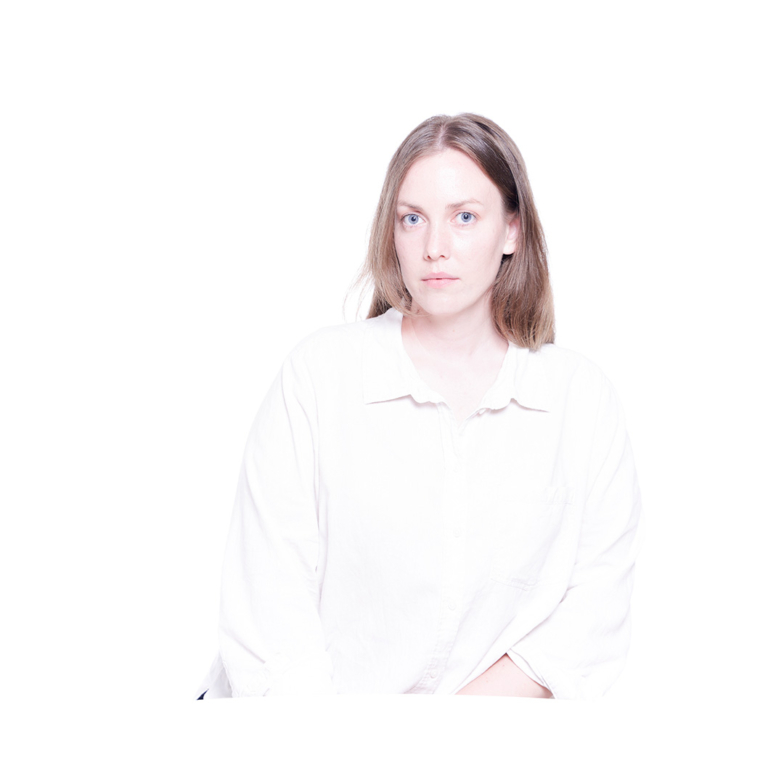
Maja Burja is a curator and producer of new media art. Her work is characterised by a critical engagement with emerging and obsolete technology and an interest in cybernetics, metafiction and emergent gameplay. She has curated and produced several art exhibitions and projects, artist residencies, lectures, workshops, meetups and festivals. She has been collaborating regularly with Ljudmila Art and Science Laboratory since 2018 and Aksioma since 2022.
CREDITS
Artist: Beti Frim
Curator and author of the text: Maja Burja
Authors of theoretical (sound) excerpts:
Morgane Billuart, Sophie Publig, Marta Ceccarelli, Bogna Konior, Maya B. Kronic & Amy Ireland, Alex Quicho, Lea Sande, Yancey Strickler, everyoneisagirl (Ester Freider)
Authors of community events:
Aljaž Zupančič & Miona Topalović, Iva Suhadolnik Gregorin, Olja Simčič Jerele & Lucija Klauž, Matej Mali, Kara Marušič
Acknowledgements:
Matej Stupica, Jela Krečič Žižek, Nina Belak, Zala Jager, Vid Topolovec, VU3 studio UMPRUM, the metal workshop master at UMPRUM, PlechExpress, friends and family, everyone who took part in the workshops and the radio
Production: Aksioma – Institute for Contemporary Art, Ljubljana, 2026
Within the U30+ initiative supporting young artists
Financial support: Ministry of Culture of the Republic of Slovenia and the City of Ljubljana