-
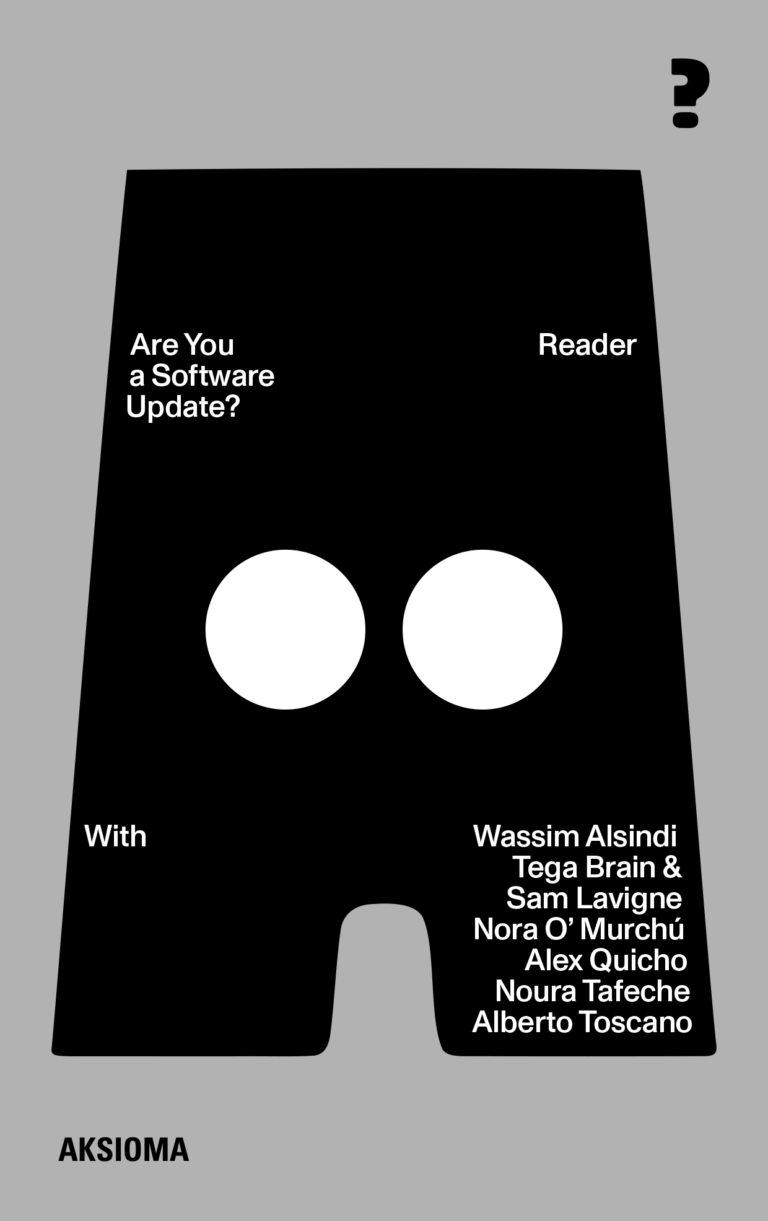
Alberto Toscano et al.: Are You A Software Update?
Not all forms of power announce themselves. Some move quietly, shaping how we feel, act and inhabit the world. Increasingly, the logic of software transforms the conditions of participation, embedding control into interfaces, automating governance through terms and conditions, and configuring compliance through algorithmic sorting, behavioural prediction and the continuous management of visibility. Are You a Software Update? brings together seven authors to examine the intensifying form of totalitarianism grounded in the quiet background logic of contemporary technology.
>ORDER -

Sophie Publig: Swiping Right on God
Swiping Right on God investigates how spirituality mutates in the age of platform capitalism. Through media theory, meme analysis and posthuman philosophy, Sophie Publig traces how angelcore aesthetics and digital mysticism reroute the internet as a sacred infrastructure, giving rise to Network Spirituality. Between post-irony and belief, kawaii semiotics disguise ideology in softness, forming an affective interface between ritualistic devotion and algorithmic governance.
>ORDER -

Alex Quicho: Girl Intelligence
The Girl is a paradox, at once hypervisible and impossible to define. Despite cultural efforts to erase or redefine her, she persists, mutating through media, politics and technology. She is not just an aesthetic persona, but an active force, capable of absorbing and subverting ideological narratives. By tracing her intertwining with AI, consumerism and gender politics, Quicho reveals the Girl’s extraordinary abilities: she can escape control and, in so doing, never truly disappears.
>ORDER -

Noura Tafeche: The Kawayoku Tales. Aestheticisation of Violence in Military, Gaming, Social Media Cultures and Other Stories
Kawayoku, a hybrid research area, explores the intersections of cuteness culture, digital warfare and the aestheticisation of violence in an era of semiotic ambiguity and post-truth. From the fetishisation of Weapons Grade Waifus and anthropomorphic warships in games like Azur Lane to the “Israeli” Defense Forces’ TikTok strategies, the essay reveals how cuteness and entertainment serve as tools of domestication, converging state-nationalism with the impish, and the uniform with the algorithm.