38 in stock

Price: 15€


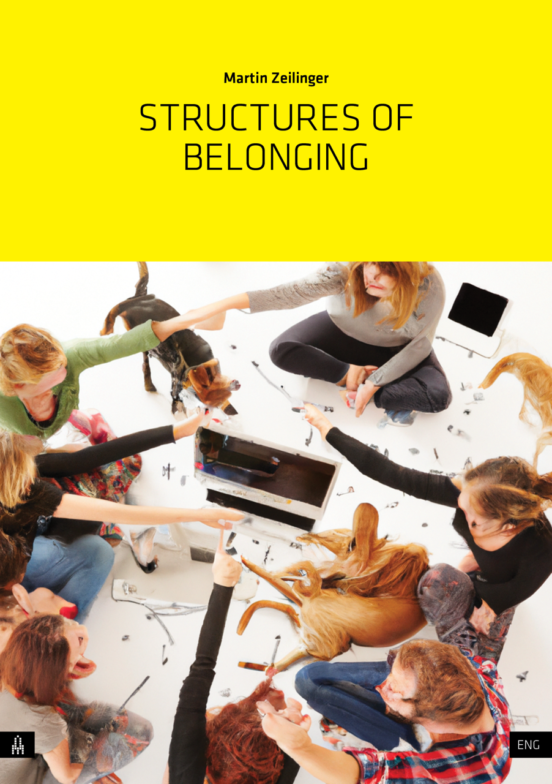
The seven essays in this book examine the desires and impulses that drive digital culture, focusing on the shift from commons to NFTs, from new forms of sharing to the expansion of private ownership and tradable commodities. They reveal just how much our culture has been transformed in the last 20 years, but also unearth surprising continuities between the commons and some of the truly experimental uses of blockchains.

Written by artists, researchers, curators and technologists from Europe, North America and East Asia, these essays bring much-needed first-hand experience and long-term perspective to the discussion.

EN | 10.5 x 16.7 cm | 120 pp | B/W | soft cover | 2022
ISBN 978-961-7173-17-8


Colophon

From Commons to NFTs
Contributors: Felix Stalder, Yukiko Shikata, Michelle Kasprzak, Denis “Jaromil” Roio, Cornelia Sollfrank, Jaya Klara Brekke, Lee Tzu-Tung

Editors: Felix Stalder, Janez Fakin Janša
Editorial assistant: Rok Kranjc
Language editors: Miha Šuštar, Cherise Fong
Japanese language consultant: Iztok Ilc
Design and layout: Federico Antonini, Alessio D’Ellena (superness.info)

Print: Collegium Graphicum
No. of copies: 300

Published by: Aksioma – Institute for Contemporary Art, Ljubljana
Represented by: Marcela Okretič
Ljubljana, October 2022

Attribution-NonCommercial-ShareAlike 4.0
https://creativecommons.org/licenses/by-nc-sa/4.0

Supported by: the Ministry of Culture of the Republic of Slovenia and the Municipality of Ljubljana

Originally published in the online magazine Makery.info between January and July 2022 in both English and French for the essay series From Commons to NFTs initiated by Shu Lea Cheang, Felix Stalder and Ewen Chardronnet. Makery is a project by ART2M, directed by Anne-Cécile Worms.
www.makery.info/en/category/from-commons-to-nfts

Related event: Tactics & Practice #13: From Commons to NFTs

Back to series

The Face of Corporate Building

FaceOrFactory
FaceOrFactory
The Face of Corporate Building

Exhibition
24 August–23 September 2022
Aksioma | Project Space, Ljubljana

Part of U30+ production programme for supporting young artists


The Face of Corporate Building is a research project that explores various strategies of formulating narratives and specific rhetorical patterns that are crucial in creating artistic NFT platforms. The process of documenting and analysing the phrases, online posts, statements of platforms and individual examples of  NFT artworks and events is designed as a video game in which the visitors gradually discover the specific economic and digital landscape as a new form of contemporary mythology in which the (human) face is ambivalently involved: on the one hand, the place of identity and representation, on the other, the front side, the face of discourses, economic transactions and political neutralisation. By collaging various pop and theoretical references and the form of trivia quizzes and appropriating the visual language of NFT platforms, the video game presents a critical reading of contemporary NFT production, while the project constantly ironically analyses the (impossible) position of its own creators, their working conditions and art practice to the formulation of the very critique of the contemporary economic market.  

THE AUTHOR
Miha Fras / Aksioma

FaceOrFactory (Aljaž Rudolf and Eva Smrekar) is an art platform that uses various approaches to explore the characteristics, the place and the functions of the (human) face in contemporary society. By harvesting DNA samples and the photogrammetry of the faces of volunteers, who become members of the FaceOrFactory corporation by donating their biological and digital material, the platform creates its own facial and informational archive, which represents the main material of its artworks. So far, FaceOrFactory’s works have been exhibited at the Kapelica Gallery, the Simulaker Gallery, Ars Electronica (Linz), Bozar (Brussels) and the 36th Youth Salon (Zagreb).


CREDITS

Author: FaceOrFactory (Aljaž Rudolf and Eva Smrekar)
3D design and animation: Jan Krek and Lara Reichmann
Music: Urška Preis (rouge-ah)
Mix: Theodor Striese
Master: Ludwig Wandinger
Music in advertisements: Gašper Torkar
Programming: Gaj Žižek

Sculpture:
Product design: Jan Krek and Lara Reichmann
Made by: Pjorkkala
Textile design: Sara Grižon

Production:
Aksioma – Institute for Contemporary Art, Ljubljana, 2022

Supported by:
the Ministry of Culture of the Republic of Slovenia and the Municipality of Ljubljana

The project was partly developed in the framework of the IMPAKT Full Spectrum Curatorship Programme

The Byzantine Generals Problem

Curated by
Domenico Quaranta

Exhibition
4 July–end of the internet
distant.gallery

Featuring works by
Anna Ridler, Ben Grosser, Constant Dullaart, DIS, FaceOrFactory, Kyle McDonald, LaTurbo Avedon, Moxie Marlinspike, Nascent, Rhea Myers, Sarah Friend, Sarah Meyohas, Simon Denny, Guile Twardowski, Cosmographia, Sterling Crispin, The Miha Artnak


An alternative to capitalism, or capitalism at its worst? An emancipatory network economy where everyone has a stake, or a dystopian panopticon where only the best man wins? An opportunity for democracy, or a techno-libertarian wet dream? A new creative economy or a pyramid scheme? A planet saver or a planet burner? Rarely has the debate around a technology been so polarized as with blockchains, web3 and NFTs. We are facing a problem of consensus, trapped within a Byzantine Generals Problem. 

Some generals are besieging Byzantium. In order to avoid catastrophic failure, they must agree on a concerted strategy, but some of them are unreliable. Used to illustrate how consensus is reached within distributed systems, this allegory can be applied to blockchains and to societies as well. Yet, in a peer-to-peer debate with no central authority, consensus is hard to reach for a reason; and the disagreeing general, the unreliable actor, may be our best resource against the common sense of the crypto-yuppies.

The Byzantine Generals Problem is an online exhibition focused on artworks which, while not avoiding to engage with blockchains and crypto culture, do it in a critically constructive way: questioning dominant narratives, raising problems, and sometimes proposing alternative solutions.


THE CURATOR

Domenico Quaranta is an art critic, curator and educator interested in the ways art reflects the current technological shift. His texts have appeared in numerous magazines, newspapers, books and catalogues. He is the author, among other things, of Beyond New Media Art (2013) and Surfing with Satoshi. Art, Blockchain and NFTs (2022) and the editor of several books, including GameScenes. Art in the Age of Videogames (2006, with M. Bittanti). Since 2005 he has curated several exhibitions, including Collect the WWWorld. The Artist as Archivist in the Internet Age (Brescia 2011; Basel and New York 2012); Cyphoria (Quadriennale 2016, Rome) and Hyperemployment (MGLC, Ljubljana 2019–2020). He lectures in Interactive Systems and is a co-founder of the Link Art Center (2011–2019).


CREDITS

The Byzantine Generals Problem

Curator: Domenico Quaranta

Authors: Anna Ridler, Ben Grosser, Constant Dullaart, DIS, Face or Factory, Kyle McDonald, LaTurbo Avedon, Moxie Marlinspike, Nascent, Rhea Myers, Sarah Friend, Sarah Meyohas, Simon Denny, Guile Twardowski, Cosmographia, Sterling Crispin, The Miha Artnak

Production:
Aksioma – Institute for Contemporary Art, Ljubljana, 2022

Realized in collaboration with and in the framework of:
distant.gallery

Supported by:
the Ministry of Culture of the Republic of Slovenia and the Municipality of Ljubljana

RELATED PUBLICATION

Domenico Quaranta
Surfing with Satoshi – Art, Blockchain and NFTs

Written amidst an explosion of technological hype and a speculative frenzy, the book sets the promise of the NFT market in a historical context, investigating the technologies it is based on, the role of certificates and contracts in contemporary art, and the evolution of the media art market over the last thirty years.

Back to series

Less Metrics, More Rando – Techniques of Resistance in a Platform World

Ben Grosser

WED, 25 May 2022
Cukrarna, Ljubljana

Today’s social media users are constantly confronted by platforms that seek to profile their interests and manipulate their emotions in order to generate never-ending profits. Yet these same platforms have become the world’s de facto communication tools, the mediums through which we connect with each other and learn about the world. How can we better understand—and thus potentially withstand—the ways these systems influence who we are and what we do? What are techniques of resistance in a platform world? This talk will examine these questions through several of the artist’s works that critically intervene in, extract from, and/or reimagine the world’s most profitable tech companies, making possible renewed opportunities for user agency over the software platforms we engage with every day.

Part of Tactics & Practice #12: New Extractivism.

Back to series

ƒ(x)=ax³+bx²+cx+d

Igor Štromajer & Sakrowski
Igor Štromajer
with Sakrowski:
ƒ(x)=ax³+bx²+cx+d

Exhibition
28 June–22 July 2022
Aksioma | Project Space, Ljubljana


Until a few years ago, it was mostly video gamers, compulsive social media users and people who, for various reasons, had to spend most of their time online that shared the feeling of living in a hybrid, material and digital reality. The pandemic has made this experience commonplace. Words that were once exotic, like augmented reality (AR) and virtual reality (VR), are now increasingly applied to our daily routine and mundane tasks and activities. As is common with digital experiences, hybrid realities have become a habit before we were even aware of them.

With its monumental and tautological representation of the possibility for inhabiting different realities, Igor Štromajer’s hybrid installation ƒ(x)=ax³+bx²+cx+d* produces and confirms this awareness and questions the different levels of perception and the ways in which the concepts of presence, ownership and accessibility relate to them.

In the installation, the central role is occupied by a 1 m³ concrete cube balanced on one of its vertices, representing the transposition into a physical space of the iconic GIF animation created by the artist in 1996 and recreated in 2021 for AR environments by art historian and curator Sakrowski.

The first two iterations of this trilogy complete the installation by materialising on the screens of visitors’ electronic devices.


* Cubic function


THE AUTHORS

Igor Štromajer, a non-amateur level para-artist – »le Pavarotti du HTML« (Libération) – researches tactical a=tF², intimate guerrilla, and traumatic low-tech communication strategies. He has shown his work at more than two hundred fifty exhibitions in more than sixty countries (transmediale, ISEA, EMAF, SIGGRAPH, Ars Electronica Futurelab, V2_, IMPAKT, CYNETART, Manifesta, FILE, Stuttgarter Filmwinter, Hamburg Kunsthalle, ARCO, Microwave, Banff Centre, Les Rencontres Internationales, The Wrong – New Digital Art Biennale and in numerous other galleries and museums worldwide) and received a number of awards (in Frankfurt, Hamburg, Dresden, Moscow, Belfort, Madrid, Maribor, Podgorica). His net art works form part of the permanent collections of the prestigious art institutions, among them Le Centre national d’art et de Culture Georges Pompidou – Musée national d’art moderne, Paris, France; the Museo Nacional Centro de Arte Reina Sofía, Madrid, Spain; Computerfinearts – net and media art collection, New York, USA; Maribor Art Gallery, Maribor, Slovenia. As a guest artist he lectures at universities and contemporary art institutes. MORE

Sakrowski holds a master’s degree in art history and works as a freelance curator in Berlin. From 1999 to 2003 he curated and organised exhibitions and lectures on net art as part of the project netart-datenbank.org. From 2007 to 2009 he worked as a freelance researcher on the “Net Pioneers 1.0” research project at the Ludwig Boltzmann Institute Media.Art.Research in Linz. Since 2007 he has been working intensively on the web.video phenomena under the name CuratingYouTube.net and has presented his own video online tool gridr.org (2012). In 2014/15 he worked for the transmediale festival “capture all” as curator. Since October 2016 he has been managing and curating the panke.gallery in Berlin-Wedding. He is a founding member (2019) of the Zentrum für Netzkunst Berlin.


CREDITS

Author of concrete cube and animated gif: Igor Štromajer
Authors of AR cube: Štromajer & Sakrowski

Production of the concrete cube:
Aksioma – Institute for Contemporary Art, Ljubljana, 2022
Manufacturer: Samo Kralj

Production of AR cube:
openAR – Augmented Reality Platform, Berlin, 2021

Production of animated gif:
Intima Virtual Base – Institute for Contemporary Art, Ljubljana, 1996

Production of the exhibition:
Aksioma – Institute for Contemporary Art, Ljubljana, 2022

Supported by:
the Ministry of Culture of the Republic of Slovenia and the Municipality of Ljubljana

Special thanks: Anja Planišček, Irena Pivka and Vlado G. Repnik

Back to series
PostScriptUM #43

The Great Algorithm

Valentina Tanni

This article is only available on Lulu.com


PostScriptUM #43

Valentina Tanni
The Great Algorithm


The works of US-based artist and programmer Ben Grosser have defined, revealed and defused how software activates the desire for more, as it follows the growth-obsessed corporate culture of Silicon Valley. His most recent project – presented at Aksioma Project Space – is the outcome of a new experiment that aims to generate “Software for Less”: less profit, less data and fewer users. It provides users with new tools to resist these tendencies and keep their agency in the digital era: a time where automated software systems increasingly take over every aspect of human existence, pushing the users to develop new tactics of resistance. In her essay, art historian, curator and lecturer Valentina Tanni discusses many of these spontaneous tactics to cheat the Great Algorithm used by social networks: some of these aim to reach more visibility, some aim to hide, some to invent a new language, some to exploit entropy. However weak and sparse, they represent a genuine and creative form of everyday survival.

EN | 14.8 x 21 cm | 17 pp | COLOUR | soft cover | 2022
ISBN 978-961-7173-14-7 (Printed)
ISBN 978-961-7173-15-4 (Digital)


Colophon

Valentina Tanni
The Great Algorithm

PostScriptUM #43
Series edited by Janez Fakin Janša

Publisher: Aksioma – Institute for Contemporary Art, Ljubljana
Represented by Marcela Okretič

Proofreading: Miha Šuštar
Design: Luka Umek
Layout: Sonja Grdina

Cover image: Ben Grosser, Go Rando, 2017

(c) Aksioma | All text and image rights reserved by the authors | Ljubljana 2022

Print on demand: Lulu.com

Supported by the Ministry of Culture of the Republic of Slovenia and
the Municipality of Ljubljana

Part of Tactics & Practice #12: New Extractivism

Price: 24€


The craze for Non-Fungible Tokens (NFTs) that erupted in early 2021 thrust the art world into the debate on the blockchain, the decentralised public ledger that holds these tokens, as well as cryptocurrencies, and promises to make “verifiable digital scarcity” a reality. Born out of the 2008 financial crisis and seen by many as the cornerstone of a new, more private, more secure Web3, the blockchain has changed the global economy and is now reshaping the digital environment in which art is increasingly being created, distributed and exchanged. Written amidst an explosion of technological hype and a speculative frenzy, Surfing with Satoshi sets the promise of the NFT market in a historical context, investigating the technologies it is based on, the role of certificates and contracts in contemporary art, and the evolution of the media art market over the last thirty years. Riding the wave of the ongoing debate, the book tackles a series of as yet open questions, including: what does art have to do with the blockchain? Does it make sense to talk about “Crypto Art”, and if so what can be said to define it, apart from the way it is traded? Is speculation the be-all and end-all of this trend? How on earth can an infinitely reproducible digital file be deemed “unique”? Will the blockchain’s promise of disintermediation destroy the art world as we know it? And how is the art world reacting to the situation? Are NFTs an opportunity for artists or a scam perpetrated against them? Who are the collectors willing to pay millions for a certificate of authenticity, and why are they doing it? And why do the visual arts seem to have acquired such a central role in the crypto economy?

EN | 10.5 x 16.7 cm | 384 pp | B/W and 1/32 colour | soft cover | 2022
ISBN 978-961-7173-12-3


Colophon

Author: Domenico Quaranta

Editor: Janez Fakin Janša
Translator and language editor: Anna Carruthers
Editorial assistant: Neža Oder
Design and layout: Federico Antonini, Alessio D’Ellena (superness.info)
Printer: Cicero d.o.o.
No. of copies: 300

Published by: Aksioma – Institute for Contemporary Art, Ljubljana
Represented by: Marcela Okretič
© Domenico Quaranta
© Aksioma
Ljubljana, April 2022

Originally published in Italian as: Surfing con Satoshi. Arte, blockchain e NFT
ISBN 9788874903030
© Domenico Quaranta
© Postmedia Srl
Milan, 2021

Supported by: The Ministry of Culture of the Republic of Slovenia, the City of Ljubljana

Related event: The Byzantine Generals Problem

Back to series

Post Growth

DISNOVATION.ORG

WED, 20 April 2022
Cukrarna, Ljubljana

What ideological, social and biophysical factors precipitate the current environmental crises? What agency is available for transformative practices and imaginaries to redefine how we satisfy our energy and material requirements and avert large scale ecosystemic breakdown?

Post Growth invites us to challenge the dominant narratives about growth and progress, and explore the radical implications of various artistic prototypes, like an economic model based on energy emitted by the Sun. This speculative research provides perspectives for a shift away from the overexploitation of fossil fuels on which the reproduction of our societies mainly depends today. Post Growth re-envisions the social metabolism through an understanding of the energy it requires. It aims to reconsider the critical dimension of living and material activities of the biosphere, drawing on ecofeminism, indigenous knowledge, environmental accounting and historical materialism.

Post Growth is an invitation to a collective and practical examination of our shared future, examining the notion of growth, in its many facets and implications, and testing the limits of technology, of politics and of our imaginations.

Part of Tactics & Practice #12: New Extractivism.

Back to series
PostScriptUM #42

No One Has Ever Produced Anything

Clémence Seurat, Dušan Kažić

This article is only available on Lulu.com

French edition


PostScriptUM #42

Dušan Kažić, Clémence Seurat
No One Has Ever Produced Anything

As part of the art-science research project Post Growth, initiated by the DISNOVATION.ORG – a working group aiming to question the dominant techno-positivist ideologies – Clémence Seurat spoke with French researcher Dušan Kažić. Kažić, a plant anthropologist who has studied the many types of relationships that farmers form with the plants they grow, invites us in this conversation to imagine agriculture and a world without production. The misconception that humanity cannot live without production is deeply rooted in our societies and has the status of common sense. Through the concept of production, economists deanimate living beings in order to make a resource out of them. Thus, we can begin to move away from production by animating living beings in order to maintain relationships with them and live with them. We live in an era of seeking ways of living with plants instead of producing to live. We need a new type of materialism that does not neglect other beings.

EN | 14.8 x 21 cm | 22 pp | COLOUR | soft cover | 2022
ISBN 978-961-7173-08-6 (Printed)
ISBN 978-961-7173-10-9 (Digital)

FR | 14.8 x 21 cm | 22 pp | COLOUR | soft cover | 2022
ISBN 978-961-7173-07-9 (Printed)
ISBN 978-961-7173-09-3 (Digital)

French edition


Colophon

Dušan Kažić interviewed by Clémence Seurat
No One Has Ever Produced Anything

PostScriptUM #42
Series edited by Janez Fakin Janša

Publisher: Aksioma – Institute for Contemporary Art, Ljubljana
Represented by Marcela Okretič

Translation: Ethan Footlik
Proofreading: Baruch Gottlieb
Design: Luka Umek
Layout: Sonja Grdina

All images: DISNOVATION.ORG, Life Support System (Ecosystem Services Estimation Experiment, part of the art-science research project Post Growth, 2018–ongoing)
pp. 19-21

Photo: Ars Electronica / Martin Hieslmair

(c) Aksioma | All text and image rights reserved by the authors | Ljubljana 2022

Supported by the Ministry of Culture of the Republic of Slovenia and
the Municipality of Ljubljana

Part of Tactics & Practice #12: New Extractivism

Back to series

Flat Fiat

The Miha Artnak
The Miha Artnak
Flat Fiat

Exhibition
THU, 14 April 2022, 6 PM–10 PM
Aksioma | Project Space, Ljubljana

In the framework of the programme:
Is the Future Going to be Encrypted?


Crypto is about banking the unbanked, and unbanking the banked. It’s attempting to usher in a more equitable financial system and open, free markets. 

Bankless

Flat Fiat, a collection of 137 fiat coins flattened by train, scanned and minted as a unique NFT, is made for numismatists, art collectors, DeFi and DAO communities that want to change the base currency to decentralized crypto and accelerate the monetary revolution. 

The artist The Miha Artnak believes that the NFT artworks of fiat coins removed from circulation declare the beginning of a new era of decentralized finance.

One of the ways to prevent hyperinflation is reducing the production of currency (coins and printed bills). The other is altering the currency basis. One form this may take is the use of a decentralized currency as a medium of exchange.

The exhibited physical fiat coins that were removed serve as physical documentation and proof of burning. 

Anything can be money as long as it fulfills these fundamental use cases: a unit of account, a medium of exchange, and a store of value.

Fiat money can sometimes be destroyed by converting it into commodity form, rather than completely forfeiting the value of the money. Sometimes, currency intended for use as fiat money becomes more valuable as a commodity, usually when inflation causes its face value to fall below its intrinsic value. For example, in India in 2007, Rupee coins disappeared from the market when their face value dropped below the value of the stainless steel from which they were made.

THE AUTHOR
Bence Pribojszki

The Miha Artnak is a Ljubljana-based artist, activist, and entrepreneur, active since the 2000s. His satirical paintings, environmental installations, and subversive performances make him one of the most talked-about artists of the last decade.


CREDITS

Author: The Miha Artnak

Production of the event:
Aksioma – Institute fot Contemporary Art, Ljubljana, 2022

In the framework of the programme: Is the Future Going to be Encrypted?

Supported by:
the Ministry of Culture of the Republic of Slovenia

Back to series

Dissecting New Extractivism

Vladan Joler

WED, 16 March 2022
Cukrarna, Ljubljana

In this talk, researcher and artist Vladan Joler dissects the various layers of the superstructures that underlie new extractivist practices. Step by step, from the gravity fields of the Internet black holes to the architecture of our personalised prison caves to the design of the numerous parts of the engines of extractivism, Joler takes us through the different allegories and concepts presented in his recent animated movie, map and essay The New Extractivism. The work illustrates various aspects of this prison in 33 chapters that each explore a different theoretical concept related to the topics of power, control, digital labour, colonialism and exploitation of nature, among others. In that sense, this lecture is a cognitive and visual rollercoaster designed to help us understand the complexities enabling the new structures of power hidden behind the screens on our devices.

Part of Tactics & Practice #12: New Extractivism.

Back to series
PostScriptUM #41

Escape Velocity. Computing and the Great Acceleration

Felix Stalder

This article is only available on Lulu.com


PostScriptUM #41

Felix Stalder
Escape Velocity. Computing and the Great Acceleration


Ever since 1990, computing has been opening up entirely new types of resources for extraction. In the digital context, the notion of extractivism points to the fact that “data is taken without meaningful consent and fair compensation for the producers and sources of that data”. Felix Stalder, professor of Digital Culture at the Zurich University of the Arts, points out that computing has boosted the great acceleration of human activities that has moved the Earth system into the Anthropocene. If we are to prevent the deeply authoritarian responses to the impending climate breakdown, we should unveil the colonialist character and the consequences of the current system of extractivism. This is what makes Vladan Joler’s work so urgent. New Extractivism, presented at Aksioma (Ljubljana), gives an insight into the world-scale infrastructure designed to collect, analyse and connect all aspects of reality and turn them into capital, which, in turn, gives rise to new accumulations of wealth and concentrations of power.

EN | 14.8 x 21 cm | 18 pp | COLOUR | soft cover | 2022
ISBN 978-961-7173-01-7 (Printed)
ISBN 978-961-7173-04-8 (Digital)


Colophon

Felix Stalder
Escape Velocity. Computing and the Great Acceleration

PostScriptUM #41
Series edited by Janez Fakin Janša

Publisher: Aksioma – Institute for Contemporary Art, Ljubljana
Represented by Marcela Okretič

Proofreading: Miha Šuštar
Design: Luka Umek
Layout: Sonja Grdina

Cover image: knowbotiq, Swiss Psychotropic Gold, the Molecular Refinery, 2020

(c) Aksioma | All text and image rights reserved by the author | Ljubljana 2022

Print on Demand: Lulu.com | www.lulu.com

Supported by the Ministry of Culture of the Republic of Slovenia and
the Municipality of Ljubljana

Part of Tactics & Practice #12: New Extractivism

Price: 0€


This publication is a collection of transcripts of eight interviews that journalist Marta Peirano conducted with world thinkers as part of the (re)programming – Strategies for Self-Renewal.

As a growing population is sharing an ever-shrinking planet, we have found ourselves at an existential crossroads: do we bring the mistakes of the enlightenment and industrialization to their logical conclusion or should we develop a capacity to reprogram ourselves as a species in order to survive? Some of the solutions might be technical, but most of the obstacles are not. Through surveillance, manipulation and escapism, multinationals and foreign governments are using the powerful tools that could help us manage the climate emergency to manage us instead. The apocalyptic narratives of destruction, natural selection and space colonization distract us from the urgent need to manage our resources and mitigate a disaster.

What will it take for humanity to change its course and build a responsible future for the generations to come?

This reader seeks answers to these questions by focusing on solutions, finding tools, words and visions across disciplines, from energy and infrastructure to community building and AI.

EN | 10.5 x 16.7 cm | 240 pp | B/W | soft cover | 2022
ISBN 978-961-7173-00-0


Colophon

(re)programming: Strategies for Self-Renewal [a reader]
Contributors: Marta Peirano, Kim Stanley Robinson, Lučka Kajfež Bogataj, Luka Omladič, Ida Hiršenfelder, James Bridle, pinchito, Navine, Sinan, Benjamin Bratton, Miha Turšič, Miloš Kosec, Marko Bauer, Michal Owczarek, Peter Purg, Jiska Morgenthal, Holly Jean Buck, Senka Šifkovič Vrbica, Borut Tavčar, Rok Kranjc, net0, laura, zoe, Anab Jain, Špela Petrič, Saša Špačal, Anja Planišček, nikamahnic, mata, jana, Kate Crawford, Nika Mahnič, Sanela Jahić, Lenart J. Kučić, anja_arih, Adam Harvey, Siri, Joana Moll, Luka Frelih, Filip Muki Dobranić, Dušan Caf, Paul, useruser, Hope Jordan, Astra Taylor, Asja Hrvatin, Barbara Rajgelj, Tjaša Pureber, Bernadette Buckley, Zarja, Dejan, Eyal Weizman, Urška Henigman, Matevž Čelik, Marko Peljhan, Bernadette Buckley, Micah J., RF.

Book editor: Janez Fakin Janša
Content editor: Marko Bauer
Language editor: Miha Šuštar
Transcriptions: Dražen Dragojević
Design and layout: Federico Antonini, Alessio D’Ellena (superness.info)

Print: Collegium Graphicum d.o.o
No. of copies: 700

Published by: Aksioma – Institute for Contemporary Art, Ljubljana
Represented by: Marcela Okretič
Ljubljana, March 2022
Co-published by: Mladinski center Velenje
Outreach partner: NERO
© Aksioma, the authors
Promotion and distribution: Sonja Grdina, Neža Oder
In the framework of konS ≡ Platform for Contemporary Investigative Art
konS is a project chosen on the public call for the selection of the operations
“Network of Investigative Art and Culture Centres”. The investment
is co-financed by the Republic of Slovenia and by the European Regional
Development Fund of the European Union.

Related event: Tactics & Practice #10: (re)programming

Back to series

Data Extraction, Materiality and Agency

Joana Moll

WED, 16 February 2022
Cukrarna, Ljubljana

Our so-called networked society has so far failed to bring the logic of interconnectedness into our lives. Citizens are becoming more machine-like and data-dependent, threatening the connection between humans and their natural habitats. Although most of our daily transactions are carried out through electronic devices, we know very little about the apparatus that facilitates such interactions, or in other words, the factory behind the interface. In this talk, we discuss the interface as a well-engineered capitalist machine that disconnects users from the material complexity of global chains of commodity and data production – and also social reproduction – in order to maximise economic profit. It is therefore necessary to trace the connections that exist between things – as well as the workload involved in the basic maintenance of these connections – if the user is to fully understand the systems in which they operate, in order to balance and repair the profoundly asymmetrical distribution of agency, energy, labour, time, care and resources within these planetary networks.

Part of Tactics & Practice #12: New Extractivism.

Back to series
PostScriptUM #40

Analysis, Exposure and Addition: The Aesthetic and Ecological Logics of Joana Moll’s Carbolytics

Matthew Fuller

This article is only available on Lulu.com


PostScriptUM #40

Matthew Fuller
Analysis, Exposure and Addition: The Aesthetic and Ecological Logics of Joana Moll’s Carbolytics


Despite their ubiquity and relevance, data collection practices remain opaque and their carbon footprint has rarely been investigated. What is more, data collection is a key resource in the global supply chain of AdTech, the primary business model of the data economy system. The Carbolytics project, developed by artist and researcher Joana Moll in collaboration with researchers from the Barcelona Supercomputing Centre, is a way of understanding the collective existence of cookies and their role in the outsourced production of carbon dioxide. The interactive web-based installation shows the average global volume of cookie traffic in real time and demonstrates how cookies parasitize user devices to extract not only personal data but also energy. Or, in the words of Matthew Fuller: in digital capitalism, the myth of the invisible hand of the market has been replaced by the reality of the partially visible cookie.

EN | 14.8 x 21 cm | 14 pp | COLOUR | soft cover | 2022
ISBN 978-961-95437-7-1 (Printed)
ISBN 978-961-95437-8-8 (Digital)


Colophon

Matthew Fuller
Analysis, Exposure and Addition: The Aesthetic and Ecological Logics of Joana Moll’s Carbolytics

PostScriptUM #40
Series edited by Janez Fakin Janša

Publisher: Aksioma – Institute for Contemporary Art, Ljubljana
Represented by Marcela Okretič

Proofreading: Miha Šuštar
Design: Luka Umek
Layout: Sonja Grdina
Text commissioned by: Sónar+D Barcelona and Aksioma

Cover image: Joana Moll

(c) Aksioma | All text and image rights reserved by the author | Ljubljana 2022

Print on Demand: Lulu.com | www.lulu.com

Supported by the Ministry of Culture of the Republic of Slovenia and
the Municipality of Ljubljana

Part of Tactics & Practice #12: New Extractivism

Carbolytics is an Aksioma commission realised within the framework of konS – Platform for Contemporary Investigative Art

Live, Laugh, Love

Exhibition
25 January–20 February 2022
Kresija Gallery, Ljubljana

6–27 May 2022
City Gallery, Nova Gorica

Artists
Dan Adlešič, Sara Bezovšek, Lea Culetto, Olja Grubić, Emil Kozole, Tamara Lašič Jurković, Danilo Milovanović, Iza Pavlina, Iris Pokovec, Dorotea Škrabo – Skrabzi

Curators
Jure Kirbiš & Janez Fakin Janša

Part of U30+ production programme for supporting young artists


Live, Laugh, Love is a slogan of the society of positive thinking, positive affirmations and manifestations, a society that rejects all criticism as an attack on the human right to exist in peace. It is pulling the wool over the eyes, a passive-aggressive form of censorship, a new conservatism. In her text Conflict Is Not Abuse, Sarah Schulman draws attention to the increasing misuse of the rhetoric of “being attacked” to avoid accountability on a personal and political level. Rather than confronting legitimate (self-)criticism, it is often met with (self-)punishment, denial, scapegoating. Similarly, to claim that merely to live, laugh and love is the answer to the myriad of daily personal and social trials is at best a self-preserving delusion, or worse,  a devaluation of one’s own agency and a method of maintaining docility. In an age fertile for conspiracy theories of all kinds, one might conspiratorially ask who it serves to have the slogan Live, Laugh, Love omnipresent in our various realities, from a  coffee cup to social media. Or, to put it another way: if capitalism is so great, why then is everyone on Xanax?

Live, Laugh, Love showcases the work of ten artists on the spectrum of the millennial generation who would like to simply live, laugh and love, but their curiosity won’t let them. Faced with the threat and absurdity of reality, they each, in their own way, cope with conditions that do not allow them to live in blissful ignorance. Sara Bezovšek’s didactic collection of pop culture references and other internet resources is about the exploitation of people and nature, which is almost without exception the unstable foundation of a seemingly utopian society. Olja Grubić’s pop-up book is a tribute to the resilience of nature and a call for the ossification of urban fissures. Danilo Milovanović’s granite cube, presented in a museum-like manner, is a call for “direct action” and a commentary on the relationship between art and political activism. Lea Culetto’s handbag and outfit set addresses the question of the true price of fast fashion. Iris Pokovec’s toilet water tests the limits of the capacity of marketing presentation. Through the matrix of an LED screen, Emil Kozole gives political literacy to a new working class of artificial intelligence. Tamara Lašič Jurković’s meditation is not an escape into oneself, but a postulate on the inevitability of coexistence. Dorotea Škrabo – Skrabzi teaches how to experience a break on the internet and succeed while doing so. Iza Pavlina demonstrates the alchemical power of the artist’s authority to turn the abject into an object. Dan Adlešič’s vase is a playful synthesis of technological innovation and the DIY principle.

The works were produced by Aksioma Institute for Contemporary Art in 2021 for Sebastian Schmieg’s Gallery.Delivery project. In 2018, the German artist conceived the format of a group exhibition to be ordered online: an individual or company places the order and the exhibition, packed in a white cubic backpack, is delivered to the client by a bicycle courier who sets it up, presents and dismantles it in an hour and a half. The host can also buy the works. The size of the individual projects was dictated by the fact that the works travelled together in a 45 x 45 x 45 cm white cube. Most of the works are thus smaller or use mainly performative and interactive approaches to fill the space. In the current exhibition at Kresija Gallery, the works have been moved from the white cube of the courier’s backpack to the white cube of the gallery space, where they are on view for the first time to the general public. The move has changed the character of the exhibition and the works in it, but still retains the commercial component, as the free works – others are already in private collections – can also be purchased. Swap the repressive message of the Live, Laugh, Love wall sign for one of the anxious-joyful artworks in the exhibition!

THE AUTHORS

Dan Adlešič is an artist, designer and conductor of short circuits – moments when fiction and reality align and fuse.

Sara Bezovšek is a visual artist, active in the fields of graphic design, new media and experimental film. In her work she researches, stores and collages the visual references she encounters while browsing online and watching movies and TV series. Through appropriation she creates new narratives on what kinds of content people consume, what they share on social media, how visual material is broadcast on the internet, and how it changes and affects users in different contexts.

Lea Culetto is a feminist artist whose practice is mainly focused on personal experience. She uses embroidery, assemblage and mixed media to create objects and installations that challenge notions of “femininity” and feminism through the prisms of fashion, the gaze and the body.

Olja Grubić is a visual artist and performer whose practice is mainly focused on the basic conditions of existence. By staging her own body, she explores the possibilities of freedom within the patriarchal and capitalist oriented society. She puts herself into an “engaged” position and often uses elements of humour and satire to cut into the structure of everyday life.

Emil Kozole is a designer who works in the context of socio-political structures. He focuses on the use of graphic design as a form of investigation in fields such as internet identity, digital surveillance and emerging technologies. Much of his artwork has been commissioned and exhibited internationally and featured in magazines such as Wired, Le Monde and Der Spiegel.

Tamara Lašič Jurković is a transdisciplinary designer focusing on societal and environmental issues of the 21st century and the role of design in their consideration. Her practice is based on the principles of regeneration, posthumanism and speculative design.

Danilo Milovanović is an artist based in Ljubljana. Creating situations that speak for themselves while producing complex meanings in simple ways is a significant feature of his work. His choices of medium and approach are always defined by ideas, mostly related to the production of urban spaces and everyday social dynamics. These temporary actions are often post-produced in a studio and presented as video installations, documentary movies or physical artwork.

Iza Pavlina concluded postgraduate studies in painting at the Academy of Fine Arts and Design in Ljubljana in 2017, after having received an award for special achievements there in 2015. In her work she often creates fictitious identities with which she enters various contexts and spaces to explore certain economic and social systems and the power relations and occurrence of social anomalies within them.

Iris Pokovec is a visual artist based in Ljubljana. Since 2017, all her art production is conducted through her own art brand Menažerija, under which she produces contemporary curiosities built upon (and using) the language and tools of today’s consumerist pop culture. Her practice consists primarily of painting and print-based media with a focus on the relationship between present-day consumer plastics, 21st-century marketing slogans and contemporary pop nihilism.

Dorotea Škrabo – Skrabzi is a visual artist, designer and social media entertainer who primarily deals with the phenomenon of photography and video on the internet. Her research is focused on new media, popular culture and art, especially through the limitations of social networks. She regularly produces short online videos where she develops a critical relation towards popular trends.

THE CURATORS

Jure Kirbiš is a curator of contemporary art who lives in Maribor, Slovenia. He works at UGM | Maribor Art Gallery.

Janez Fakin Janša is a conceptual artist, performer and producer. He is a co-founder and co-director of Aksioma – Institute for Contemporary Art, Ljubljana.

CREDITS

Authors: Dan Adlešič, Sara Bezovšek, Lea Culetto, Olja Grubić, Emil Kozole, Tamara Lašič Jurković, Danilo Milovanović, Iza Pavlina, Iris Pokovec, Dorotea Škrabo – Skrabzi

Production:
Aksioma – Institute for Contemporary Art, Ljubljana, 2022

Part of U30+ production programme for supporting young artists

We would like to thank the following for lending the artworks for the exhibition: Adam Giacomelli, Borut Krajnc, Iris Pokovec & Matej Tomažin, Ištvan Išt Huzjan, Jana Jovanovska, Lara Paukovič, Ljudje, Maja Bogataj Jančič, Mateja Vidmar, Mila Peršin, Moja, Nejc Šubic, Nika Oblak & Primož Novak, Olja Grubić, Peter Rauch, Sara Bezovšek, Tanja Hrovat Svetičič, Tanja Oblak Črnič & Aleš Črnič, Tatiana Kocmur & Boštjan Čadež, Urša Chitrakar, Vera Matič.

Sound editor for the project Hacked Meditation: Mauricio Valdes

Supported by:
the Ministry of Culture of the Republic of Slovenia and the Municipality of Ljubljana

Back to series

Recomposing the Web

Ben Grosser
Ben Grosser
Recomposing the Web: Tools and Techniques to Regain Agency in a Software-Driven World

Workshop
25 May 2022, 2 PM–5 PM
The Academy of Fine Arts and Design, UL, Video, Animation and New Media, Tobačna 5, Ljubljana

Registration required.

Language: English
Max. number of participants: 25

Aimed at:
art and design students, young artists, professors of visual art, new media and design, students and professionals in the fields of sociology, cultural anthropology and philosophy

Part of Tactics & Practice #12: New Extractivism
In the framework of konS – Platform for Contemporary Investigative Art


Over the last twenty years, software has enabled the web, animated the smartphone and made possible, in the words of one big tech CEO, a world “more open and connected.” Yet software, which is now used by billions across the planet every day, has embedded within it the capitalist ideologies of those who make it. Coming out of growth-obsessed entrepreneurial culture from Silicon Valley in the United States, today’s software wants what its creators want: more. This want is fundamental, driving how software works, what it does and what it makes (im)possible. The result is a global populace now dependent on software platforms that intentionally activate within users a “desire for more” – a need that software meets with its “like” counts, algorithmic feeds and endless notifications, all in the service of what big tech most seeks to realize their hopes and dreams: more users, more data and more profit. 

While periodic cries to #deletefacebook or otherwise disconnect from online platforms gains occasional waves of attention and press, few (are able to) disengage. Given this, an alternative approach is the author’s artistic strategy of “software recomposition,” or the treating of existing websites and other software systems not as fixed spaces of consumption and prescribed interaction but instead as fluid spaces of manipulation and experimentation. Through a series of software observation and online performance exercises, this workshop will introduce methods, tools and techniques of software recomposition that anyone can use to gain renewed agency over the software systems they use every day.

Takeaways
Attendees will develop:
– a critical lens on software interfaces: how do they work, why, who benefits?
– experience detecting when and how software influences us
– an understanding of “software recomposition” methods
– a set of skills/tools/techniques for regaining agency in big tech platforms

THE AUTHOR

Ben Grosser creates interactive experiences, machines, and systems that examine the cultural, social, and political effects of software. Recent exhibition venues include the Barbican Centre in London, Museum Kesselhaus in Berlin, Museu das Comunicações in Lisbon, and Galerie Charlot in Paris. His works have been featured in The New Yorker, Wired, The Atlantic, The Guardian, The Washington Post, El País, Libération, Süddeutsche Zeitung, and Der Spiegel. The Chicago Tribune called him the “unrivaled king of ominous gibberish.” Slate referred to his work as “creative civil disobedience in the digital age.” Grosser’s artworks are regularly cited in books investigating the cultural effects of technology, including The Age of Surveillance Capitalism, The Metainterface, Critical Code Studies, and Technologies of Vision, as well as volumes centered on computational art practices such as Electronic Literature, The New Aesthetic and Art, and Digital Art. Grosser is an associate professor in the School of Art + Design, and co-founder of the Critical Technology Studies Lab at the National Center for Supercomputing Applications, both at the University of Illinois at Urbana-Champaign, USA.

CREDITS

Author: Ben Grosser

Production:
Aksioma – Institute for Contemporary Art, Ljubljana, 2022

Partner:
The Academy of Fine Arts and Design, University of Ljubljana

Part of the series:
Tactics & Practice

In the framework of:
konS – Platform for Contemporary Investigative Art

The project konS:: Platform for Contemporary Investigative Art was chosen on the public call for the selection of the operations “Network of Investigative Art and Culture Centres”. The investment is co-financed by the Republic of Slovenia and by the European Regional Development Fund of the European Union.

To top