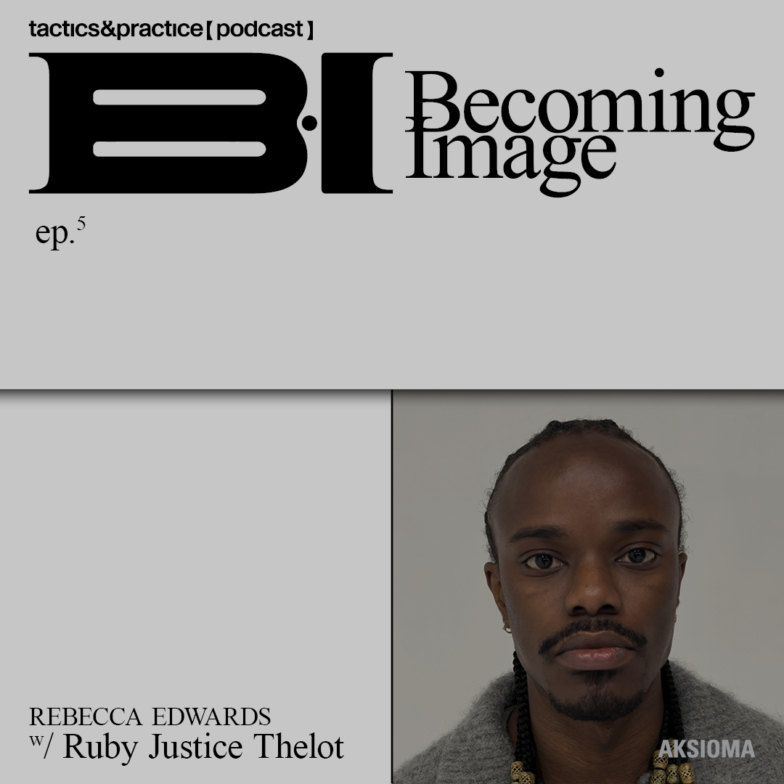
S6 [Becoming Image] E5: The image that’s tired [w/Ruby Justice Thelot]
What does it mean to have more AI generated images online than images created by humans? Should we resist constant uptime, visibility, and acceleration? And do we need to rethink reality in the age of AI when ‘default fakeness’, ‘flippening’ and ‘image amnesia’?
In the final episode, I’m joined by designer, artist and cyberethnographer Ruby Justice Thelot alongside artist Nina Davies to explore how AI image generation is reshaping the political role of images. Together we discuss the diminishing “sticking power” of images, the legal limits of photography as evidence, the long history of image manipulation, desire-driven virality, and the tactics that make real events appear AI-generated. Ruby introduces the concept of “necromimetics,” arguing that generative “slop” can neutralise an image’s capacity to enact symbolic death. We close with a conversation on marketing, trend forecasting, Meta glasses, and why “life admin” parties might be the future.
RELATED LINKS
Future Artefacts podcast
Nina Davies Image Syncers
The Western Front, Canada
Ruby’s essay for Ocular called The Death of The Image Has MAde Us Wake Up To Reality
The Treachery of Images essay
How I Learned to Stop Worrying and Love the Slop essay
Everything is Default Fake essay
Taste 101 Substack
The Commissar Vanishes by David King
Postmodernism, or, The Cultural Logic of Late Capitalism by Fredric Jameson
Mythologies by Roland Barthes
Discipline and Punish by Michel Foucault
Necropolitics by Achille Mbembe
Gramophone, Film, Typewriter by Friedrich Kittler
A Theory of Vibe by Peli Grietzer
Rijksakademie Fake exhibition
John Heartfield artist
Anthropic’s 81,000-person study
The Capture tv series on BBC
Canon 35 courtroom photography rule
COLOPHON
Host: Rebecca Edwards
Guest: Ruby Justice Thelot & Nina Davies
Recording: Rebecca Edwards
Music: Gašper Torkar
Editing: Rebecca Edwards, Janez Fakin Janša
Audio post-production: Oskar Kandare, Staš Kramar
Becoming Image podcast series
Curated by: Rebecca Edwards
Coordinated by: Janez Fakin Janša
Produced by: Marcela Okretič
Production:
Aksioma | Institute for Contemporary Art Ljubljana, 2026
Part of:
tactics&practice#17: Becoming Image
Curated by Marco De Mutiis
Supported by:
the Ministry of Culture of the Republic of Slovenia and the Municipality of Ljubljana