Lecture
In frame of Eternal September.
Free entrance
Stari trg 21, Ljubljana, Slovenia

Lecture
In frame of Eternal September.
Free entrance
Stari trg 21, Ljubljana, Slovenia

Free entrance
Stari trg 21, Ljubljana, Slovenija

Street action
Side programme of Eternal September.
Exhibition
2–26 September 2014
ŠKUC Gallery, Ljubljana
Curated by
Valentina Tanni
Featuring: Anonymous (The Game Pro), Tymek Borowski & Pawel Sysiak, Mauro Ceolin, Paolo Cirio, Paul Destieu, Electroboutique, Matthias Fritsch, Colin Guillemet, David Horvitz, Maskull Lasserre, Aled Lewis, Dennis Logan (Spatula007), Valeria Mancinelli & Roberto Fassone, Mark McEvoy, Casey Pugh et al., Steve Roggenbuck,Smetnjak Collective, Helmut Smits, Phil Thompson and Wendy Vainity (madcatlady) (*)
Eternal September is a group exhibition that aims to explore the relationship between professional art making and the rising tide of amateur cultural movements throughout the Web, a historical event that has triggered a huge, fascinating shift in every field of culture, especially the visual one. The exhibition includes works by 15 authors and artistic groups (professionals and amateurs alike) and a series of special projects and accompanying events that will take place both offline and online.
“Nothing like a little disaster for sorting things out.”
Blow-Up (1966)
“Eternal September” is a slang expression that was coined by David Fischer in a comment sent to the Usenet group alt.folklore.computers in 1994 (“September 1993 will go down in net.history as the September that never ended.”). The sentence refers to September 1993, the year in which the major providers began offering access to all their customers. Up to that time, the network population was composed mostly of university members, a group that would get a little bit bigger every year in September when a number of freshmen would enter college and have their first net access. Every time a fresh influx of “newbies” joined a network, its community had to confront their “net illiteracy” and general lack of netiquette; their behaviour was, in fact, considered annoying and potentially dangerous for the quality of content and discussion.
After 1993, this influx of new users became permanent, and this “Eternal September” is still happening today at exponential speed. Internet access, which is now global, is constantly growing, despite the well-known “digital divide” issues. This phenomenon, which transformed from a tidal wave into an unstoppable tsunami, gave birth to an enormous cultural shift.
This “access” topic needs to be addressed in a very broad sense: the opportunity to access information, as well as that to use production tools and distribution channels. Every system previously used to managing and controlling cultural production is now experiencing a deep crisis, which is also causing the inevitable collapse of all the related business models.
The ultimate consequence of this scenario is also the most radical one: the questioning of “professionalism”, an event that has been foreseen by many observers ever since the 1970s. Gene Youngblood, for instance, wrote about it in the 1982 Siggraph catalogue:
“A tool is ‘mature’ insofar as it’s easy to use, accessible to everyone, offering high quality at low cost and characterized by a pluralistic rather than singular practice, serving a multitude of values. Professionalism is an archaic model that’s fading in the twilight of the Industrial Age.”
The Eternal September exhibition also aims at highlighting another fundamental feature of the emerging cultural scenario: the speed that characterizes the production and distribution of creative content. This hectic and unstoppable circulation of ideas and digital artifacts has led many critics and journalists to use words and adjectives borrowed from biology jargon: viral contents, mind viruses, contagious media. Some also refer to a controversial scientific theory that was born in the 1970s in the context of the genetic research boom: the so-called “memetics”. This theory postulates the existence of “memes”, units of human cultural transmission analogous to genes, arguing that replication also happens in culture. In a fast and liquid environment such as the Internet, in which any content – images, sounds, texts – can be edited in real-time and fed back into the communication circuit, the metamorphic nature of any cultural product rises exponentially.
In an era like the present one, in which image production is so advanced and refined that it can be easily considered scientific matter, the amateur “look and feel” of many contemporary cultural products also seems to function as proof of authenticity, passion and enthusiasm. This attitude reminds us of what happened in the early twentieth century, when the simplicity and spontaneity of archaic and exotic artifacts was seen as an antidote to the weariness of Western culture, considered decadent and artificial. Today, the new “primitivism” coincides with the “amateur”.
This exhibition comprises a mix of artworks by professional artists and “non-professional” ones, comparing images, aesthetics and languages. A great number of contemporary artists, in fact, actively and fearlessly confront this new scenario in which the boundaries between professional art making and amateur products are increasingly blurred and intertwined. The project also aims to show how some of the aesthetic and stylistic strategies normally associated with cutting-edge contemporary art have been assimilated by popular culture that is born and happens online.Our definition of art is once again changing radically, challenging both artists and viewers, two categories that are getting more and more unstable and interconnected. Eternal September is an attempt to acknowledge the revolution that is subverting today’s visual culture, a colorful and messy catastrophe that is rapidly wiping away all our landmarks in the artscape. This show does not offer any new certainty, though. Instead, it’s an invitation to dive in together, and start figuring things out.
This group exhibition consists of a wide range of artworks, a selection that includes almost all artistic media: paintings, photographs, videos, software art, installations, performances and web-based projects. Phil Thompson (UK, 1988) addresses the complex issue of copyright with a series of oil paintings made by anonymous Chinese workers. These images are copies of the blurred artworks (hidden for copyright reasons) that we can find browsing through the virtual rooms of international museums using Google Art Project. A humorous comment on intellectual property is also present in Aled Lewis’ (UK, 1982) work, an illustration that borrows the “Not Sure If” meme to make a clever commentary on the nature of appropriation and copyright in the Internet age.
Paul Destieu’s (FR, 1982) installation My Favourite Landscape is a re-appropriation of the well-known desktop picture by Windows XP, one of the most popular images of our age, here represented in a classic bug configuration accidentally generated by a computer error. The other major installation on view is the one by Mauro Ceolin (IT, 1963). His project Memezoology focuses on the strange, viral and pervasive history of memes in a fascinating attempt to build a taxonomy of collective imagination through contemporary folk imagery. Memes are also the theme of the anonymous Nyan Cat 10 Hours Reaction Video, a crazy performance done by an Internet user known as TheGamePro, who recorded himself watching the famous Nyan Cat meme video for ten hours straight.
Somewhat in between an extended performance and a net art work, David Horvitz’ (US, 1982) Public Access project, an artist’s infiltration inside Wikipedia, is a very poetic research that deals with the issue of image circulation on the web. Similarly, but in a different form, Mark McEvoy’s (UK, 1973) work analyses the nature of image making and authorship in the contemporary age, an ongoing visual research that uses appropriation and remix as its major tools of investigation. Remix, of course, is a practice that is strong and visible in numerous artworks throughout the show, both in the main exhibition and in the collateral projects and screenings. Artomat, a software artwork by Electroboutique (RU, founded in 2005 by Alexei Shulgin, born 1963, and Aristarkh Chernyshev, born 1968), explores this issue through a system for the automated production of art, employing algorithms capable of generating images. “The viewer becomes a user-artist, creating artworks to suit his or her own taste.”
Another great example comes from an amateur video. Cat Slap Joy Division by YouTube user Dennis Logan (Spatula007) juxtaposes some weird found footage of a man slapping his cats on an ironing board with the song Atmosphere by the rock band Joy Division, resulting in a strangely compelling short film. Wendy Vainity (also known as matcatlady) is another extremely creative YouTube user. The 3D animations made by this self-taught and very prolific Australian woman are incredibly bizarre and somewhat disturbing, but also pervaded with an undeniable sense of humor. Another YouTube star is Steve Roggenbuck (US, 1987), poet, blogger and performer. His research is focused on building a new kind of poetry based on Internet language, styles and aesthetics, reconnecting the ancient art of literature with the social potential of Web communities.
Sculptural works are a very important part of the exhibition. We have chosen a group of works that prove, with their strong presence, how materiality still matters a lot, even in a world where immaterial artifacts seem to be winning the game. Around the World by French artist Colin Guillemet (FR, 1979) is both a sculptural work in the traditional sense as well as also being strong and poetic visual statement about diversity, inventiveness, self-building and unconventional behaviours in the Internet era. Maskull Lasserre’s (CA, 1978) Incarnate, the figure of a life-sized human skull carved into old software manuals is another powerful visual allegory, a true contemporary vanitas. The work by Helmut Smits (NL, 1974), which completes this sculptural trio, is a minimal and playful intervention on the wall consisting in eight little nails resembling a very familiar, usually immaterial, image: the YouTube loading wheel, a static, motionless icon you can do nothing but stare at.Last, but surely not least, comes the video by Tymek Borowski & Pawel Sysiak (PL, 1984) entitled How Art Works? A serious movie about problems and solutions, a thoughtful and engaging visual essay that raises important questions about the quality of the artworld and about the (long-lost) sincerity and boldness of artists.

Valentina Tanni (1976, Rome, Italy) is a contemporary art critic and curator. Her research is focused on the relationship between art and new media, with particular attention to Internet culture. In 2002, she graduated in Art History from La Sapienza University in Rome with a master’s thesis on net art (Net Art.1994–2001), and in the following years she published a great number of articles, reviews and essays about new media art, web culture and contemporary art in general. She is the founder of Random Magazine, one of the first web columns entirely dedicated to net art (that also gave birth to a book in 2011, Random, Link Editions), and she is the co-founder of Exibart and Artribune, two important Italian art magazines. She also directed the online version of the magazine FMR (FMR Online).She curated the Net section of the art show Media Connection (Rome and Milan, 2001), the exhibitions Netizens (Rome, 2002), L’oading. Genetically Modified Videogames (Syracuse, 2003), Maps and Legends. When Photography Met the Web (Rome, 2010), Datascapes (Rome, 2011), Hit the Crowd. Photography in the Age of Crowdsourcing (Rome, 2012), Nothing to See Here (Milan, 2013) and numerous solo shows. She also collaborates with many digital arts festivals and she’s been one of the guest curators of FotoGrafia. International Photography Festival in Rome from 2010 to 2012. She has written articles for Italian and international magazines and she works as a teacher and lecturer for universities and private institutions.
Casey Pugh et al.
Star Wars Uncut
Screening
20–29 August 2014
Aksioma | Project Space, Ljubljana
Star Wars Uncut is a crazy fan mashup remake of the original Star Wars movies. It is the brainchild of Casey Pugh, a developer dedicated to creating interactive experiences on the Web. In 2009, Casey was inspired to use the Internet and an ever-ready pool of passionate Star Wars fans to crowdsource the classic film Star Wars IV: A New Hope. This pet project turned into a labor of love and creativity on a large scale. Nearly a thousand fans came together to participate, and the resulting movie is equal parts fun, kooky and dearly nostalgic.

Paolo Cirio
Street Ghosts
Action
30–31 August 2014
Streets of Ljubljana
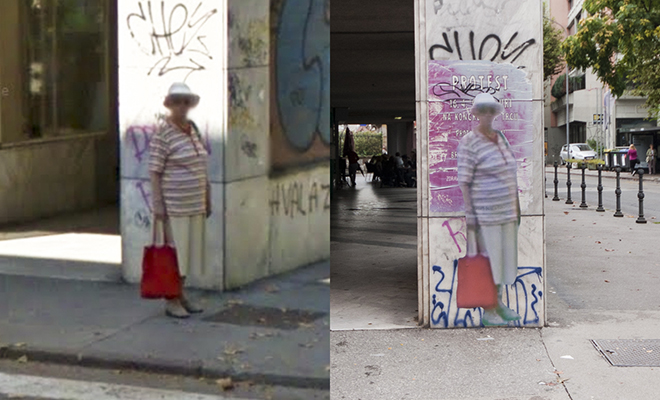
Life-sized pictures of people found on Google’s Street View were printed and posted without authorization at the same spot where they were taken. The posters are printed in color on thin paper, cut along the outline, and then affixed with wheatpaste to the walls of public buildings at the precise spots on the walls where they appear in Google’s Street View images. Street Ghosts reveals aesthetic, biopolitical, privacy and legal issues, which can be explored through the artist’s statement and theoretical considerations. The artwork becomes a performance, re-contextualizing not only ready-made informational material, but also a conflict. Ghostly human bodies appear as casualties of the info-war in the city, a transitory record of collateral damage from the battle between corporations, governments, civilians and algorithms.
Matthias Fritsch
The Story of Technoviking
Screening and artist’s presentation
2 September 2014 at 6 pm
Aksioma | Project Space, Ljubljana
The Story of Technoviking is a film project by German artist and filmmaker Matthias Fritsch. While one of his videos became the world famous Internet meme “Technoviking”, known by tens of millions of users, he is all alone in a legal battle in Germany. One decade after his video was first published online, the video’s protagonist emerged, sued him over uncleared personality rights, demanded financial compensation and the removal of the meme including user reactions. Matthias is making a film about this case, telling the story behind the Technoviking meme and give a voice to fans, lawyers and specialists that can help other active users and artists to protect themselves against old laws that have yet to catch up to contemporary meme culture.
In the framework of Akcija!, a cycle of screening events


Valeria Mancinelli, Roberto Fassone
The Importance Of Being Context
Online exhibition
2–26 September 2014
Link Cabinet
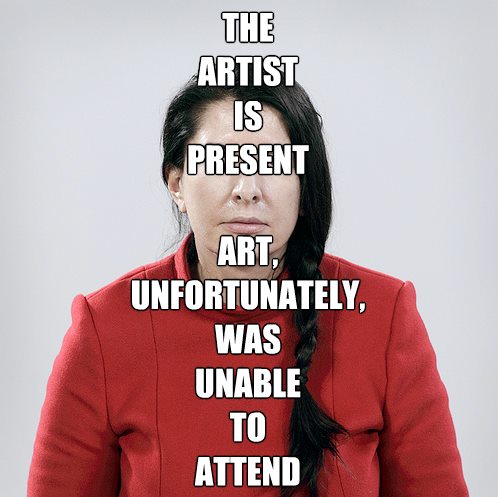
The Importance of Being Context is a web project that intends to develop some reflections on the performing practice. The website is an archive of the most famous performances of contemporary art history. Marina Abramovic’s, Vito Acconci’s, Bruce Nauman’s and other artists’ works are substituted by YouTube videos in which different individuals unwittingly perform similar actions to the ones performed by the performer in the artistic context.
Link Cabinet is a curatorial project by Matteo Cremonesi for the Link Art Center.
Smetnjak Collective
We started a meme, which started the whole world crying
Talk
9 September 2014 at 6 pm
ŠKUC Gallery, Ljubljana
Was it ever possible to practice critical theory within a form of meme? The problem is not just that its concept was invented by evolutionary biologist and that the cats they are a-LOLin’, entailing all the misgivings of informatics, communication, like/dislike binaries, quantification, valorization… it’s also that critical theory has a crisis of its own on its hands, or as Tiqqun puts it: “We don’t need any more critical theory. We don’t need any more professors. Now critique works for domination. Even the critique of domination.” In short, has subversion been reduced to a joke or does the joke itself have to be taken seriously?
Vladimir Vidmar
Eternal September
Guided tour of the exhibition
17 September 2014 at 6 pm
ŠKUC Gallery, Ljubljana

Various Authors (edited by Valentina Tanni)
The Great Wall of Memes
Online project
The Great Wall of Memes is a research project in the shape of a visual archive. It began in 2012 as a collection of art-related Internet memes (Contemporary Art People: y u no have irony?, available on Facebook and Pinterest) and made its first appearance in physical space in Milan the following year in the form of a giant wall covered with found images (Nothing To See Here, Swiss Institute, Milan, June 2013). In Lubljana, this project will reach a whole new stage, both online, through a dedicated Tumblr blog, and in the exhibition space, with a new custom installation. The project is loosely based on the “Mnemosyne Atlas” by Aby Warburg, updating his idea in light of the current cultural context (participatory and viral). The goal is to re-trace the traveling of some images through time and space, highlighting the different ways in which they have been used, remixed and re-invented.
Production:
Aksioma – Institute for Contemporary Art, Ljubljana, 2014
Coproduction:
Škuc Gallery, Ljubljana
Partner:
LINK Center for the Arts of the Information Age, Brescia
Curator: Valentina Tanni
Assistant Curators: Serena Silvestrini and Anna Simone
Artistic directors: Janez Janša (Aksioma), Vladimir Vidmar (Škuc)
Advisor: Domenico Quaranta
Producers: Marcela Okretič, Joško Pajer
Executive producer: Sonja Grdina
Technicians: Atila Boštjančič, Valter Udovičić
Public relations: Mojca Zupanič
Documentation: Miha Fras, Adriana Aleksić, Tatjana Cankar
Thanks: Ultrasonic audio technologies
Media partnership: Neural magazine
Eternal September is realized in the framework of Masters & Servers, a joint project by Aksioma (SI), Drugo more (HR), AND (UK), Link Art Center (IT) and d-i-n-a / The Influencers (ES).
This project has been funded with support from the European Commission. This communication reflects the views only of the author, and the Commission cannot be held responsible for any use which may be made of the information contained therein.
Supported by:
Creative Europe Culture, the Ministry of Culture of the Republic of Slovenia, the Municipality of Ljubljana, Istituto Italiano di Cultura in Slovenia and Institut français de Slovénie.
Street Ghosts has been realised as part of the citywide celebration EMONA 2000.
DISCLAIMER: Every effort has been made by the galleries and the curator to get in contact with all the authors of the works in the show. Nonetheless, due to the particular nature of the project, in some cases, we have not been able to trace the source, or we attempted to get in touch but got no response. We invite everyone who recognizes his/her work and wants to be credited, to contact us at aksioma@aksioma.org. The nature of the project is non-commercial and the works in the show are not for sale.

Opening screening (124 min): WED, 20 August 2014 at 8 pm
Free entrance
Komenskega 18, Ljubljana, Slovenia

Presentation of the process of cooperation with Humboldt University, Institute of Biology, Department of Comparative Zoology
In frame of group exhibition [macro]biologies II: organisms
Prinzenallee 34, Berlin, Germany


Performance of Marko Batista and a guided tour with the curator of the exhibition, Andreja Hribernik
In frame of Museums on a Summer Night 2014.
Free entrance
Trg francoske revolucije 7, Ljubljana, Slovenia

Mono Spectacle
Free entrance
Škrlovec 2, Kranj, Slovenia

Performans/Lecture
The lecture was followed by a screening of the film My Name is Janez Janša.
Karađorđeva 59, Beograd, Serbia

In frame of the group exhibition [macro]biologies II: organisms
Prinzenallee 34, Berlin, Germany

Solo Exhibition
Exhibition opening: WED, 18 June 2014 at 20 pm
Free entrance
Komenskega 18, Ljubljana, Slovenia

Mono Spectacle
Collateral event
Workshop on the setting up of the video on stage: TUE, 27 May 2014, 1 pm at DDT
Part of Red Districts (Rdeči Revirji), festival of performing arts.
Free entrance
Trg svobode 11a, Trbovlje, Slovenia

In frame of the collective exhibition My Fiction is Real.
Exhibition opening: THU, 8 May at 6 pm
Wivenhoe Park Colchester, University of Essex, CO4 3SQ, Essex, UK

Solo Exhibition
Exhibition opening: TUE, 27 May 2014 at 7 pm
Free entrance
Trg francoske revolucije 7, Ljubljana, Slovenia
Solo Exhibition
Exhibition opening and lecture by Constant Dullaart: WED, 14 May 2014 at 8 pm
Free entrance
Komenskega 18, Ljubljana, Slovenia

New Media Exhibition
Exhibition opening: WED, 23 April 2014 at 8 pm
Free entrance
Komenskega 18, Ljubljana, Slovenia

Multimedia presentation of the project
Free entrance
Kidričeva 43, Koper, Slovenia

New Media Installation
Exhibition opening: THU, 10 April 2014 at 7 pm
Project presentation and aritst’s talk: FRI, 11 April 2014 at 8 pm
Organisators: Udruženje za razvoj kulture “URK” / Klub Močvara, KONTEJNER | biro suvremene umjetničke prakse, Aksioma – Institute for Contemporary Art, Ljubljana
Trnjanski nasip bb, Zagreb, Croatia
Seminar
22–23 April 2014
Kino Šiška Center for Urban Culture, Ljubljana
What is New Media Art? What does this term really describe? What has occasioned the schism between this term and the art scene it is supposed to describe? And lastly, what can explain the limited presence of this artistic practice – which appears to have all the credentials for representing an era in which digital media are powerfully reshaping the political, economic, social and cultural organisation of the world we live in – in critical debates? All these and many other questions are tackled by Italian art critic Domenico Quaranta in his new book Beyond New Media Art (Link Editions, 2013).
Beyond New Media Art is, on the one hand, an attempt to analyse the current positioning of the so-called New Media Art within the broader field of contemporary arts and to investigate the historical, sociological and conceptual reasons for its marginal position and limited visibility in contemporary art history. On the other hand, the book is also an attempt to introduce new critical and curatorial strategies, which would render this marginalisation a thing of the past, and to elucidate the topicality of art that deals with media and the issues of the information age.
Domenico Quaranta will introduce the book at the press conference for journalists and experts and at a two-day free seminar, intended primarily for students and artists, but open to general audiences.
On this occasion, the Aksioma issued a Slovenian translation of the book, which is available through an online platform for print on demand and as a free e-book (epub and pdf).
DAY 1
Press Conference / Book Presentation: open to anybody, addressed to journalists specifically (overview of the topics addressed in the book)
Session #1: New Media Art
The first session will focus on the meaning of the label “New Media Art”, considering the broad spectrum of literature in which this label or its more widespread surrogates such as “Media Art” and “Digital Art” are adopted, and discussing the terminology issues it raises. Is it a medium-based definition, as it seems at first glance?
Session #2: A Brief History of the New Media Art World
The second session will trace the history of New Media Art from its origins in the sixties to the early nineties, focusing on what in this history may support the thesis according to which this practice developed into an art world of its own, and on the reasons for this independence/segregation from the art world.
Session #3: Two Worlds Compared
The third session will analyse the differences between the New Media Art world and the contemporary art world, considering their systems of production, distribution and comments. Both worlds will be discussed in relation to the idea of art in which they are grounded, the type of artist they support, the borders by which they are defined, and the production and distribution systems they have developed.
Conversation Domenico Quaranta / Vuk Ćosić: the role played by the internet and net-based practices in bringing new media art to the attention of a wider contemporary art audience.
DAY 2
Session #4: The Boho Dance: New Media Art and Contemporary Art
In the fourth session, recent developments in the history of New Media Art will be discussed according to the model of behaviour of the avant-garde described by Tom Wolfe in The Painted World (1975). Focusing on the way New Media Art has been presented on the platform of contemporary art since the mid-nineties until today, the author will discuss the modes and rhetorics of presentation adopted by museums and dealers.
Session #5: The Postmedia Perspective
The fifth session will attempt to answer two fundamental questions. If many artists formerly known as new media artists are increasingly migrating to the contemporary art world, what will happen to the New Media Art world? Does it have to reinvent itself or die? And what, on the other side, can contemporary art critics and curators do to facilitate the integration of these artists and artworks in the art world and to achieve a better understanding of them?
Heath Bunting (Lecture): The contemporary British artist Heath Bunting will offer a complete overview of his work, from its roots in public art to the net.art years to the present time.
The Slovenian New Media Art Scene (Presentation):
Ljudmila; – Zavod Projekt Atol; Zavod K6/4 – galerija Kapelica; KID Kibla; Zavod Cona; KUD MoTA; Zavod Aksioma
POST-SEMINAR FORUM:
Launch of an online “reading group”: A forum where selected quotes will be posted and commented upon by anybody interested in taking part in the discussion. The site will be launched during the seminar and will also provide updated information about it, documentation and links. The author will be available for online discussion with the audience for two weeks after the seminar.

Domenico Quaranta is an art critic and curator. His work focuses on the impact of contemporary techno-social developments on art. His texts appear regularly in Flash Art in Artpulse magazines. In 2006, he co-edited (with M. Bittanti) the book GameScenes: Art in the Age of Videogames; in 2010, he published Media, New Media, Postmedia. As a curator, he has organise various shows and events in Italy as well as in the international arena, including: “Holy Fire: Art of the Digital Age” (Brussels 2008, with Y. Bernard); “Pixxelpoint” (Nova Gorica 2008 and 2009); “RE:akt! | reconstruction, re-enactment, re-reporting” (Bucharest – Ljubljana – Rijeka – Maribor 2009–2010); “Playlist” (Gijon 2009 and Brussels 2010); and “Collect the WWWorld: The Artist as Archivist in the Internet Age” (Brescia 2011, Basel and New York 2012). In 2010, he participated in the seminar “Tactics and Practice: New Media Drivers” in Ljubljana. He is the artistic director of the LINK Center for the Arts of the Information Age and a lecturer at the Brera Academy of Fine Arts in Milan as well as several other universities in Italy.

Domenico Quaranta
Beyond New Media Art
► eBOOK
►PRINT ON DEMAND
► LIST ON ISSUU
Published by Link Editions.

Vuk Ćosić is an internet veteran and an internationally renowned classical author of net art. He is also the co-founder of Ljudmila, the Ljubljana laboratory for digital media, and of Nettime and Syndicate, global forums for internet theory.
He lives in Ljubljana with his wife Irena, his daughter Luna and his dog Taksi.
He is a frequent exhibitor and lecturer. He has been the subject of numerous honours theses, masters and doctoral dissertations (universities in Rome, São Paulo, Leeds, Manchester, Brussels, Trieste, etc.), media articles (NY Times, Liberation, La Repubblica, Guardian, Financial Times, Cahiers du Cinema, Artforum, Newsweek, Wired, Haaretz, ORF, CNN, BBC, etc.) and the key publications on new media (MIT Press, Thames & Hudson, Tate, Taschen, etc.).
Heath Bunting is a contemporary British artist born in 1966. Based in Bristol, he is the founder of the site irational.org and was one of the early practitioners of Net.art in the 1990s. Bunting’s work is based on creating open and democratic systems by modifying communications technologies and social systems. His work often explores the porosity of borders, both in physical space and online.
In 1997, his online work Visitors Guide to London was included in the 10th documenta exhibition in Kassel. An activist, he created a dummy site for the European Lab for Network Collision (CERN) and works to maintain a list of pirate radio stations in London.

Emil Kozole
E-dentity
Installation
22–23 April 2014
Kino Šiška Center for Urban Culture, Ljubljana

Andrea Knezović
On the Threshold
Perfromance
22 April 2014
Kino Šiška Center for Urban Culture, Ljubljana

Golan Levin
Free Universal Construction Kit/F.U.C.K. + QR Codes for Nomads
Exhibition opening / group visit
23 April 2014
Aksioma Project Space, Ljubljana

Heath Bunting
Survival/Security
Workshop
THU, 24 April 2014, 11 AM–2 PM
Tivoli Park, Ljubljana
British artist Heath Bunting invites you to take part in his workshop, Survival/Security at the Tivoli park in Ljubljana. The workshop is aimed at anyone who wants to spend few hours in the artist’s company and learn about edible plants, building tree houses or hunting.
The workshop is organized and coordinated by Maja Kalafatić with the support of the Hochschule für musik und tanz Köln, the Zentrum fur zeitgenössischen tanz, JSKD and Aksioma – Institute of Contemporary Art Ljubljana.
Production of the seminar:
Aksioma – Institute for Contemporary Art, Ljubljana, 2014
Coproduction:
Center For Urban Culture Kino Šiška, Ljubljana
Partner:
LINK Center for the Arts of the Information Age, Brescia
The projects E-dentity by Emil Kozole and On the Threshold by Andrea Knezović were conceived as part of the U30 – the initiative for supporting young artists.
The programme of Aksioma Institute is supported by the Ministry of Culture of the Republic of Slovenia and the Municipality of Ljubljana.
Sponsor: Datacenter d.o.o.